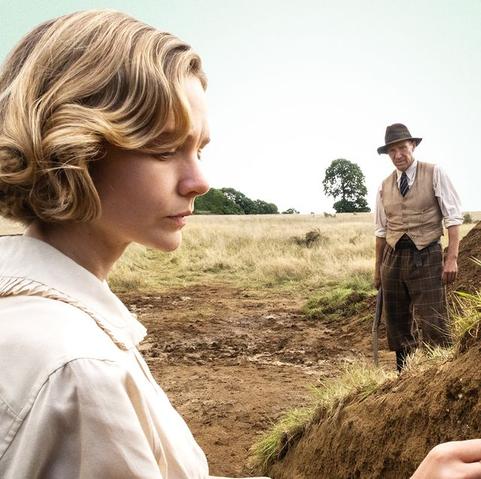
Netflix’s The Dig
“The Dig” has just debuted on Netflix, which is an adaptation of the novel by John Preston. The story is about the discovery of the Sutton Hoo ship grave, which is among the most significant archaeological finds ever found within the borders of modern England. The archaeological finds there remain among some of the most illuminating and important discoveries for their period of time for Anglo-Saxon culture. For the curious, a Hoo is a spur of land, in this case a parcel of land that overlooks the River Deben that is situated about 8-10 miles or so from the coastline in the Suffolk region of England (southeast coast). Today it’s part of Britain’s National Trust, while many of the artifacts (especially from the 1938-39 excavations) are housed in the British Museum in London, some artifacts (or replicas of the artifacts) are on display at Sutton Hoo.
The Dig – Netflix
So as a Heathen is the movie worth the watch?
Sadly, no—at least not for anything about the ancient culture. There’s very little emphasis placed on the unique discoveries themselves, nor any major discussion of Anglo Saxon history. The glimpses of the treasure are fleeting at best (seconds here, seconds there). It glosses over the archaeological work. You lose the fact that Basil Brown explored 4 mounds, over two years. It creates a love story that never happened (between archaeologist Peggy Piggott and the fictional Rory who never existed), implies that Stuart Piggott was in a homosexual relationship (and I find no evidence that he was queer), and invents a cave in that never happened to Basil Brown.
The film is very much a period character drama. The real events took place on the eve of Britain’s entry into World War II, and the looming war is very present in the film with constant reminders. The film becomes an encapsulation of life, that there is never enough time, and death ever looms. Yet for all of that it’s not a depressing film, just an ode to life. The script takes some biographical liberties with the characters to heighten that theme and the timeframe (right before WW2) in the film. While at the same time, seemingly pushing story elements for the modern consumer.
I enjoyed the film for what it was, an interesting insight into how this find came into being and the people behind ‘the dig’ albeit exaggerated for the purpose of a somewhat fictional narrative. But for the history buffs while it’s perhaps a pleasant diversion and tangential if not historically accurate supplemental, there’s so much more to dig into–pun intended.
The burial mounds at Sutton Hoo
The Real History
During its heyday the Roman Empire stretched from the British Isles, across Europe to Asia Minor and northern Africa. But the empire as it collapses offers opportunity. As the Empire’s power falls and it’s borders shrink, Germanic tribes begin their migration across Europe (taking advantage of the power vacuum and turmoil), including the Germanic tribes of the Angles and Saxons eventually migrating into England.
Source: British Museum
The finds at Sutton Hoo are exceedingly rare and precious, featuring superb craftmanship (some of the best in the time frame across all of Europe). The artifacts tell a story not only of wealth and art, but also of trade in the types of grave goods found. Some of the work was clearly created in the Byzantine Empire, as far away as Antioch (ancient Syria, modern Turkey), and others appear Celtic in origin. Character dialogue in the film have some statements along the lines of this was the end of the dark ages, because the art showed they weren’t just savages, or barbarians. Keep in mind there was still something of a belief (thanks to how the Romans themselves thought of the Germanic and native Britons as barbarians) that when Rome fell, so too did culture and civilization. This leads to what is called the “Dark Ages” across Europe. When education was heavily classics based for the historians and scholars of the time, this meant Roman scholarship about these other cultures was also taught and the prevailing thought and bias persisted.
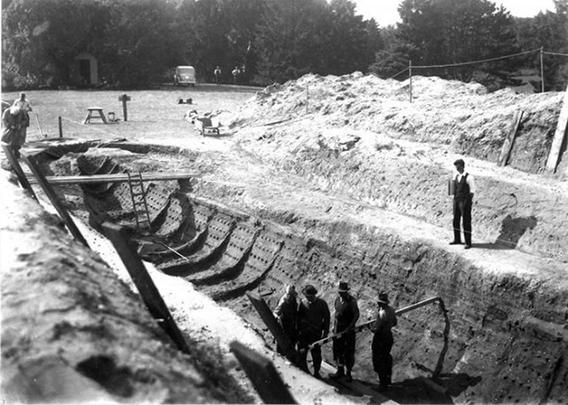
There wasn’t just one dig at Sutton Hoo, but a series of digs over the years.
Sutton Hoo – photo by Barbara Wagstaff
Britain’s National Trust has a great overview of the timeline of the ‘digs’ at the site through the centuries. In the 1600s you had treasure seekers (what they found was melted down to new purpose), and in the mid 1800s more treasure seekers, who had ship metal work reworked into horse shoes. Up until this point everyone was looking for profit, not so much for knowledge. Then comes 1938 where an exploration begins and finds some evidence that something good may lurk, but it’s not until 1939 we get the major ship burial discovery (the time in which this film takes place). More work would be done to the area of the original find, but it wasn’t really until the 1980s when significant work resumed at the site that would eventually lead to more burial graves including a woman of status. Currently the tally is at 18 mounds.
The prevailing theory is that King Rædwald of East Anglia’s grave was the one discovered in 1939. This was the ship burial that was so famously discovered with the accoutrements of a warrior: from the now famous helmet, to the shield and sword. The helmet gives to us what is most likely Odinic imagery. The eyes were rimmed with garnets. The right eye had gold foil behind the garnets to reflect the light back through the stone. The left eye did not. Scholars Neil Price and Paul Mortimer examining a reconstruction of the helmet both noted the very intentional difference. The effect by firelight or sunlight made the one eye very visible and the other dark. While much of the decorative paneling of the helmet hasn’t survived intact, some panels of what does remain mirrors Odinic imagery we find elsewhere on Vendel era helmets, with ties to Odin and a warrior cultus.
No bodies have been discovered on site, as the acidic soil decomposed them long ago. However, chemical markers in the soil are consistent with what would happen to a body decomposed in situ, and there have been ‘sand bodies’ found too. In the later case the soil has interacted with the decomposition and left us the form of their bodies in the soil. Wood hasn’t survived in the soil either due to the high acidity. The ribbing of the boat here is a result of the decomposition of the wood reacting with soil to give us this impression, which really gives you an idea of the carefully meticulous work necessary in the excavation NOT to destroy the find.
If after watching the film you’re left wanting to know what biographical details were accurate, and which ones were not, there’s some more factual, accurate historical biographical information on some of the real people depicted in the film at the National Trust website.
At the end of the film, as often occurs with some stories based on real events and people, they did have a little bit about what happened to the people after the timeframe depicted in the film. I feel it was a miss not to show at least at the end here the artifacts they found, or any information about the later discoveries at the site. So to make up for that lack, here are some photos highlighting some of what has been found at Sutton Hoo. (And even this pales in truly presenting the scope from the site and nearby areas). The Sutton Hoo Helmet, one of four Helmets from the period ever discovered, remains in many ways the star of the discoveries. Popularly used on various book covers to represent the Anglo-Saxon culture, and even some adaptations of the early English epic, Beowulf.
Some Sutton Hoo Artifacts
#AngloSaxon #AngloSaxonEngland #BasilBrown #EastAnglia #EdithPretty #film #heathen #heathenry #JohnPreston #KingRædwald #movie #NeilPrice #Netflix #NorseGod #NorsePaganism #northernTradition #Odin #Odinic #pagan #PaulMortimer #PeggyPiggot #polytheism #SuttonHoo #TheDig LearnLabLift

 Historian1661
 Cathie Dunn – Books & History

 AvonLovesBlake
 Wyrd Designs