Is the “million-year-old” skull from China a Denisovan or something else?
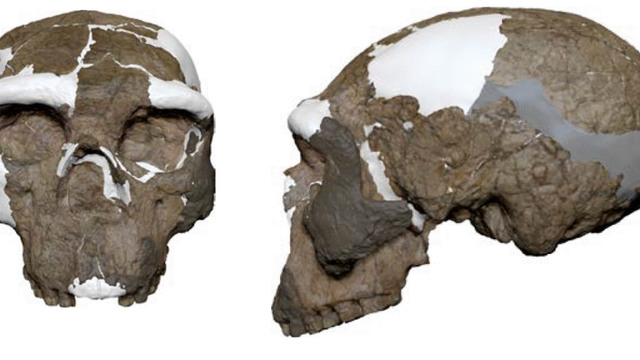
A fossil skull from China that made headlines last week may or may not be a million years old, but it's probably closely related to Denisovans. The fossil skull, dubbed Yunxian 2, is one of three unearthed from a terrace alongside the Han River, in central China, in a layer of river sediment somewhere between 600,000 and 1 million years old. Archaeologists originally identified them as Homo erectus, but Hanjiang Normal University paleoanthropologist Xiaobo Feng and his colleagues’ recent digital reconstruction of Yunxian 2 suggests the skulls may actually have belonged to someone a lot more similar to us: a hominin group defined as a species called Homo longi or a Denisovan, depending on who’s doing the naming. The recent paper adds fuel—and a new twist—to that debate. And the whole thing may hinge on a third skull from the same site, still waiting to be published. Read full article Comments
Is the “million-year-old” skull from China a Denisovan or something else?
A fossil skull from China that made headlines last week may or may not be a million years old, but it's probably closely related to Denisovans. The fossil skull, dubbed Yunxian 2, is one of three unearthed from a terrace alongside the Han River, in central China, in a layer of river sediment somewhere between 600,000 and 1 million years old. Archaeologists originally identified them as Homo erectus, but Hanjiang Normal University paleoanthropologist Xiaobo Feng and his colleagues’ recent digital reconstruction of Yunxian 2 suggests the skulls may actually have belonged to someone a lot more similar to us: a hominin group defined as a species called Homo longi or a Denisovan, depending on who’s doing the naming. The recent paper adds fuel—and a new twist—to that debate. And the whole thing may hinge on a third skull from the same site, still waiting to be published. Read full article Comments
Is the “million-year-old” skull from China a Denisovan or something else?
A fossil skull from China that made headlines last week may or may not be a million years old, but it's probably closely related to Denisovans. The fossil skull, dubbed Yunxian 2, is one of three unearthed from a terrace alongside the Han River, in central China, in a layer of river sediment somewhere between 600,000 and 1 million years old. Archaeologists originally identified them as Homo erectus, but Hanjiang Normal University paleoanthropologist Xiaobo Feng and his colleagues’ recent digital reconstruction of Yunxian 2 suggests the skulls may actually have belonged to someone a lot more similar to us: a hominin group defined as a species called Homo longi or a Denisovan, depending on who’s doing the naming. The recent paper adds fuel—and a new twist—to that debate. And the whole thing may hinge on a third skull from the same site, still waiting to be published. Read full article Comments
Is the “million-year-old” skull from China a Denisovan or something else?
A fossil skull from China that made headlines last week may or may not be a million years old, but it's probably closely related to Denisovans. The fossil skull, dubbed Yunxian 2, is one of three unearthed from a terrace alongside the Han River, in central China, in a layer of river sediment somewhere between 600,000 and 1 million years old. Archaeologists originally identified them as Homo erectus, but Hanjiang Normal University paleoanthropologist Xiaobo Feng and his colleagues’ recent digital reconstruction of Yunxian 2 suggests the skulls may actually have belonged to someone a lot more similar to us: a hominin group defined as a species called Homo longi or a Denisovan, depending on who’s doing the naming. The recent paper adds fuel—and a new twist—to that debate. And the whole thing may hinge on a third skull from the same site, still waiting to be published. Read full article Comments
 purescience_news
 purescience_news