 Hacker News
Abstract Interpretation in the Toy Optimizer
https://bernsteinbear.com/blog/toy-abstract-interpretation/
#HackerNews #AbstractInterpretation #ToyOptimizer #ProgrammingResearch #CompilerDesign
Abstract Interpretation in the Toy Optimizer
https://bernsteinbear.com/blog/toy-abstract-interpretation/
#HackerNews #AbstractInterpretation #ToyOptimizer #ProgrammingResearch #CompilerDesign
https://www.di.ens.fr/~cousot/COUSOTpapers/IFIP77.shtml
Static determination of dynamic properties of recursive procedures. Cousot 1977
does abstract interpretation need the full (category-theoretic) generality of adjunction or does (order-theoretic) gallois connection suffice? i guess maybe it depends on what kind of abstraction you're doing? are there good concrete examples where you need the former?
I am listening to the @ttforall podcast with Jimmy Koppel on which parts of CS theory all software engineers should learn about (see also his blog post from 2021 on why programmers should(n't) learn theory). Now I'm curious to learn which parts of "theory" you think are the most useful for a software engineer.
Please boost this so this also finds an audience beyond the types community!
#SoftwareEngineering #Education #TypeTheory #ProgramVerification #AbstractInterpretation #ProofAssistant #HoareLogic #ModelChecking #SMT #OperationalSemantics #CategoryTheory #DomainTheory
Type Theory Forall is a podcast about Type Theory and Programming Language research in general. We interview relevant people in our field.
Møller and Schwartzbach's lecture notes on #staticanalysis: https://cs.au.dk/~amoeller/spa/
I especially liked the exposition on #abstractinterpretation given in the slides https://cs.au.dk/~amoeller/spa/11-abstract-interpretation.pdf
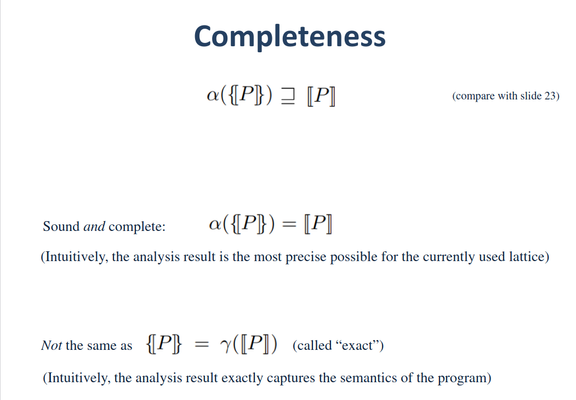
Friday night light (not actually) reading #StaticAnalysis #paper #AbstractInterpretation
Hi there,
Can't help noticing that I am having a hard time finding fediverse accounts about my domain. Any chance you know people talking about #AbstractInterpretation, #StaticAnalysis, #SymbolicExecution, #SMT solvers and #FormalMethods in general?
Thanks in advance!
Cat's Eye Technologies has been foisting weird #programminglanguages and other awful computational things on the world since 1995, which is far too long really and it's high time we stopped, but whatever.
Some of our more popular projects are #Befunge (#esolang, 25 years old this year!) and #ALPACA (#DSL for cellular automata.)
One of our recent projects is #SixtyPical, which puts #abstractinterpretation in the service of #retrocomputing.
For more, see http://catseye.tc/
Minor #releaseannouncement:
SixtyPical 0.15 released.
🔧 https://github.com/catseye/SixtyPical/tree/0.15
Some highlights are:
▸ symbolic constants
▸ "fallthru" optimization (eliminates unneeded JMPs)
▸ rudimentary #Atari2600 support!

 jnpn
jnpn chris martens
 Jesper Agdakx ♾️
 Tiago Cogumbreiro
 Jurjo but it's a medieval rat
 otini
otini Cat's Eye Technologies/💾
 Cat's Eye Technologies