 Westport Observatory
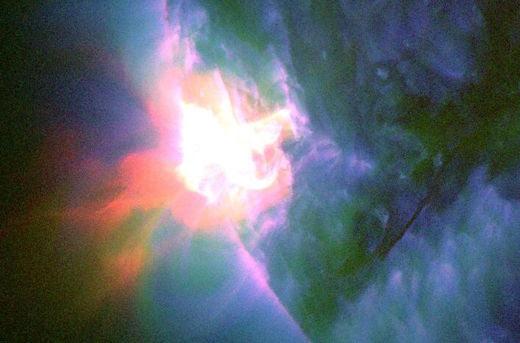
HARD RADIATION STORM: Sunspot AR3664 (now known as AR3697) just did it again. A powerful explosion on the sun today peppered Earth and nearby spacecraft with "hard" protons. The radiation storm fogged satellite cameras for hours. Following close behind, a CME is heading for Earth, and its arrival on June 10th could spark G2-class geomagnetic storms. https://spaceweather.com has updates.
 DoomsdaysCW
No #GeomagneticStorm predicted yet. But with former #AR3664 (now #AR3697) belching out big flares, we might be in for another #Aurora treat soon...
#SpaceWeaherUpdate via #SolarHam
#XFlares Are Piling Up
June 1, 2024 @ 10:20 UTC
"Good morning. How about another X-Flare!
"The latest event measuring X1.4 was just detected around AR 3697 (3664) at 08:48 UTC (Jun 1). Much like the X-Flare yesterday evening, a CME does not appear to be associated with this event. Some dimming was observed to the north of 3697 before this event, but coronagraph imagery does not seem to reveal any plasma leaving the Sun. The flare producing machine is now in a good location for potential Earth directed eruptions.
"And with this now being the 49th X-Flare of the current solar cycle, we have tied the X-Flare total from the previous solar cycle 24. When will #50 take place? Stay tuned to find out."
EARTH IS BACK IN THE STRIKE ZONE: Returning sunspot AR3664 (now known as AR3697) is picking up where it left off two weeks ago. Today, it unleashed a long-duration X1.4-class solar flare, which caused a deep shortwave radio blackout over the Americas. From now on, every explosion will be geoeffective as the sunspot turns to squarely face our planet in the days ahead. Go to the smack zone on https://spaceweather.com