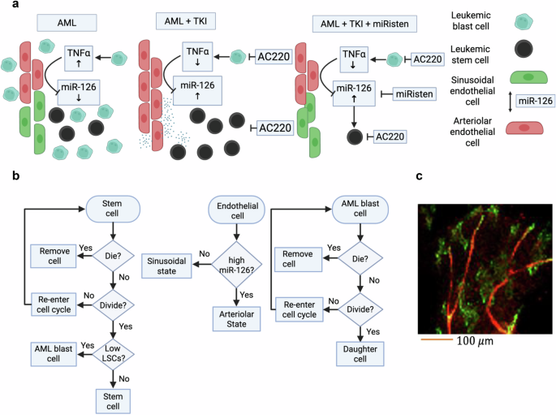
Acute myeloid leukemia (AML) is a hematologic malignancy originating in the bone marrow and often progressing to extramedullary sites. Despite advances in molecularly targeted therapies and hematopoietic stem cell transplantation, clinical outcomes remain poor. Tyrosine kinase inhibitors (TKIs) provide benefit to a subset of AML patients harboring FLT3-ITD mutations; however, relapse and resistance remain common. These therapeutic failures are driven by both intrinsic properties of leukemic stem cells (LSCs)—a quiescent, self-renewing population—and extrinsic cues from the tumor microenvironment. We previously demonstrated that arteriolar endothelial cells (ECs) produce miR-126, which is transferred to LSCs, promoting quiescence, treatment resistance, and niche retention. During disease progression, TNF-α secreted by expanding blasts suppresses EC miR-126 production. Following TKI administration, blast reduction lowers TNF-ɑ levels, restoring EC miR-126 production, and this miR-126 expression enables LSCs to re-enter quiescence—thereby escaping therapy and facilitating relapse. To explore this dynamic, we developed an agent-based computational model of the AML bone marrow microenvironment, parameterized with in vitro and in vivo data. The model captures vascular niche remodeling and feedback between leukemic populations and endothelial signaling. Simulations reveal that LSC protection mediated by miR-126 can be disrupted by combining TKIs with miRisten, a miR-126 inhibitor. When administered on a defined schedule, this combination dismantles the protective niche and enhances LSC eradication. These findings underscore the therapeutic potential of targeting microenvironmental feedback to overcome resistance and prevent AML relapse.
@v_d_richards @adfichter #SWIFT bzw. #FATCA als auch diverse "#CTF / #AML-Austauschabkommen" geben dem Treasury Dept. Vollzugriff!
@[email protected] es wird Zeit dass @[email protected] und Mitgliedsländer (insbesondere @[email protected] ) konsequent die #US-#Sanktionen verbieten und entsprechende #Nötigung und #Erpressung von #Banken und #Unternehmen sowie #Individuuen nicht nur verbietet, sondern aktiv strafrechtlich sanktioniert! - Es kann nicht sein dass das #Trump-Regime (oder sonstige Drittstaaten, nicht nur die #USA!) über die #SozialeTeilhabe und #Existenz von Menschen in der #EU entscheiden kann! - Hier erwarte ich von der @[email protected] eine klare Ansage, dass entsprechende *"#Debanking-Angriffe"* verfolgt werden und von der #Bundesregierung erwarte ich dass diese sich nicht dem #Terrorismus und Erpressung ais Übersee beugt, sondern aktiv aus jeglichen Ünereinkommen aussteigt!
[Tweede Kamer] Algemene Rekenkamer:
Rapport Gevolgen groot, opbrengsten onbekend; Onderzoek naar de anti-witwasaanpak in de bankensector #AML Anti-witwascontroles hebben grote gevolgen, maar resultaten onbekend
> https://www.tweedekamer.nl/kamerstukken/kamervragen/detail?id=2026D11246&did=2026D11246
A significant cross-border enforcement case targeting carding infrastructure.
A Chilean national has been extradited to the U.S., accused of operating Telegram-based carding marketplaces.
Allegations include:
• Trafficking unauthorized access devices
• Distribution of stolen card dumps
• ~26,000 cards from one brand
• Sales via encrypted channels
• Multi-year operation (2021–2023)
The case illustrates persistent fraud ecosystem patterns:
– Dump marketplaces leveraging messaging apps
– Bulk sale of compromised payment data
– International actors targeting U.S. financial brands
– Delayed but coordinated extradition efforts
For security teams, this reinforces the need for:
Real-time fraud analytics
Dark web & channel monitoring
Card reissuance automation
Cross-border intelligence sharing
Is fraud detection adapting fast enough to decentralized carding markets?
Engage below.
Follow TechNadu for high-signal infosec reporting.
Repost to amplify awareness.
#Infosec #Carding #FinancialSecurity #FraudDetection #PaymentFraud #ThreatIntelligence #AML #Cybercrime #DarkWebMonitoring #SecurityOperations #RiskManagement #DataProtection #GlobalCybercrime
A significant prosecution targeting digital identity fraud infrastructure.
The alleged operator of “OnlyFake” pleaded guilty to conspiracy involving identification document fraud. Authorities report:
• 10,000+ digital fake IDs generated
• Cryptocurrency-based payments
• Bulk document packages
• Targeted bypass of remote KYC workflows
• ~$1.2M forfeiture agreement
The platform reportedly produced customizable ID images — scan-style, tabletop photo simulations — designed to pass digital verification checks.
Implications for security teams:
– Remote onboarding risks
– Weak document authenticity checks
– Gaps in AI-driven fraud detection
– Overreliance on static ID uploads
– Exposure in crypto compliance pipelines
As digital identity ecosystems expand, synthetic document fraud becomes increasingly scalable.
Are organizations deploying sufficient liveness detection, behavioral biometrics, and cross-database validation?
Engage below.
Source: https://www.justice.gov/usao-sdny/pr/creator-onlyfake-charged-and-pleads-guilty-selling-more-10000-digital-fake
Follow @technadu for high-signal infosec analysis.
Repost to amplify awareness.
#Infosec #IdentitySecurity #FraudDetection #KYCCompliance #AML #CryptoCompliance #ThreatModeling #Cybercrime #DigitalForensics #RiskManagement #SecurityArchitecture #FinancialSecurity

🔥 Binance fires top investigators who claim to have uncovered evidence of Iranian sanctions violations | Fortune
「 After the investigators surfaced the findings through internal reports, at least five were fired starting in late 2025, according to the sources, who spoke with Fortune on the condition of anonymity owing to fear of legal repercussions. At least three of the investigators came from law enforcement backgrounds in Europe and Asia 」
https://fortune.com/2026/02/13/binance-investigators-fired-iran-sanctions-potential-violations/