 Ben Kanter
 Carl T. Bergstrom
I love how Springer-Nature has hopped so unapologetically onto the grift train that they are trying to sell unframed "posters" (read: silly certificates of merit) to their authors for 189 bucks.


| Website | https://vigji.github.io |
| Google Scholar | https://scholar.google.com/citations?user=FQDeRWQAAAAJ&hl |
@yoginho I appreciate your blog post as it provides context to why you're so frustrated. I'm fine with calling people out, but the manner in which you did it I take issue with. Shouting at someone in repeated posts claiming their worldview is dangerous and delusional and without merit, even if you're correct (!), is not a fruitful way to start a conversation. It's human behavior to avoid such an attack. And even as a passive observer it's unpleasant. So I'm calling you out ;)
And to be sure, I wouldn't care if you were a troll or kook but your ideas are fascinating and I want people to pay attention. I listened to you on Brain Inspired (after this exchange) and it was one of my favorite episodes of the 50 or so I've listened to. I loved in particular the part about limitations of dynamical systems thinking for brains/organisms, and the idea of organismal closure. I'm very sympathetic to your critique of computationalism, too, particularly because functions the brain carries out are ill defined and much of its function is almost surely not algorithmic, in my opinion.
In the podcast, however, you acknowledge the utility of the computational approach for exploring many things the brain does and appreciate that we can (and maybe already have) achieve great insights with that framework. The problem is that some proponents started to confuse the map for the territory, as it were. Much more even handed than this exchange with Blake, and much more likely to get people to listen and discuss!
@MarinManuel, something along the lines of this kind positive feedback amplification has been tried by a former lab mate (although not in a mouse line), you can read a bout it here:
https://www.nature.com/articles/s41467-020-19864-w
It is super sensitive though as you can imagine , and optimizing the plasmid to get to 0 leakage was very complex - I guess it would be a true challenge in a mouse line!

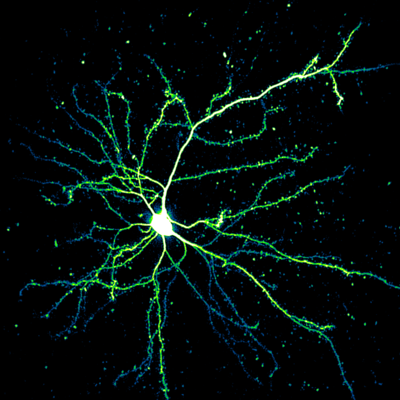
Genetic mosaicism is frequently present in monogenic diseases of the central nervous system. Here the authors design a dual-colour reporter system that can be used to tune the degree of mosaicism in mouse models.
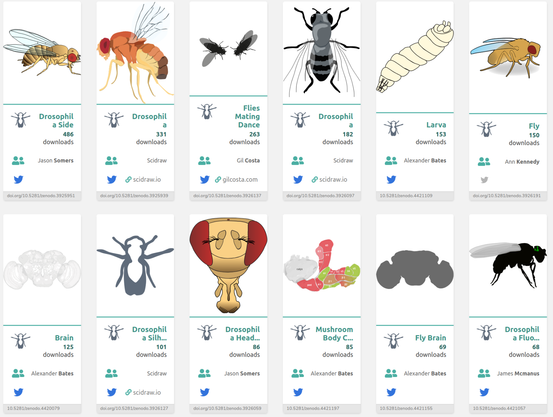
If you are drafting figures for a scientific paper or presentation, remember that https://scidraw.io/ exists: a repository of free SVG cartoons for science.
#SciDraw is supported by the Sainsbury Wellcome Centre – @SWC_Neuro
All content on SciDraw is shared under creative commons license (CC-BY) unless stated otherwise.


Is Nature a predatory journal?
- humongous publication fees
- poor reproducibility
- aggressive marketing strategies
It checks out in my book!
In which Adam Mastroianni argues that psychology is so poorly theorised than even outright fraud by hyperprolific research stars has causes no loss to our collective knowledge - almost like 100s of papers with 10,000s of citations don't represent true knowledge anyway
"The plane crashed and nobody checked the bodies", he says in a memorable phrase. Meaning, "everyone knows that many studies don't replicate, but exactly which ones doesn't seem to matter"
https://www.experimental-history.com/p/im-so-sorry-for-psychologys-loss
1/


 Albert Cardona
 Uri Hasson
 lenahallesaale
 Tom Stafford
 Matteo Carandini
 Nick Steinmetz