 DDTea
DDTeaHappy Solstice
The Seasons Greetings to one and all


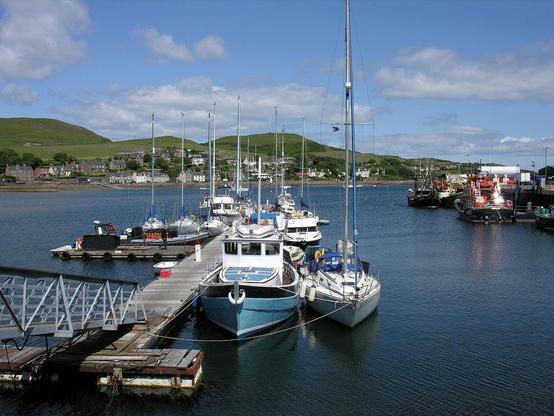
At the head of a deep loch sheltered by Davaar Island and surrounding hills lies Campbeltown, one of the largest towns in Argyll. Campbeltown is a considerable distance from other centres of population, but well worth the effort it takes to get to. More: https://www.undiscoveredscotland.co.uk/campbeltown/campbeltown/index.html
Happy Winter Solstice! The Wren's Egg, near Monreith in Galloway is aligned to the Winter Solstice sunset. Read about it in the latest edition of Ancient Times from Stone Club - https://stoneclub.rocks/

The Earliest Vegetal Motifs in Prehistoric Art: Painted Halafian Pottery of Mesopotamia and Prehistoric Mathematical Thinking
Halafian skills of symmetry and precise division of space. The depictions of flower petals in the geometric sequence of the numbers 4, 8, 16 and 32, as well as 64 flowers in another type of arrangement, point to arithmetical knowledge.
We argue that in the early village communities of the Near East the ability to make precise divisions was relevant to various needs, such as equal sharing of crops from fields that were collectively cultivated by a number of families, or the whole village.
https://link.springer.com/article/10.1007/s10963-025-09200-9

The earliest systematic depictions of vegetal motifs in prehistoric art appear on painted pottery vessels of the Halafian culture of northern Mesopotamia, c. 6200–5500 BC. The motifs are varied, representing flowers, shrubs, branches and trees. The first part of our analysis deals with four major questions. What was chosen to be depicted? How common were the vegetal motifs? What was the distribution of these motifs? And why were vegetal motifs introduced in this particular era? The second part of the analysis deals with the Halafian skills of symmetry and precise division of space. The depictions of flower petals in the geometric sequence of the numbers 4, 8, 16 and 32, as well as 64 flowers in another type of arrangement, point to arithmetical knowledge. We argue that in the early village communities of the Near East the ability to make precise divisions was relevant to various needs, such as equal sharing of crops from fields that were collectively cultivated by a number of families, or the whole village.
Part of Tollcross House in Tollcross Park, Glasgow. Designed by David Bryce in a Scots Renaissance style, it was built in 1848 for James Dunlop, proprietor of the Clyde Ironworks. I love the way the corners of this building are decorated with wavy lines.
#glasgow #architecture #architecturephotography #tollcross #tollcrosspark

BBC News: I got to say 'high' to Sir Walter Scott as he gets a monumental face-lift
eHammurabi
The Law Code of Hammurabi is one of the oldest legal texts from ancient Mesopotamia. The artifact, a basalt stele, is believed to have been created between c. 1792–1750 BCE.
It was discovered by Jacques Jean Marie de Morgan's team around 1901 in Susa, or present-day Iran.
The name "Hammurabi" belongs to the sixth ruler of the Old Babylonian dynasty.
The cuneiform inscription is in the Old Babylonian language, which is a later dialect of ancient Akkadian.
An Account of Egypt, by Herodotus
The pyramids also were greater than words can say, and each one of them is equal to many works of the Hellenes, great as they may be; but the labyrinth surpasses even the pyramids.
It has twelve courts covered in, with gates facing one another, six upon the North side and six upon the South, joining on one to another, and the same wall surrounds them all outside; and there are in it two kinds of chambers, the one kind below the ground and the other above upon these, three thousand in number, of each kind fifteen hundred.
The upper set of chambers we ourselves saw, going through them, and we tell of them having looked upon them with our own eyes; but the chambers under ground we heard about only; for the Egyptians who had charge of them were not willing on any account to show them, saying that here were the sepulchres of the kings who had first built this labyrinth and of the sacred crocodiles.
Accordingly we speak of the chambers below by what we received from hearsay, while those above we saw ourselves and found them to be works of more than human greatness.
For the passages through the chambers, and the goings this way and that way through the courts, which were admirably adorned, afforded endless matter for marvel, as we went through from a court to the chambers beyond it, and from the chambers to colonnades, and from the colonnades to other rooms, and then from the chambers again to other courts.
Over the whole of these is a roof made of stone like the walls; and the walls are covered with figures carved upon them, each court being surrounded with pillars of white stone fitted together most perfectly; and at the end of the labyrinth, by the corner of it, there is a pyramid of forty fathoms, upon which large figures are carved, and to this there is a way made under ground.
Why Grand Designs-style eco-homes aren’t a good blueprint for sustainable living
Fair and inclusive
The second issue concerns fairness and access. If permission for remote single household plots is to be restricted in number, then that cap should be explicit and justified. At present, it is neither.
The result is that only the wealthy – people able to acquire attractive rural land, navigate the planning system and fund bespoke eco-builds – can pursue this lifestyle. This risks breeding resentment, especially if access to attractive countryside or forest locations becomes effectively privatised by those who can afford large, low-density housing.
Here, we show that vanadium (V) isotope ratios in 2.32-2.26-billion-year-old (Ga) shales from the Transvaal Supergroup, South Africa, capture a unidirectional transition in global ocean redox conditions shortly above the stratigraphic level marking the canonical rise of atmospheric O2. Around 2.32 Ga, sedimentary sinks were dominated by anoxic environments that drove extensive seawater V drawdown.

Compared to the oxygenation of Earth’s atmosphere, little is known about the build up of dissolved oxygen in the oceans. Vanadium isotopes in shales suggest shallow oceans equilibrated with a newly oxygenated atmosphere in just a few million years.
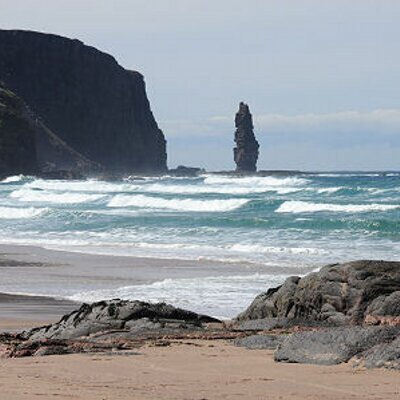 Undiscovered Scotland
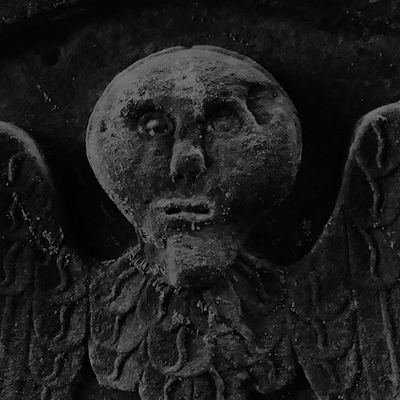 Dark Galloway
 This Is My Glasgow
 Scottish Lass
