
Piali Sengupta

312 Followers
208 Following
111 Posts
Brandeis Bio/Neuro. We study multiple aspects of sensory biology. Mostly in worms. Lab appears to be powered by vast quantities of junk food. Opinions mine.
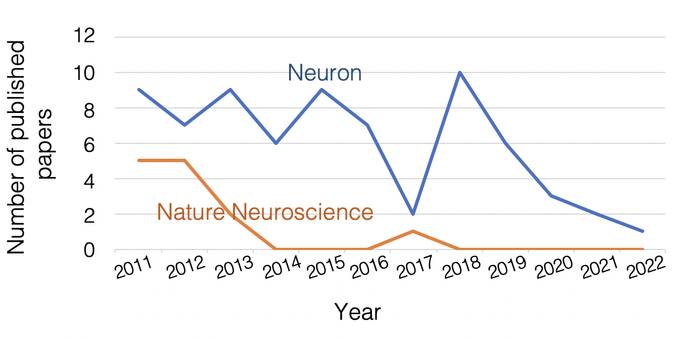
For my #worm #neuroscience friends:
Was suspecting this trend so went looking for numbers. Searched for #research #papers (both short and long) with 'elegans' in abstract. Caveats - no idea what the denominator is of course, and no guarantee of accuracy.
Two gorgeous pics from my very talented photographer bro-in-law Indrajeet Dasgupta. A lesser flamingo and a tug-of-war between two Eastern imperial eagles. At the Great Rann of Kutch salt marshes in Gujarat, India.
PYT-1 (named for its conserved PY motifs), is particularly cool. TM protein. Sits only at the AFD sensory endings. Responds transcriptionally only to a large magnitude temperature upshift. And, its function is required ONLY during this upshift to drive response and behavioral plasticity. 6/n

The gene #regulatory program is complex as expected, and is in part mediated by the usual suspects – calcium channels, CaMK and direct and indirect regulation by the #CREB transcription factor.

But does this differential regulation mean anything for AFD functions in response to specific temperature experiences? Yes!

Levels of the DAC-1 TF read out absolute warm growth temperature & this TF regulates the warm temperature-driven decision to enter the dauer stage. 5/n

The results were unexpected. We find that the gene expression program in AFD appears to quantitatively encode multiple features of the temperature stimulus.

Expression changes of some genes reflect the duration of the temperature change, others reflect its absolute value, yet others read out the magnitude of the temperature change. 4/n

A big advantage of using #temperature as a stimulus is that it is precisely quantifiable. To see if temperature might regulate gene expression in AFD, we used TRAP-Seq to obtain snapshots of gene expression profiles in AFD in animals experiencing different temperature stimuli. 3/n

We wanted to directly correlate a stimulus with changes in the expression of defined genes at single neuron resolution, and then assess effects of the expression change on plasticity. And also get at the #regulatory mechanisms.

We know that #worms respond to multiple aspects of #temperature using just the single AFD thermosensory neuron pair. Worms respond to the absolute value of temperature, & both magnitude & duration of its change. Does AFD encode all this information? How? 2/n

Cool story from Taihong Wu, Yun Zhang and colleagues. Exposure to a #pathogenic bacteria switches #worm behavior from #pheromone avoidance to attraction & promotes mating. A 'reserve' pheromone receptor is induced in an attraction-mediating #olfactory neuron to drive this behavioral plasticity. They even identify a transcription factor that is induced in this olfactory neuron that turns on this pheromone receptor.
https://www.nature.com/articles/s41586-022
The highlight of a few days off in #NewOrleans. Powerful art in a very atmospheric warehouse space #StudioBeNOLA. The whole #Bywater area was fun to walk around in - great street art, beautifully painted shotgun houses, and no crowds.
Joint effort (joint being non-synonymous with equal!) on a long lazy cold Xmas eve Saturday. 1000 piece Yayoi Kusama puzzle. Hardest part was her dress.