S.AND worlds

64 Followers
80 Following
66 Posts
Here posts the S.AND research group of the MPI for Social Anthropology in Halle, Germany — we are social anthropologists interested in #sand and how it organizes #coastalprotection — curious to learn how thinking with sand can inform theories of #urbananthropology.
MPIhttps://www.eth.mpg.de/6008586/emmy_noether_ley

In a fieldnote shared by Teresa Cremer on S-AND.org you can meet Salim Ali Mohamed of the Malindi Beach Management Unit in Kenya. To him, sand indexes a healthy ocean. Poetically, Salim considers the ecological work of sand as cleansing respirations. What do receding shorelines, an unwanted effect of urban development, say about ownership, access, and practices of more-than-human care?
Read the full fieldnote here:
https://s-and.org/blog/sand-the-ocean-breather

#research #fieldwork #anthropology
@academicchatter

Sand, the ocean breather

Teresa Cremer reflects on coastal transformations and Bajuni relations with the sea. Sand and ocean perform important, life-sustaining tasks in Kenya.

Sand makes up coastal bioinfrastructures in Guyana, as Sarah Vaughn shows in a recent essay, https://roadsides.net/vaughn-010/. Groynes used to prevent erosion "reinforce the shoreline’s existing sandy terrain." These groynes themselves contain sand. The essay is part of a special issue entitled "Bioinfrastructures" co-edited by Raúl Acosta and S.AND team member Lukas Ley. Check out the full open access issue here: https://roadsides.net/collection-no-010/
Through the term "bioinfrastructures," Ley and @raulaco reckon with the surge in projects to (re)create lively urban landscapes: While this shows that "infrastructure is never just a single entity or one discrete thing but rather an evolving set of multispecies and material relations," they also interrogate the ambivalent politics of bioinfrastructures.
What is the significance of bioinfrastructures "for larger political projects, emancipatory movements and Indigenous sovereignty?"

#infrastructures #urbanlife #anthropology
@academicchatter

vaughn-010 | Roadsides

Roadsides

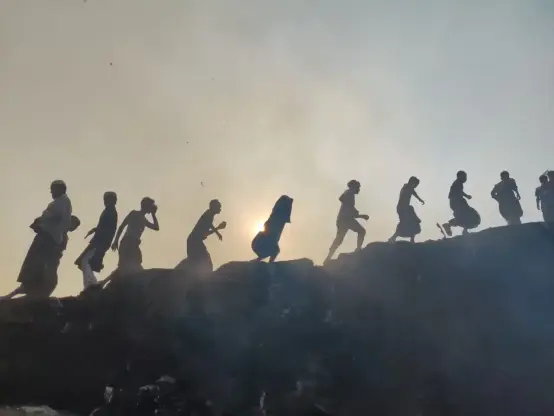
Did you know that thousand of displaced Rohingya live on an island in the Bengal Delta? Team member Javed Kaisar examines everyday island maintenance activities by Ronigya and the Bangladeshi government in Bhasan Char. A first glimpse of his fieldwork can be found on our website:
https://s-and.org/blog/a-glimpse-of-the-life-and-aspirations-of-a-rohingya-adolescent-living-in-bhasan-char

#anthropology #island
@academicchatter

Fieldnote: Life between camps – the story of a Rohingya adolescent living on Bhasan Char

Javed Kaisar describes the situation of a Rohingya adolescent living in Bhasan Char, an island in the Bay of Bengal that is home to newly built refugee camp.

'Wait, gravel isn't the same as sand.' You're right! But we thought that Franz Krause's work on gravel and solid-fluid grounds in Aklavik is still really interesting. Prof. Krause does research in the Mackenzie Delta, where grounds are more or less solid. Sometimes, they even become fluid! Follow the link to find out why #gravel matters in the lives of Inuvialuit and Ehdiitat Gwich’in people:

https://s-and.org/blog/on-solid-fluid-grounds-in-river-deltas

#anthropology
#research
@academicchatter

On Solid-Fluid Grounds in River Deltas

Franz Krause reports on his work on granular materials in the Mackenzie Delta where gravel helps solidify melting grounds.

Tarini Monga joins one of the Imagination Walks in Panjim, Goa along salt pans and reflects on material interactions within marshy spaces. This short field note from her diary highlights thoughts around shifty matter, changing forms of ownership and systems of land use in Goa. Read more for a glimpse into how new questions emerge during a walk through the city: https://s-and.org/blog/the-city-s-salted-rim-a-walk-through-goan-salt-pans

#anthropology #fieldwork #sand
@academicchatter

The City’s Salted Rim: A walk through Goan salt pans

PhD researcher Tarini Monga joined an Imagination Walk in Goa. In this fieldnote, she reflects on the maintenance of salt pans and their ownership.

This week, Lukas spends time with the Living Ports consortium in the port of Vigo. Divers extract #concrete tiles that PhD student Siff Nejst Lørup from DTU will analyze to determine the level of chloride penetration. Living Ports uses the special concrete designed by ECOncrete which is more hospitable to marine life than conventional products.

#anthropology #research #fieldwork
@academicchatter

Last week, the S.AND team met with Jingru Cheng, Harvard GSD Wheelwright Prize Fellow (https://wheelwrightprize.org/2023-winner-jingru-cyan-cheng/), and Chen Zhan to talk about multimodal research on sand. Trained in architecture and anthropology, they work with artists in the Mekong Delta, Miami Beach, and Greenland to understand sand's material and cultural pathways and "what makes a building happen".

Jingru and Chen are also filmmakers. Learn more about their most recent short film project here: https://rrr.network/

#anthropology
@academicchatter

2023 Winner Jingru (Cyan) Cheng - Wheelwright Prize

July 5, 2023 – Harvard University Graduate School of Design (GSD) is pleased to name Jingru (Cyan) Cheng the winner of the 2023 Wheelwright Prize, a $100,000 grant to support investigative approaches to contemporary architecture, with an emphasis on globally minded research. Her project, Tracing Sand: Phantom Territories, Bodies Adrift, focuses on the economic, cultural, and ecological impacts […]

Wheelwright Prize

Re:inventing Grassi is the curatorial initiative of Leipzig's anthropological museum aimed at diversifying exhibitions and casting critical perspectives on ethnological collections. We met with director Léontine Meijer-van Mensch and Kevin Breß to discuss S.AND's curatorial concept. More soon!
https://grassi-voelkerkunde.skd.museum/en/exhibitions/reinventing-grassiskd/

#anthropology #museum #sand

Museum für Völkerkunde zu Leipzig: REINVENTING GRASSI.SKD

The Staatliche Kunstsammlungen Dresden are one of the most important museums in the world - 14 museums offer a thematic variety that is unique in its kind.

Tired of theory and abstract matter? Our website is the place to learn about coastal sand.

The S.AND website is collecting 'tangible' accounts of ongoing ethnographic research in the Afrasian Sea and other oceans. For instance, check out Lukas Ley's fieldnote on diving in the harbour of Marseilles and the formation of "natural concrete": https://s-and.org/blog/touching-calcification. Over the year, there will also be articles, pictures, and other insights from our fieldwork and even the occasional joke.
#sand #anthropology #concrete #fieldwork
@academicchatter

Touching calcification

Lukas Ley provides redacted fieldnotes from his ongoing research with a French company producing