Roby Bhattacharyya

638 Followers
332 Following
184 Posts
ID doc (MGH), PI (Broad Institute), antibiotic resistance resister, COVID doc, husband, dad. Coffee, tennis, kindness, science, and sleep enthusiast. Here to learn, as that other place devolves. Views mine. | bhattacharyyalab.org

3 bhattacharyyalab.org posters today @ #IDWeek2023!

#250 PierreAnkomah: kinetics of a novel monocyte subtype in sepsis, implications for immunopathology

#623 Eleanor Young: a promising approach to fungal diagnostics

#875 David Roach: democratizing AMR diagnostics

Stop by!

OK last announcement.

If you live in *Ohio* you should have voted "no" by now. But, if you haven't you still have till the end of Aug 8th! Time to search up your poll site and get going!

(But, don't feel bad if this referendum caught you off guard, Ohio Republicans are hoping no one will show up to vote.)

Vote NO on issue 1. It's a strange constitutional amendment that changes the threshold to make it possible for a small group to veto everything. It's the only thing on the ballot.

Talmudic Question #205

There are plenty of natural product families that inhibit essential enzymatic functions in cell wall synthesis (e.g., ß-lactams, glycopeptides), translation (e.g., aminoglycosides, tetracyclines) and transcription (e.g. rifampicin). Yet, there are very few (if any) natural products that specifically inhibit bacterial DNA polymerase. Why have such compounds not been found?

Read more → https://schaechter.asmblog.org/schaechter/2023/07/talmudic-question-205.html

#microbiology

Talmudic Question #205

There are plenty of natural product families that inhibit essential enzymatic functions in cell wall synthesis (e.g., ß-lactams, glycopeptides), translation (e.g., aminoglycosides, tetracyclines) and transcription (e.g. rifampicin). Yet, there are very few (if any) natural products that specifically inhibit bacterial DNA polymerase. Why have such compounds not been found?

Small Things Considered

@macroliter lmk how it is over there.

I don't do SoMe on my phone, and it seems Threads is mobile only at this point, so I'll sit this one out for now. (Both from a data privacy standpoint, and even more from a self-control standpoint, I'm a computer-only SoMe user.)

Just realized that the https://www.bhattacharyyalab.org/ officially turned 4 on July 1!

But I sortof missed the occasion. In my defense, 3 of those years were fairly distracting as an ID doc…

Bhattacharyya lab

Bhattacharyya lab

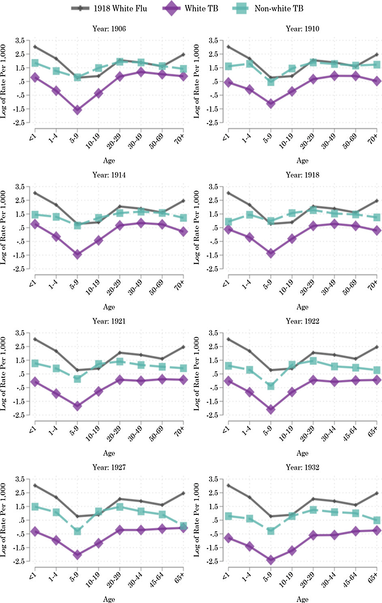
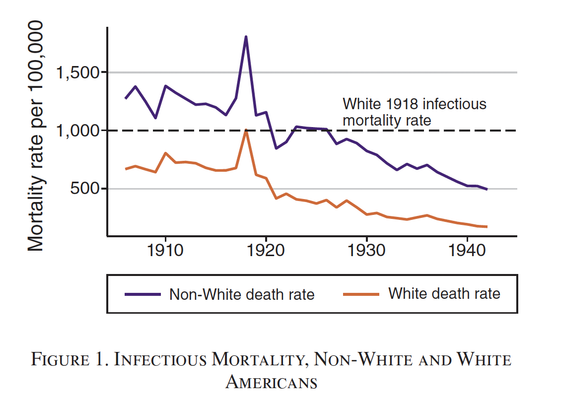
What was so horrifying in 1918 was not only that so many people died. It was also that they died *so young*

We found that, because of tuberculosis, these pandemic-scale prime-of-life deaths were also the *typical experience* of Black populations in cities

https://doi.org/10.1017/ssh.2023.4

Racial Inequality in the Prime of Life: Infectious Disease Mortality in U.S. Cities, 1906–1933 | Social Science History | Cambridge Core

Racial Inequality in the Prime of Life: Infectious Disease Mortality in U.S. Cities, 1906–1933 - Volume 47 Issue 3

Cambridge Core

2. In prior work, some of us showed that urban white mortality during the twentieth century's deadliest pandemic, the 1918 flu, was still not as bad as urban Black mortality was *every single year*

Here, we learned that analogy is deeper than we knew

Previous paper:
https://doi.org/10.1007/s13524-019-00789-z

Regional and Racial Inequality in Infectious Disease Mortality in U.S. Cities, 1900–1948 | Demography | Duke University Press

New paper w Aja Antoine-Jones, James Feigenbaum, Lauren Hoehn-Velasco, and Chris Muller

"Racial Inequality in the Prime of Life: Infectious Disease Mortality in U.S. Cities, 1906–1933"

tells us two new things about the staggering racial inequity in this era

(cont'd)

#demography #sociology #history #RacialDisparities #mortality #EpidemiologicalTransition #HealthEquity #HistoricalDemography

https://doi.org/10.1017/ssh.2023.4

Racial Inequality in the Prime of Life: Infectious Disease Mortality in U.S. Cities, 1906–1933 | Social Science History | Cambridge Core

Racial Inequality in the Prime of Life: Infectious Disease Mortality in U.S. Cities, 1906–1933 - Volume 47 Issue 3

Cambridge Core

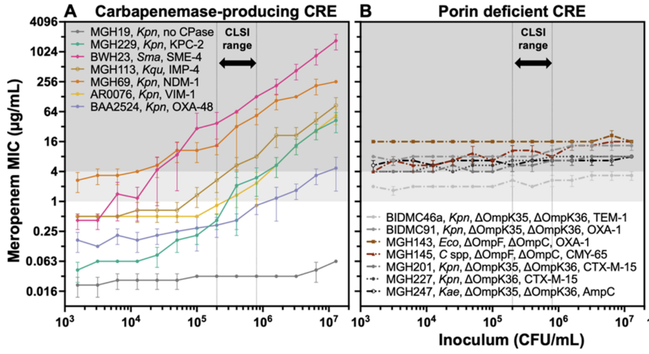
Until a project led by my lab's first postdoc, Alex Jaramillo, & stellar RA Kyra Taylor, my thoughts on the inoculum effect (IE) - the more bacteria there are, the greater the conc of antibiotic required to kill them - were fuzzy.

In a new preprint, imo we clarified the carbapenem IE: carbapenemases act as shared goods for bacterial communities. All carbapenemase-producing strains had a strong IE; those resistant due to porin deficiency had no IE at all.

This has key consequences…

🧵 1/n

For those interested, I found the energy to post a thread on this preprint (not sure how this pseudo-quote-toot will work): https://mstdn.science/@roby/110661479775958698
Roby Bhattacharyya (@[email protected])

Attached: 1 image Until a project led by my lab's first postdoc, Alex Jaramillo, & stellar RA Kyra Taylor, my thoughts on the inoculum effect (IE) - the more bacteria there are, the greater the conc of antibiotic required to kill them - were fuzzy. In a new preprint, imo we clarified the carbapenem IE: carbapenemases act as shared goods for bacterial communities. All carbapenemase-producing strains had a strong IE; those resistant due to porin deficiency had no IE at all. This has key consequences… 🧵 1/n

mstdn.science