
Roby Bhattacharyya

638 Followers
332 Following
184 Posts
ID doc (MGH), PI (Broad Institute), antibiotic resistance resister, COVID doc, husband, dad. Coffee, tennis, kindness, science, and sleep enthusiast. Here to learn, as that other place devolves. Views mine. | bhattacharyyalab.org
8/n
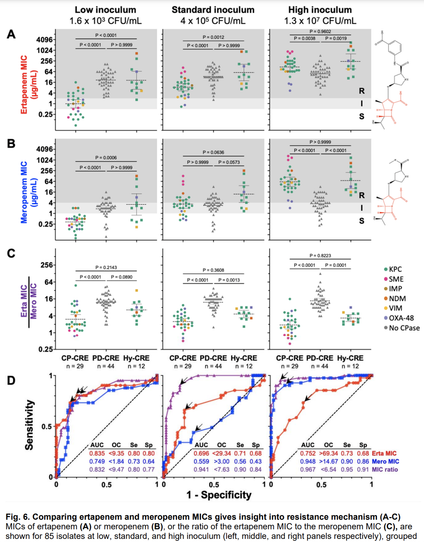
…1. Diagnostic implications (cont'd): we realized that ertapenem, which is bulkier, is more affected by porin deficiency than meropenem, whereas both are ~equivalently hydrolyzed by carbapenemases. So we checked, and sure enough, the ratio of ertapenem to meropenem MICs at standard inoculum performs almost as well as the IE at identifying CP-CRE - and since we always measure both erta & mero MICs, this is "free" info that can help flag CP-CRE that might otherwise be missed.
7/n
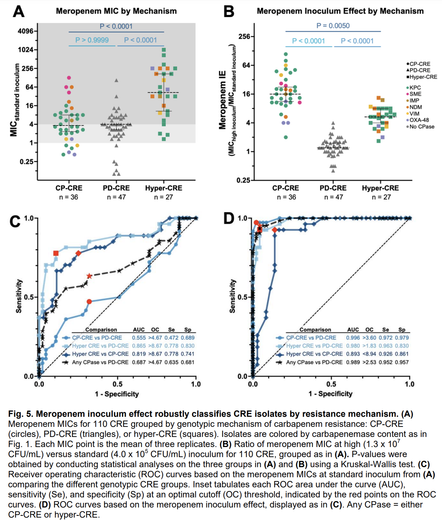
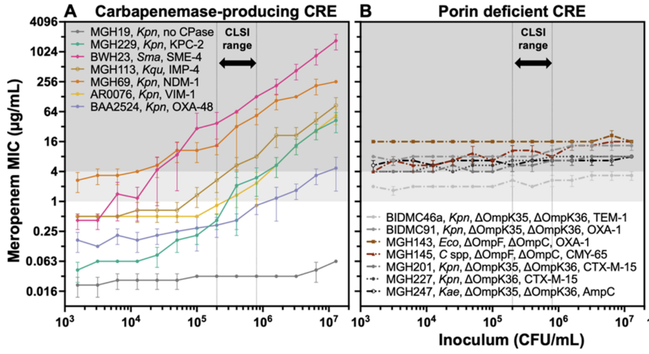
…1. Diagnostic implications (cont'd): so what can we do to find CP-CRE better? It turns out meropenem MIC is lousy at distinguishing CP-CRE from non-CP-CRE - almost literally a coin flip, since MIC distributions of CP-CRE and non-CP-CRE cross in the CLSI inoculum range. Measuring the IE does an excellent job at finding CP-CRE, but requires an unacceptable amount of extra work for already-too-busy clin micro labs.

5/n
So why is this important? We thought of diagnostic, clinical, and mechanistic implications.

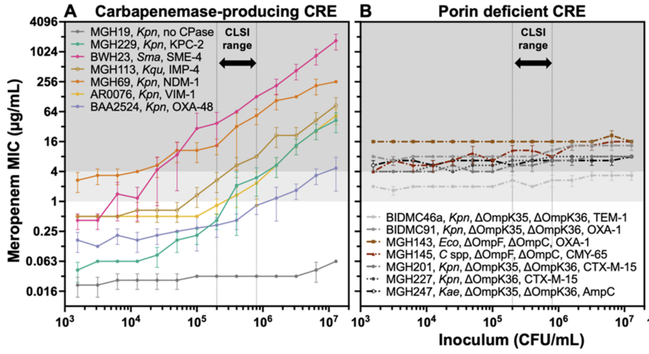
1. Clinical diagnostics: we measure resistance at a certain cell density to guide antibiotic use, so having MICs that vary widely is a problem. The IE is known, so guidance is given on acceptable inoculum range ("CLSI range" in figs) - but even in this range, MICs can vary widely. In fact, 1/3 of CP-CRE changed meropenem resistance class in the allowed range, and 25% tested S at an approved inoculum.

4/n
…which means these carbapenemases end up shared with neighbors. (In theory they could be constrained to the periplasm, but at least above a certain cell density, this doesn't seem to be the case: all CP-CRE have a strong IE.

By contrast, porin deficiency, which prevents carbapenems from getting into the periplasm, is a cell-autonomous resistance mechanism that has no effect on neighbors, hence no IE.

We verified this in >100 clinical CRE: 63 CP-CRE all had an IE; none of 47 non-CP-CRE did.

(3/n)
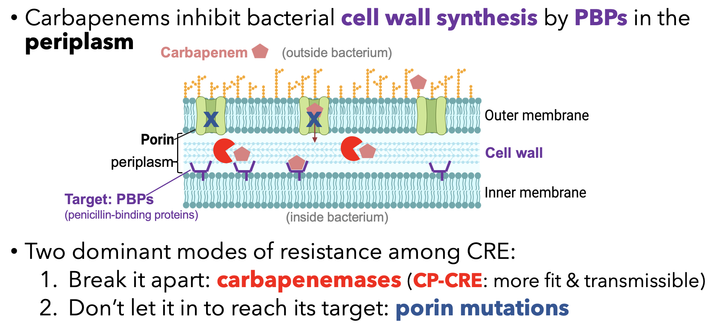
Some background: there are two main mechanisms of resistance to carbapenems, which (like penicillin) inhibit bacterial cell wall synthesis (focusing here on carbapenem resistant Enterobacterales, aka CRE):

1. carbapenemase production ("CP-CRE") - break the drug down

2. porin deficiency - don't let the drug into the periplasm where it can act

Because carbapenems act outside the cytoplasm (in the periplasm, where the cell wall is made), carbapenemases need to act outside the cell…

Until a project led by my lab's first postdoc, Alex Jaramillo, & stellar RA Kyra Taylor, my thoughts on the inoculum effect (IE) - the more bacteria there are, the greater the conc of antibiotic required to kill them - were fuzzy.

In a new preprint, imo we clarified the carbapenem IE: carbapenemases act as shared goods for bacterial communities. All carbapenemase-producing strains had a strong IE; those resistant due to porin deficiency had no IE at all.

This has key consequences…

🧵 1/n
6/9

Key findings (3/3):
- candidate persisters seen! The small cspD-expressing magenta subpopulation in the prior tweet
- enriching this subpop by FACS validated that all detectable persisters came from the cspD-high fraction (!)

5/9

Key findings (2/3):
- Klebsiella's tx'nal response to quinolones, aminoglycosides was more or less uniform (still some exaggerated MGE subpops), but the tx'nal response to carbapenems was far more heterogeneous, w various stress responses seen at 30m (that may avg out in bulk, explaining "slow" tx'nal response? this has puzzled me abt beta-lactams for yrs)

4/9

Key findings (1/3):
- MGEs hyperactive in a small % at baseline
- the subpopulation w active MGEs had higher abx resistance freq!
- one strain w known high transposition rate had several independent sub-populations, each w different active IS element (Fig 4e, not shown here)

2/9

Key methods (heavily inspired by the published works of others - see next post):
- single-cell transcriptomes from millions of bacterial cells per expt
- dual barcoding: split-pool up-front, then integrates w 10x Genomics system for ease/robustness/scale
- rRNA depletion via RNaseH (>60% reads = mRNA)
- demonstrated for GNR (Klebs, E coli, Pseudomonas) & GPC (Enterococcus)