Fred Jaya 👨‍💻🧬

64 Followers
62 Following
15 Posts
PhD @ The Australian National University | phylogenetic methods (dev.) | evolutionary genomics | recombination | clack addict ⌨️
(9/10) For more details on the methods, results, and discussion (and acknowledgements!) please have a look at our paper. มีบทคัดย่อภาษาไทยด้วยนะครับ 🇹🇭

New co-author paper out! We compared the microbiomes of healthy cattle between cattle with a respiratory illness and found a bunch of new viruses. 😁

https://doi.org/10.1186/s40168-023-01591-1

#microbiome #virus #bacteria #epidemiology

Expanding the range of the respiratory infectome in Australian feedlot cattle with and without respiratory disease using metatranscriptomics - Microbiome

Background Bovine respiratory disease (BRD) is one of the most common diseases in intensively managed cattle, often resulting in high morbidity and mortality. Although several pathogens have been isolated and extensively studied, the complete infectome of the respiratory complex consists of a more extensive range unrecognised species. Here, we used total RNA sequencing (i.e., metatranscriptomics) of nasal and nasopharyngeal swabs collected from animals with and without BRD from two cattle feedlots in Australia. Results A high abundance of bovine nidovirus, influenza D, bovine rhinitis A and bovine coronavirus was found in the samples. Additionally, we obtained the complete or near-complete genome of bovine rhinitis B, enterovirus E1, bovine viral diarrhea virus (sub-genotypes 1a and 1c) and bovine respiratory syncytial virus, and partial sequences of other viruses. A new species of paramyxovirus was also identified. Overall, the most abundant RNA virus, was the bovine nidovirus. Characterisation of bacterial species from the transcriptome revealed a high abundance and diversity of Mollicutes in BRD cases and unaffected control animals. Of the non-Mollicutes species, Histophilus somni was detected, whereas there was a low abundance of Mannheimia haemolytica. Conclusion This study highlights the use of untargeted sequencing approaches to study the unrecognised range of microorganisms present in healthy or diseased animals and the need to study previously uncultured viral species that may have an important role in cattle respiratory disease. Video Abstract
BioMed Central
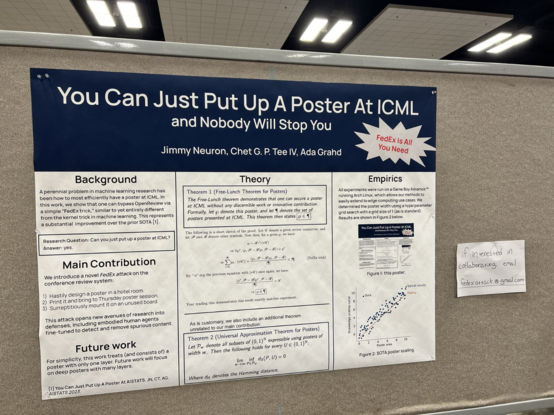
A friend attending #ICML just sent me a photo of this front runner for best poster award.

Dear Mastodon friends, it's my pleasure to share this new manuscript on distinguishing gene flow from incomplete lineage sorting (ILS)

https://www.biorxiv.org/content/10.1101/2023.07.06.547897v1

[1/6]

Come on slack....
cute

Supervisors who hoist Dart-data onto their students with zero computational skills:
do you hate your students

and did you realise that the time they waste on this is far more expensive than the little bit of money you saved by not doing WGS/RAD

I'm looking for recorded talks that are publicly available online (e.g. seminar/lecture series, past conferences). Interested specifically for things on #phylogenetics methods, but anything within the scope of #evolutionarybiology #bioinformatics; general research and philosophy of science more broadly.

On the hunt for things similar to Phyloseminar. pls boost!

RT @combine_au

COMBINE is starting a journal club!
💻Monthly meetings to discuss bioinformatics papers
💡Opportunity to present and learn from your peers
🌏A chance to form friendships across the country
Interested? Complete the EOI form
https://docs.google.com/forms/d/e/1FAIpQLScC7zMzfWX8n2pJKLYlHk2UD-JYt7kr1Rz3RMrrZ_I2Gr8u_w/viewform

Journal club EOI

COMBINE is organising an online journal club for anyone in our community to join! This is a form to confirm proposed details and gauge interest. You are welcome to join the #journal-club channel on the COMBINE Slack and get straight into it! You can also email us on [email protected] for questions and suggestions. Here is the proposed model: Before every meeting, 2 or 3 members will choose a paper to present The selected papers will be circulated to everyone via Slack channel at least 2 weeks prior to the meeting Questions to the presenter about a paper can be sent to the same channel During the meeting, 10 - 15 min presentations will be followed by 5 - 10 mins of questions, and social time in the end Meeting minutes and presentations will be uploaded to the COMBINE GitHub When, where, how? Meeting times - once a month between March and November on select Fridays in the afternoon First meeting planned for Friday March 17th 4:30-5:30 AEDT Medium - Slack channel and Zoom meetings The topic of papers discussed can be anything: Method papers, both new and commonly used (a podcast for inspiration!) Research papers in your field with a sizeable bioinformatics section Even your own publications! Please let us know in the form below if you are happy with this arrangement, or suggest any other ideas.

Google Docs

#Introduction

Hey Mastodon! I'm a PhD student working on developing #phylogenetics methods for untangling messy (recombinant) trees, and finding faster ways to do it 🌴

Previously dabbled in #bioinformatics, #popgen and #genomics 🧬 of cool Australian animals and #virology, but fell deeply in love with #programming, #linux and #dataviz. 👨‍💻

Hope to connect with folks from the bird site, and new!

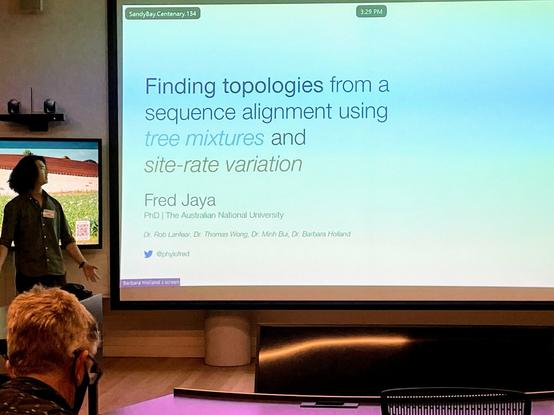
📷: Sharing some preliminary PhD progress at Phylomania 2022