Philippe Rufin

@philrufin@mapstodon.space
279 Followers
440 Following
380 Posts
Geographer with special interest in #Earthobservation & #machinelearning applications in the context of food production, water resources, and sustainable land management.
-----------------------------------------------------------
F.R.S. FNRS Postdoctoral Fellow
ELI UCLouvain | EOLab HU Berlin ๐Ÿ‡ช๐Ÿ‡บ
Websitehttps://philipperufin.github.io/
ORCIDhttps://orcid.org/0000-0001-8919-1058
GitHubhttps://github.com/philipperufin

Joint effort by Pauline Hammer, Leon-Friedrich Thomas, Sรก Nogueira Lisboa, Natasha Ribeiro, Almeida Sitoe, Patrick Hostert & @pmeyfroidt

Thanks to Descartes Labs and ESA for providing access to SPOT6/7 data, and the F.R.S.-FNRS for funding the research!

Our team had the opportunity to access SPOT6/7 data (1.5 m resolution) for Mozambique! We produced ~21 million individual field delineations for 2023, which allow unique insights into the spatial distribution of agriculture, field size and the linkages between agriculture and forest cover change!
The reason behind it is oftentimes constrained access to satellite imagery at very high spatial resolution needed in these systems (also see https://doi.org/10.1073/pnas.2410246122).
Smallholder-dominated landscapes are entirely different from the mechanized and consolidated landscapes (which are oftentimes considered for benchmarking AI models).
The literature on field delineation in smallholder systems remains relatively scarce and progress is slow overall (although cudos to the colleagues working on it). Therefore we donยดt have field delineations at policy-relevant scales (e.g. national) where they are most needed.
Despite free access to petabytes of satellite data, cloud computing platforms, and a wealth of high-performing computer vision models, satellite-based field delineation simply doesnยดt work in landscapes dominated by smallholders (fragmented, heterogeneous, and dynamic)!
๐ŸŒ ๐Ÿ›ฐ๏ธ ๐ŸŒฑ ๐ŸŒฝ๐Ÿ‘จ๐Ÿฟโ€๐ŸŒพ๐Ÿ›–๐Ÿ’ปโš™๏ธ
Preprint on national-scale satellite-based crop field delineation in smallholder landscapes is out:
https://doi.org/10.48550/arXiv.2507.10499
๐ŸŒ ๐Ÿ›ฐ๏ธ ๐ŸŒฑ ๐ŸŒฝ๐Ÿ‘จ๐Ÿฟโ€๐ŸŒพ๐Ÿ›–๐Ÿ’ปโš™๏ธ

I find it rather alarming and creepy that this integration with Google Vision API reads a photo/selfie and then tries to assess one's income, religion, politics and then recommends target advertising.

It didn't do this back in December.

Yes, even if it's a photo of your cat! ... privacy at your own risk. Try it via -
https://theyseeyourphotos.com/

"The Tabby cat is a mammal. It is likely earning 0-100 USD a year. It is possibly a follower of paganism. The creature seems observant, lethargic, and tranquil. The cat is not wearing any clothes. It enjoys activities such as sleeping, grooming, and staring contests, while it may also engage in shredding toilet paper, biting ankles, and shedding hairballs. The cat is unlikely to be politically affiliated.

The Tabby cat seems to exhibit predictable behavior and susceptibility to visual stimuli; hence we can target it with niche and general pet-related products, such as catnip-infused scratch posts (FelineFrolic), self-cleaning litter boxes (LitterLess)... "

#Google
They See Your Photos

Upload a photo to find out how much an AI sees.

They See Your Photos
Today, we have opened formal proceedings against TikTok for a suspected breach of the Digital Services Act.

Following serious indications that foreign actors interfered by using TikTok in the Romanian presidential elections, we are now thoroughly investigating whether TikTok has violated the DSA by failing to tackle such risks.

We must protect our democracies from any foreign interference.

More: https://europa.eu/!w7DbvY

#EU #DSA

Are there any PhDs in law/social sciences/public policy out there in the fediverse who would like to help hammer global, regional, and local AI Policy into shape? The AI Policy Lab at Umeรฅ University is looking for a staff scientist/policy analyst for a full-time, permanent position. #getfedihired #academicchatter

Last day to apply is January 15th!

https://umu.varbi.com/en/what:job/jobID:775734/

Staff scientist with a focus on AI policy and governance

The AI Policy Lab at Umeรฅ University is committed to advancing research and developing actionable policy insights to support the ethical and responsible governance of AI. We collaborate with key stak

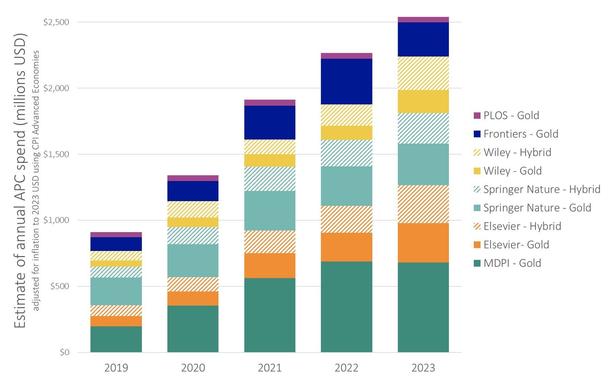
New preprint is out! We combine our recent open dataset of #APC prices with the publication counts per journal-year from @OpenAlex to estimate how much the academic community has paid in APCs over the last five years.

A: $8.349 billion ($8.968 billion in 2023 US dollars) spent on APCs.

$2.5B in 2023 alone.

We also find that median APCs *paid* are higher than median *listed* fees for both gold (paid: $2,450 vs listed: $2,000) and hybrid ($3,600 vs $3,230).

https://arxiv.org/abs/2407.16551

Estimating global article processing charges paid to six publishers for open access between 2019 and 2023

This study presents estimates of the global expenditure on article processing charges (APCs) paid to six publishers for open access between 2019 and 2023. APCs are fees charged for publishing in some fully open access journals (gold) and in subscription journals to make individual articles open access (hybrid). There is currently no way to systematically track institutional, national or global expenses for open access publishing due to a lack of transparency in APC prices, what articles they are paid for, or who pays them. We therefore curated and used an open dataset of annual APC list prices from Elsevier, Frontiers, MDPI, PLOS, Springer Nature, and Wiley in combination with the number of open access articles from these publishers indexed by OpenAlex to estimate that, globally, a total of \$8.349 billion (\$8.968 billion in 2023 US dollars) were spent on APCs between 2019 and 2023. We estimate that in 2023 MDPI (\$681.6 million), Elsevier (\$582.8 million) and Springer Nature (\$546.6) generated the most revenue with APCs. After adjusting for inflation, we also show that annual spending almost tripled from \$910.3 million in 2019 to \$2.538 billion in 2023, that hybrid exceed gold fees, and that the median APCs paid are higher than the median listed fees for both gold and hybrid. Our approach addresses major limitations in previous efforts to estimate APCs paid and offers much needed insight into an otherwise opaque aspect of the business of scholarly publishing. We call upon publishers to be more transparent about OA fees.

arXiv.org