
Oliver Batchelor

103 Followers
113 Following
92 Posts

Hello!

I am a computer vision and agricultural robotics researcher, working on methods for optically scanning, reconstructing and extracting structure of plants.

Interested generally in functional programming, machine learning and various forms of 3D reconstruction, SFM, photogrammetry etc.

Also keen on climbing, running and cycling - proportions of which vary depending on enthusiasm levels!

Christchurch, New Zealand

Githubhttps://github.com/oliver-batchelor/
Twitterhttps://twitter.com/oliver_batch
Websitehttps://ucvision.org.nz/
Orcidhttps://orcid.org/my-orcid?orcid=0000-0002-6542-1661

There's a standout article in #ThePress by Charlie Mitchell detailing how in the 1960s Christchurch city, NZ, came within a whisker of having a major motorway built through the middle of Hagley Park. That's the big park in the core of the city. The majority of local politicians were all for the motorway and it was only stopped by a coincidental administrative change in the way parks were managed that was backed by a national government decision.

Christchurch's mayor in the late 1960s, Ron Guthrey, was an ardent motorway supporter. The Press article notes how, in his inaugural speech as mayor, "he floated the idea of allowing cars to drive through the Botanic Gardens". At the next election he became the first sitting Christchurch mayor to be defeated in nearly half a century.

I see some parallels here with our current self-described "petrol head" mayor who wants to dig up a central city cycleway.

In the 1960s, opposition to the motorway was led by conservative councillor Peter Skellerup. “Surely the cult of the motor-car is not so strong that we carve through our oldest and most beloved reserve,” he said in 1963. “You can't land an aeroplane in the city… surely the car should be restricted from certain places.” "Skellerup, running to reclaim his seat, won more votes than any other council candidate in New Zealand’s history."

https://www.thepress.co.nz/nz-news/360820413/road-not-taken-how-abandoned-hagley-park-motorway-changed-christchurch

#Christchurch #nz #Cars #roads #UrbanPlanning #motorways

The Press

Here at BigCo you will be rewarded for doing stuff that looks like work. Any actual work you do will be incidental and may count against you.
As a life long robot enthusiast I endorse this assessment
https://circumstances.run/@davidgerard/115196555559161386
David Gerard (@[email protected])

so the teensy little issue with humanoid robots as the next great tech hype is just that they're shit, they don't work and they have no applications https://spectrum.ieee.org/humanoid-robot-scaling (expect answers to this post about how they could totally work out that didn't read the link)

GSV Sleeper Service

A Photorealistic Painting of Christopher Luxon is now A Redacted Painting of Christopher Luxon. Let's see if it stays up this time.

As before, please ask me Questions on the auction listing, so I may Answer them

#art #nzpol

https://www.trademe.co.nz/a/marketplace/art/nz-artists/listing/4974376165

A Redacted Painting of Christopher Luxon | Trade Me Marketplace

This is a highly accurate, 1:1 scale portrait of New Zealand Prime Minister Christopher Luxon. This portrait has been (re)designed from the ground up to app...

Trade Me
Torpedo dog!
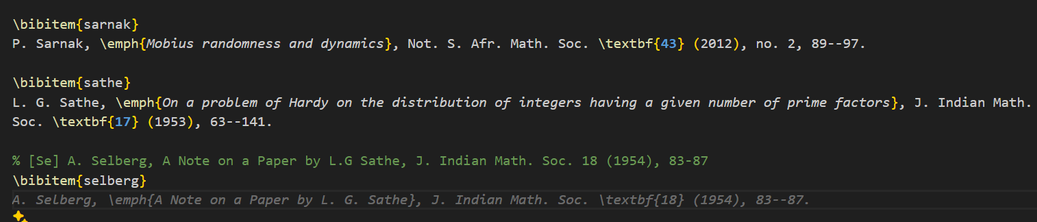
The two most time-saving uses of #AI I am finding in my work are not in the obvious use case of asking AI about my math problems, but rather either in creating computer code for various scientific computations, or in mundane data formatting tasks. A case in point is that of putting together a bibliography for a paper (with or without BibTeX). Often, I need to grab a dozen or so references from other sources (e.g., PDF documents) and format them to a specific bibliography style. This is not difficult, but is certainly tedious. With Github Copilot, it has become quite trivial; I paste in the raw reference in some random format as a comment, and Copilot usually understands without any additional prompting that I want to convert it to precisely the same format that all other references are in, usually correcting for any typos and other misprints in the original comment This is far faster than any previous method of collecting references that I have used. (And I have started taking joint papers in Overleaf offline to edit, solely to take advantage of these sort of autocompletions.)

Test of some alternative split and prune operations on 2D image. Black and white image to give a sparse scene (more similar to 3D).

#GaussianSplatting #ComputerVision
#MachineLearning

A little #introduction if I may:

I'm Buck, by day I work on self driving cars and by night I work on #OpenSource. I'm currently focused on @formak to magically translate Python to high performance C++. You can read more about FormaK here https://buckbaskin.com/blog/tag/formak.html

(edited to link the official FormaK Mastodon)

Building and Breaking - FormaK tag

It's also good for what I originally wanted! Which was de-coupling projection from rasterization and allowing any sized features without recompile. Using Taichi for implementation gave me both, maintainable projection using autograd and easy JIT for parameter changes.

Still much to do, applying to a 3D training scenario rather than just dummy 2D tests (like the optimizing-to-image in the repo), and of course a variety of experiments for which I wanted it in the first place.