NEW: NSO Group has released a transparency report that is even less transparent than its own previous transparency reports, as it contains no data or information on customers at all.
Experts say the report is just an attempt to appease and push the U.S. government to be removed from a blocklist.
The spyware maker did not respond to our questions asking it to share details on the customers that it has rejected, investigated, suspended, or terminated due to human rights abuses.
https://techcrunch.com/2026/01/08/critics-pan-spyware-maker-nsos-transparency-claims-amid-its-push-to-enter-us-market/

Critics pan spyware maker NSO's transparency claims amid its push to enter US market | TechCrunch
The infamous spyware maker released a new transparency report claiming to be a responsible spyware maker, without providing insight into how the company dealt with problematic customers in the past.
✒️Even after Assad’s fall,
#disinformation in
#Syria is thriving. In an opinion piece The Citizen Lab’s
@noura discusses how new trends and tactics have emerged, and how foreign powers and non-state actors exploit social media to manipulate narratives and spread fear.
Read more here:
https://timep.org/2025/01/30/truth-in-transition-disinformation-in-post-assad-syria/
Truth in Transition: Disinformation in Post-Assad Syria
Disinformation fuels fear and division in Syria’s new political landscape, eroding trust and blocking the path to a peaceful political transition.
In an opinion piece for
@globeandmail The Citizen Lab’s Emile Dirks ,
@sanstis @noura and
@rondeibert underscore how the
#HogueCommission’s report missed an opportunity to address transnational repression. Read it here 👇🏽
https://www.theglobeandmail.com/opinion/article-the-final-hogue-report-was-a-missed-opportunity-to-tackle/
The final Hogue report was a missed opportunity to tackle transnational repression
Canada’s commission on foreign interference did not adequately address the problems faced by diaspora communities
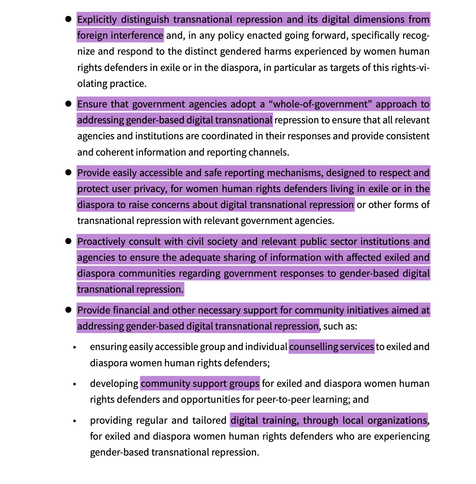
8/ Recommendations:
Social media platforms must improve content moderation policies, develop gender-specific reporting channels, and protect activists from surveillance abuse.
7/ Recommendations:
Host states must respond effectively to address transnational repression, including its digital and gender dimensions, ensuring institutions receive training on gender-based digital repression and immigration-related issues.
6/ Social media is essential for exiled WHRDs, but also a space where they face significant threats.
🔹 Content moderation often fails, especially in non-English contexts
🔹 Platforms were unresponsive to gender-based digital transnational threats
5/ Participants shared that the responses of host states were insufficient, leaving them feeling compelled to manage the situation on their own. As a result, they developed their own coping mechanisms and resistance strategies.
4/ The Hidden Toll of Gendered Digital Transnational Repression:
🔸On mental health & wellbeing,
🔸Sense of security & social relations
🔸Activism and professional work
3/ Key findings:
1️⃣ Exiled WHRDs face politically motivated digital attacks using a variety of technologies
2️⃣ Top perpetrators of gender-based DTR: gov of home country,or state-related actors
3️⃣ These attacks are gender-based
4️⃣ Targets are WHRDs involved in transnational advocacy
2/ Our report findings draw on the lived experiences of 85 women human rights defenders originating from 24 home countries and residing in 23 host countries.
This map shows countries of origin of the participants


 Lorenzo Franceschi-Bicchierai
 The Citizen Lab