Noura Aljizawi 

204 Followers
116 Following
47 Posts
Senior Researcher @citizenlab | Alumni @uoft @munkschool | Board member @CVTorg
8/ Recommendations:
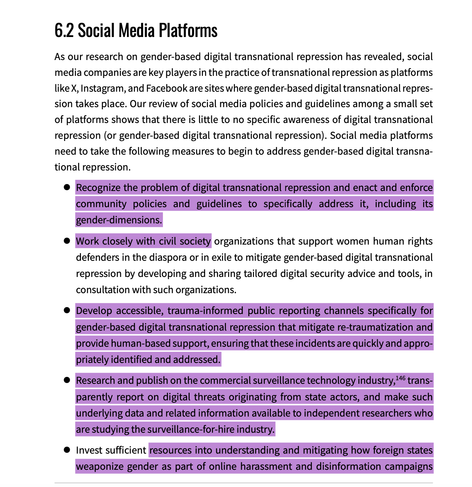
Social media platforms must improve content moderation policies, develop gender-specific reporting channels, and protect activists from surveillance abuse.
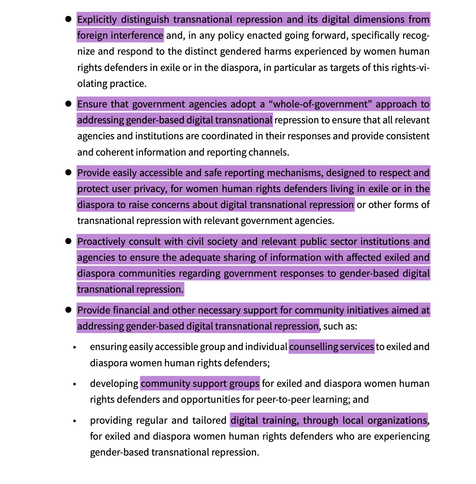
7/ Recommendations:
Host states must respond effectively to address transnational repression, including its digital and gender dimensions, ensuring institutions receive training on gender-based digital repression and immigration-related issues.
5/ Participants shared that the responses of host states were insufficient, leaving them feeling compelled to manage the situation on their own. As a result, they developed their own coping mechanisms and resistance strategies.
4/ The Hidden Toll of Gendered Digital Transnational Repression:
🔸On mental health & wellbeing,
🔸Sense of security & social relations
🔸Activism and professional work
3/ Key findings:
1️⃣ Exiled WHRDs face politically motivated digital attacks using a variety of technologies
2️⃣ Top perpetrators of gender-based DTR: gov of home country,or state-related actors
3️⃣ These attacks are gender-based
4️⃣ Targets are WHRDs involved in transnational advocacy
2/ Our report findings draw on the lived experiences of 85 women human rights defenders originating from 24 home countries and residing in 23 host countries.
This map shows countries of origin of the participants

1/
📢 New Report: No Escape: The Weaponization of Gender for the Purposes of Digital Transnational Repression.

We examine how gender shapes digital transnational repression—where governments target, suppress, and surveil activists across borders using digital tools
📖 Read the full report: https://citizenlab.ca/2024/12/the-weaponization-of-gender-for-the-purposes-of-digital-transnational-repression/

No Escape: The Weaponization of Gender for the Purposes of Digital Transnational Repression - The Citizen Lab

Building upon our prior research and the contributions of other scholars to this field, the aim of this novel study is to understand the security risks and harms caused by digital transnational repression against exiled and diaspora women human rights defenders.

The Citizen Lab

🚨 New Report Alert! 🚨

Excited to share our latest research, "Enhancing Cybersecurity Resilience for Transnational Dissidents," published by the Center for Long-Term Cybersecurity. Co-authored with my @citizenlab colleagues Gözde Böcü & Nicola Lawford, the report dives into the cybersecurity threats faced by exiled women dissidents in the U.S.

As the foundation for this study, we conducted 17 semi-structured interviews with women-identifying victims of digital transnational repression (DTR) in the U.S., along with five current and former staff members from digital rights organizations. The paper outlines the distinct cybersecurity challenges these dissidents and their organizations face, using a structure based on SAFETAG—a cybersecurity framework designed for small non-profit organizations—along with additional themes and insights drawn from these interviews.

In this report, we shed light on the growing cybersecurity threats targeting these women and their organizations, from spyware attacks to disinformation campaigns. Operating at the intersection of gender, politics, and digital repression, these activists face unique challenges in their fight for justice and free expression.

We also highlight how these activists have developed their own cybersecurity practices based on their experiences and needs. Their resilience extends into all areas of daily life, including home, family, external employment, and navigating their host country and diaspora community.

#cybersecurity #DigitalRights #TransnationalRepression #DTR
Check it out

https://cltc.berkeley.edu/publication/cyber-resilience-for-transnational-dissidents/

Enhancing Cybersecurity Resilience for Transnational Dissidents - CLTC

A report published by the Center for Long-Term Cybersecurity, Enhancing Cybersecurity Resilience for Transnational Dissidents, examines the cybersecurity posture, vulnerability, and resilience of exiled women dissidents in the…

CLTC
@citizenlab QuaDream systems were detected operated in Bulgaria, Czech Republic, Hungary, Ghana, Israel, Mexico, Romania, Singapore, UAE, and Uzbekistan.