miranda_lubbers

303 Followers
325 Following
168 Posts
Professor at UAB Barcelona studying #socialcohesion, #exclusion, and #polarization from a #networkscience perspective. Director COALESCE lab (coalesce-lab.com); #ERC Advanced Grant holder (PATCHWORK); #ICREA Acadèmia fellow. Opinions are my own. #sociology #anthropology #socialnetworks. mirandalubbers.com
My new paper in the European Sociological Review:
"The role of social networks in institutional trust during economic downturns": https://doi.org/10.1093/esr/jcaf011 Exposure to distress via our networks is quite relevant for whether we trust institutions. Hope you like it!

Extreme inequality between rich and poor is a feature of capitalism, an inevitable and desired result. Another feature is contemptible disregard for those less fortunate.

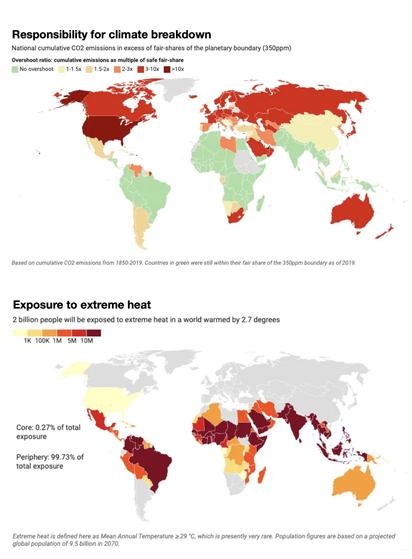
As the world continues heating up, millions or even billions of disadvantaged humans in the Global South will suffer the consequences of rampant consumerism and capitalist greed in the Global North.

This is all deliberate. It's not an accident.

That's how capitalism works: shift the damage of our lifestyles far away so we don't have to see it or think about it.

#History #Science #Environment #Climate #ClimateChange #ClimateJustice #Capitalism

📢 3 days left to apply! Full-time postdoc for social network research in Barcelona (22 months) in a big European Research Council-funded project! No ref. letters needed. No teaching. Incl. healthcare. Mediterranean climate 🌞, partially working from home allowed
At Coalesce Lab at UAB we look for a post-doc in the ERC-funded project on network-scientific approach to social cohesion. Spread the word, share, apply! https://euraxess.ec.europa.eu/jobs/319601 @sna @sociology
Post-doctoral researcher (2025DILIFRUA24)

Job position

EURAXESS
Fun looking paper: The Homo Economicus as a Prototype of a Psychopath?
https://link.springer.com/article/10.1007/s10551-024-05638-7
The Homo Economicus as a Prototype of a Psychopath? A Conceptual Analysis and Implications for Business Research and Teaching - Journal of Business Ethics

Since the beginning of business research and teaching, the basic assumptions of the discipline have been intensely debated. One of these basic assumptions concerns the behavioral aspects of human beings, which are traditionally represented in the construct of homo economicus. These assumptions have been increasingly challenged in light of findings from social, ethnological, psychological, and ethical research. Some publications from an integrative perspective have suggested that homo economicus embodies to a high degree dark character traits, particularly related to the construct of psychopathy, representing individuals who are extremely self-centered and ruthless, without feelings of remorse or compassion. While a growing body of research notes such a similarity on a more or less anecdotal basis, this article aims to explore this connection from a more rigorous perspective, bridging insights from psychological, economic, and business research to better understand the potentially dark traits of homo economicus. The analysis shows that homo economicus is not simply some kind of psychopath, but specifically a so-called subclinical or Factor 1 psychopath, who is also referred to as a “corporate psychopath” in business research. With such an analysis, the paper adds an additional perspective and a deeper psychological level of understanding as to why homo economicus is often controversially debated. Based on these insights, several implications for academic research and teaching are discussed and reflected upon in light of an ethics of virtue and care.

SpringerLink
@EsGroot @miranda_lubbers no, that would be constructive feedback. I would not have a problem with that at all.
@mbojan @sociology @sna @academicchatter just 10 days left for submission of abstracts to this special issue in Social Networks!

Interesting study by Schuster et al. suggesting that cycling in urban areas has a positive effect on the common good (i.e. political participation, social participation in organizations, neighbourhood solidarity, and neighbourly helpfulness)

https://www.sciencedirect.com/science/article/abs/pii/S0272494423001731?dgcid=author

#PublicSpace #EnvironmentalPsychology
@sociology @politicalscience @geography

@csmarcum @mbojan no worries, it’s been very helpful!
@csmarcum @mbojan @sociology @sna @academicchatter thank you for sharing, Chris, I didn’t know that. Just found the award data, I’ll write to him. Thanks! 🙏