southern new england checking in. about five hours ago my daughter served as an enthusiastic measuring stick for the snow we're getting. it's been snowing ever since.

I used to analyze information ecosystems. I now ponder bees and trees along the CT-RI border.
Posts delete after three months.
| About Me | https://michael.cervieri.com |
| Trees & Bees | https://tree.dance |
A few tasty tidbits from an article titled "Food For Thought: The ecological cost of feeding 8 billion people"...
____________________________
As reported by ReFED: In the U.S., a staggering 38% of all food goes unsold or uneaten. It’s valued at $444 billion, roughly 2% of U.S. GDP, and it has the same climate footprint as the entire U.S. aviation industry (passenger, commercial, and military).
According to the UN, nearly 30% of harvested food is lost globally. At the same time, 250 million people (4% of human population) are living on the verge of starvation. In the developed world, food wastage is primarily related to consumer habits, while in the developing world, a lot of food is lost due to a lack of refrigeration and supply chain spoilage.
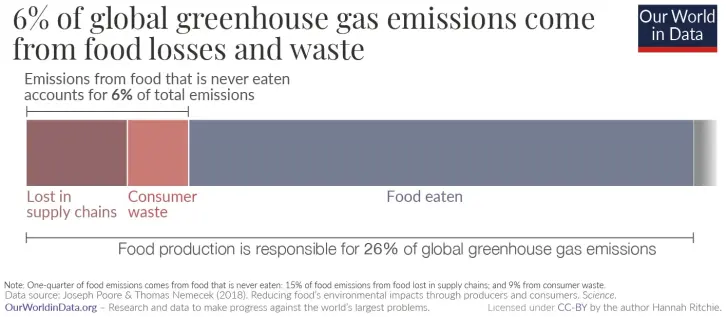
A staggering 6% of global greenhouse emissions are associated with production of food that is never eaten. Half of that is related to consumer waste, which is completely in our control. The other half has to do with supply chains.
You might think you have no control over this, but you can help by eating locally produced food. Look for fruits and veggies that are locally grown during your next visit to the grocery store.
This may be wishful thinking, but if humans stopped consuming animal products and instead switched to a plant-based diet, we could ‘rewild’ 30% of Earth’s habitable land (equal to five Amazon rainforests).
____________________________
FULL ARTICLE -- https://medium.com/@praful.bits/food-for-thought-the-ecological-cost-of-feeding-8-billion-people-2ab7f97607cd
Just now I misread "Neurodiverse" as "Neuroverse", and I loved intensely the idea of using #Neuroverse as a fully inclusive way to describe the whole multi-dimensional space of our brains and their mysterious ways.
So I'm keeping it! The neuroverse. ❤️
Distribution of greenhouse gas emissions are incredibly skewed in the US: 10% of the population emits 40% of the emissions, and there's a tiny population of wealthy super-emitters who manage put out as much in 15 days as the bottom 10% of the population does in their entire lifetime.
Paper:
https://journals.plos.org/climate/article?id=10.1371/journal.pclm.0000190

NSF invests millions to unite Indigenous knowledge with Western science


 Science Scholar
 Bread and Circuses
 Laura Langdon
 Damon Outlaw
 David Sacerdote
 Rebecca Sear