Mindy Weisberger (she/her)

@laminda
2.5K Followers
602 Following
568 Posts
Science writer, editor and producer, previously with Scholastic, Live Science and the American Museum of Natural History. Pro-union (WGAE member) and anti-fascist. Cynical girl.
Verified byhttps://fedified.com/
Live Sciencehttps://www.livescience.com/author/mindy-weisberger
Space.comhttps://www.space.com/author/mindy-weisberger
Life's Little Mysteries podcasthttps://www.open.spotify.com/show/2h05HNKFSZQ2WEiH9aGjH1?si=86de8c4e6f234c44

Let's say you're a parasitic ant queen eyeing the colony of another species. But ants will attack anything that smells like trouble, and boy, do you smell like trouble.

So you execute a simple plan:

1. Hide your scent by rubbing one of the colony's workers all over your body
2. Stealthily infiltrate the nest
3. Ambush the queen and spray her with chemicals from your abdomen
4. Sit back and watch as her daughters tear her to bits
5. All hail the usurper!

https://www.cnn.com/2025/11/17/science/parasitic-ant-queen-workers-kill-mother

#science #ants

Scientists uncover an ant assassination scheme that helps a parasitic queen rise to power

Scientists newly described how a parasitic ant queen infiltrates another ant species’ colony and tricks the workers into killing their mother.

CNN

Live birth in toads! Is a thing! Three newly described species of tree toads give birth to toadlets, at least 40 or more at a pop and each just a few millimeters long.

They're in a genus that's known for live birth but were previously all lumped together as one species: Nectophrynoides viviparus. However, new analysis of hundreds of museum specimens (yay museums!) and recordings of their calls identified them as three different species in that genus.

https://www.cnn.com/2025/11/13/science/tree-toad-three-species-live-birth

#science #scicomm

Newly identified species of Tanzanian tree toad leapfrog the tadpole stage and give birth to toadlets

Researchers have newly described three extremely rare species of toad that leapfrog over the egg-to-tadpole stage and give birth to toadlets.

CNN

Massive relatives of modern kangaroos once roamed Australia, and about 50,000 years ago, First Peoples may have collected the animals' fossils.

In my latest for CNN, researchers revisit a cut in a tibia from an extinct giant kangaroo, finding that the mark was made after the bone dried out and fossilized. This counters prior interpretations of the mark as a sign of butchering, proposing instead that First Peoples collected fossils.

https://www.cnn.com/2025/10/27/science/australia-first-peoples-fossils

#science #australia #paleontology

New research upends theory that Indigenous Australians hunted large animals to extinction

Two recently examined fossils suggest that Australia’s First Peoples valued big animals for their fossils as well as for their meat, according to a new study.

CNN

Big thanks to the folks at CBC's Quirks and Quarks for having me on as a guest to talk about Rise of the Zombie Bugs! It was great fun chatting with host Bob McDonald about my favorite zombifiers and what we can learn from them about parasitism, neuroscience and evolution.

Scroll down their page to check out the book trailer, edited and animated by @monospace!

https://www.cbc.ca/radio/quirks/oct-25-zombies-wolves-methane-screaming-9.6951725

#science #zombie #books #bookstodon

Oct 25: Rise of the zombie bugs, and more... | CBC Radio

On today's extra spooky episode: Wolves are afraid of the big bad human, tracking the invisible monster methane in Montreal, screaming babies make us hot to get our attention and baby pterosaurs died in a torrential storm.

CBC

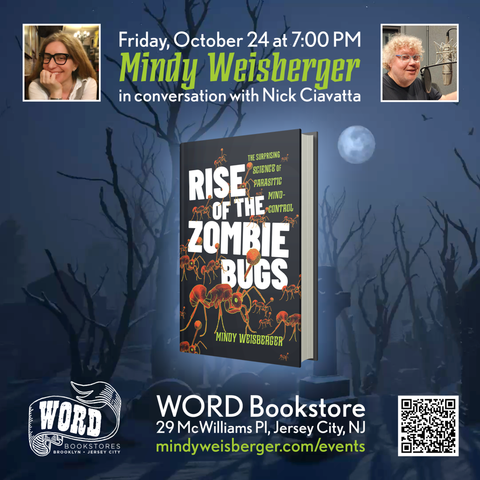
Heads up, NJ/NY folks! 'Tis the season for zombie science, and on Friday Oct. 24 I'll be at WORD Bookstore in Jersey City talking with Nicholas Ciavatta about zombie ants (and the zombie-ant fungus that inspired "The Last of Us"), zombie roaches, zombie caterpillars, zombie cicadas and more.

How many different ways are there to make a zombie? Come find out! It's free!

RSVP: https://mindyweisberger.com/events/

Graphic by the very awesome @monospace

#science #zombie #halloween #newjersey #books

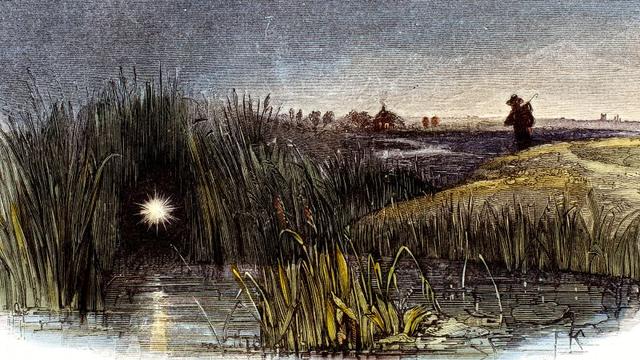
Ever seen a spooky glow called a will-o'-the-wisp hovering in a swamp, bog or cemetery? Wet places where organic things decay are gassy as hell, fueling these eerie lights.
But what provides the spark? Microlightning that jumps between electrically charged bubbles of methane, according to a new study that I covered for CNN.

https://www.cnn.com/2025/10/08/science/will-o-the-wisp-microlightning

#science #chemistry #halloween

Sparks between microscopic bubbles could explain the ghostly, glowing will-o’-the-wisps, study finds

Flashes of microlightning between microscopic bubbles of methane in water may ignite the eerie blue flames of will-o’-the wisps, new research suggests.

CNN

Polar explorer Ernest Shackleton called his ship one of the strongest to ever visit Antarctica; he blamed its sinking in 1915 on rudder damage, after the vessel had been trapped and mangled by pack ice.

In my latest for CNN, new analysis of records and journals suggests that a structural flaw may have doomed the HMS Endurance from the start, and that Shackleton knew about it all along.

https://www.cnn.com/2025/10/06/science/endurance-ship-sinking-structural-weakness

#science #antarctica

A broken rudder wasn’t what doomed the Endurance, new analysis suggests

When explorer Ernest Shackleton’s ship, Endurance, got trapped in pack ice, a broken rudder was blamed. New analysis suggests structural weakness caused the sinking.

CNN

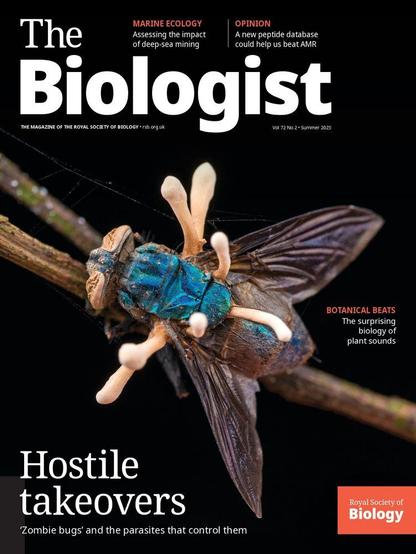
It was great talking to Tom Ireland of The Biologist (magazine of The Royal Society of Biology) about Rise of the Zombie Bugs, and what scientists learn from zombifying organisms about parasite-host relationships, behavior manipulation and neuroscience.

Read the Q&A: https://www.rsb.org.uk/biologist-features/the-rise-of-the-zombie-bugs

Plus! The book's 30% off (today's the last day) at @HopkinsPress with code HMOR25 https://press.jhu.edu/books/title/53677/rise-zombie-bugs

A stunner of an Archaeopteryx fossil preserves SO MUCH soft tissue, including scales on its toe pads and a group of flight feathers never seen before in Archaeopteryx. Called tertials, they lie between the elbow and the body, and play a key flight role in modern birds.

In my latest for CNN, lead study author and paleontologist Jingmai O'Connor explains how these feathers confirm a longheld hypothesis that Archaeopteryx was capable of powered flight.

https://www.cnn.com/2025/05/21/science/archaeopteryx-fossil-includes-feathers

#science #fossil

‘Important moment in evolution’: Fossil preserves never-before-seen flight feathers in ‘first bird’

Scientists were finally given access to a remarkable Archaeopteryx fossil that’s allowed them to better understand exactly how the earliest known bird could fly.

CNN

When insect fossils are this intact, just looking at them makes you go WHOA. Plus, preserved body structures reveal how their group evolved!

In my latest for CNN, I wrote about how a truly stunning cicada fossil from Germany's Messel Pit places singing cicadas in Europe earlier than expected, by millions of years. Its large abdomen hints that males had a roomy resonating chamber, for producing louder songs.

https://www.cnn.com/2025/05/13/science/oldest-singing-cicada-fossil-europe

#science #fossils #insects #germany #paleontology

Newly named ancient cicada fossil is so well preserved you can see the veins in its wings

Two fossils of singing cicadas, one of which was remarkably well preserved, reveals that the insects dispersed in Europe millions of years earlier than once thought.

CNN