 Felicitas Macgilchrist
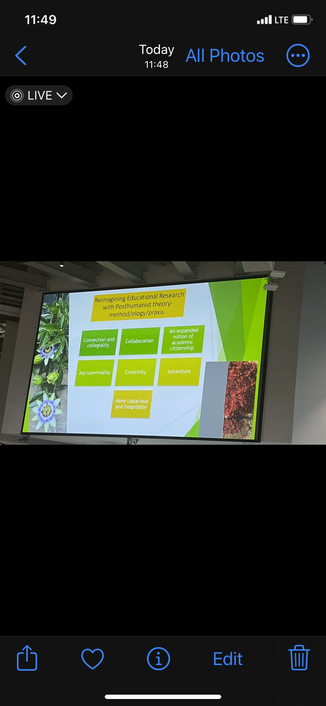
This was a beautiful keynote by Carol A Taylor on posthuman educational research. #ECER2023

| web | https://www.irina-zakharova.com/ |
| @UniBremen | https://www.uni-bremen.de/en/zemki/about-zemki/members/members/member-profile/idm/5372?cHash=2876331a2a2a2293d74de375846cdca0 |

Do predictive analytics dream of risk free education?
I have just published an open access paper with @irzakhar in which we analyse risk prediction-related design features of five globally used learning management systems (#lms).
https://link.springer.com/article/10.1007/s42438-023-00411-x
We discuss (1) the promises these lms make about the possibilities of a risk-free education; (2) how risk prediction features work; and (3) the resulting politics of who is perceived as a carrier of risk.


The future is always shaped and, to some extent, haunted by design decisions of the present and their future residues. Predictive learning analytics, as increasingly used in education, is an example of a technology that is future-oriented by design. Particularly risk prediction concerned with the students at risk, risk factors hindering educational success, and their management has a long history in education. Currently, identification of students ‘at risk’, risk prediction, and mitigation are being automated through learning analytics. Understanding risk as integral both to modern society and the educational processes, our goal in this paper is to trace the politics of risk prediction and educational futures. We argue that the future orientation of educational technologies materialise in form of design features. To analyse these future making features, we examine the risk prediction-related design features of five globally used learning management systems. We consider their politics for future making through the ways in which they define what is problematic, what is thinkable, and what is desirable in education. We discuss (1) the promises and aspirations these learning management systems promote to educators about the possibilities of a risk-free educational future; (2) how risk prediction features work, e.g., on which different data categories they operate; and (3) the resulting politics of who is perceived as a carrier of risk in education and who is called upon to act. We close with a discussion on the politics (and risk) of aspiring for risk-free learning and risk mitigation in datafied education.
Join us in thinking about #Careful #DataStudies.
We want to explore whether and how shifting from critique to care opens new pathways for more generative engagements with the transforming roles, relations, practices & politics of data-driven automation.


Die Niederlande wollen vormachen, wie sich automatisierte Entscheidungssysteme einhegen lassen. Skandale wie die Kindergeldaffäre sollen mit einer neuen Algorithmenaufsicht und Transparenzregistern verhindert werden. Davon könnte sich die EU eine Scheibe abschneiden und den AI Act verbessern.
Join us for the 4th episode of our #geopolitics of #technology series: Infrastructural Distortion and Possession.
@Elinor_Carmi, Seda Guerses & Fenwick McKelvey are guest speakers; @nielstenoever moderator. w/@giganetr @SPUI25
📅 Dec. 14
⏰ 20:00-21:30
📍 online
👉 read more & register: https://bit.ly/3dOMNdr

Global internet infrastructure is increasingly becoming part of geopolitical conflicts. However, politics have always been an inherent part of communication infrastructures. One could even argue that that the internet infrastructure has been a field of reconfiguration of global power for decades, we just failed to see it. Elinor Carmi, Fenwick McKelvey and Seda Guerses have been will shine a light on the actors and particularly the material reconfiguration of our life-worlds and politics through technology. This is an online event and is co-organized by Giganet.
 Juliane Jarke
 Ingmar Lippert
 netzpolitik.org
 Hendrik Heuer
 ACES
ACES Charlotte Högberg