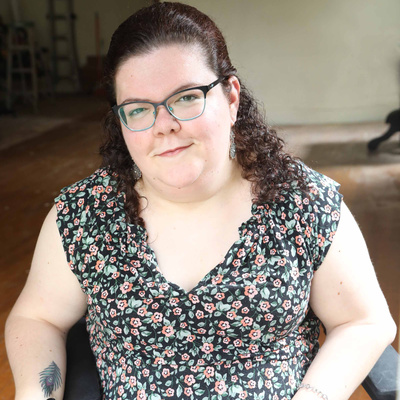
Getting a little spicy...
Started a new podcast with one of my favorite badass disabled babes, Kings Floyd!
We're getting down and dirty about sex and disability.
The first episode of DisCo Sex is now live. It's transcribed!
Image description: A red figure sitting on a shiny disco ball meant to be a wheelchair. The red figure's arms are wrapped around an orange figure who is sitting on their lap.

Pilot - Welcome to DisCo Sex
Welcome to DisCo Sex, a podcast about disability & sexuality in today's world. ------- Transcript: Pilot Emily This is Emily. Kings This is Kings. Emily This is Kings DisCo sex. Emily Oh, I'm so excited. Kings I am so excited too! Hey y'all. Welcome. Emily Hi, everyone. So why don't we get started with some introductions? What do you say? And then we'll get to the juicy stuff. Kings Yeah. Emily Alright, cool. So I am Emily Ladau, I use the pronouns she/her/hers. And I'm a white woman who has a physical disability called Larsen syndrome. It's a genetic joint and muscle disorder. So I use a wheelchair to get around. In terms of my sexual and gender identity, I am a cisgender woman who identifies as heterosexual. And let's see what else is there to say about me? I guess I should... Kings You sexy as fuck. Emily Oh, that's a rave review from you. And likewise, you're so hot. That--yes, I also identify as hot. Kings Good, glad we've vocalized that, gotten that out of the way. Emily Tell us about yourself. Kings How's it going? This is Kings Floyd. My pronouns are she/her, I present as a white cisgender physically disabled woman. I have a rare form of muscular dystrophy and use a power chair in red, the sexiest color. I identify as pansexual. And I am so excited to be here with my phenomenal co-host and all of y'all. Emily Okay, so I'm super pumped. I feel like we have so much to talk about. But first of all, I think it makes sense for us to contextualize a little bit why we're even doing this podcast and how we relate and connect to the conversation about disability and sexuality. Because I'm going to be the first to admit I am not an expert here. That is not the point of us doing this podcast. Kings Yeah, no, definitely not a professional in the sex, pleasure, or medical capacity for any sense. But I think that's a win in this case, because we don't have the the traditional viewpoint. You know, I know I speak for myself other than my thesis paper in college which was about disability and sexuality and just my natural enthusiasm for the topic, I haven't really been involved professionally in this kind of work. Emily But I also think that is what makes this so important, because you don't need to be an academic and you don't need to be a medical professional, to have conversations about sex. And I also did my college thesis paper on disability and sexuality. So I'm very curious, do you have like a top line explanation of what yours was about without having to like, dive into all of it. Kings My hypothesis was something around the fact that in every media representation of a person with a disability, they are not given a robust sexual identity, which is kind of a turnoff for movies. One because as you know, like, we sexy as fuck, but two, I wanted representation as a little kid, I wanted to see a disabled lead, fall in love. So, you know, whenever the disabled character in a love story, you know, dies or gets broken up with, which I think are the two most common endings, I was tired of that narrative. So looking at why that is the narrative, and then what would happen if we change that? Emily Can I just say we might have been the same person in college. So my thesis was on representations of disability and sexuality in the media, romantic love as well. And I did sort of a qualitative analysis where I had a bunch of people watch clips from different shows. And the shows were questionable, honestly. But it was kind of limited choices at the time. It was Glee, and it was Pushed Girls. But the thing is that both of those shows had representation, whether or not it was good representation was another thing entirely. But I wanted to see how those representations affected people's perceptions of whether disabled people could fall in love, have sex, things like that. So yeah, but it all came back to the media representation. Yeah, fun stuff. Anyway. So, yes, Kings and I have done, I would say some research and just have a general interest in the topic. But I think, most importantly, we need to get it out there. Like we are just disabled human beings who have had sex. I think that, that, in and of itself, is something that I wouldn't say makes us qualified to talk about it, because you don't have to have had sex to qualify to talk about it, but it does make it so I feel like I can at least speak from my own experience. I can't speak for anybody else. But I can at least speak to what I know. Kings True, true, I also I, I want to shift the narrative that we can be, we don't always have to be, but we can be inherently sexual beings. And I think a lot of the misconceptions from the able-bodied or nondisabled community is that many people with disabilities are ace or, you know, don't involve themselves in sexual activity. And obviously, that is a personal choice, regardless of disability. But looking to foster that conversation of what is disability, what is sexy, and why aren't we talking about it more? Emily Yeah, and also, I think that there's such a lack of recognition that disabled people do exist across the full spectrum of sexualities. And so if there is someone who identifies as asexual and disabled, there may be no correlation whatsoever between the fact that they're disabled and asexual, those can be two entirely separate parts of their identity that happen to coexist within one person. Same thing, if somebody is bisexual and disabled, they may have nothing to do with one another. But they can also overlap in certain areas, right? Because identities and experiences overlap. And so I just want to put that out there, that, yes, we speak from our experiences, but we acknowledge that there's a full range of human sexuality that disabled people can experience, Kings Human sexuality and intersectionality. Emily Exactly. Couldn't have said it better myself. So on that note, I want to talk a little bit more about why this podcast needs to exist. And I know we've been talking about that a little bit already, but I want to dive more into kind of how we decided that it should exist. And what that spark moment was like, when did the light bulb go off for you? Kings Oh, that's a good question. In some ways, I mean, like, my light bulb goes off every time I see your face. Emily Don't make me swoon. Kings I think the, like actual light bulb for the podcast idea came a couple of months ago when we were talking about our respective challenges, but also strategies around disability, dating, and sexuality. And we realized that we were talking a lot about it with ourselves, between ourselves, but that there could be a platform where others would engage and learn from these topics. Emily I think it's so important to be open and there are plenty of other disabled people who are openly having conversations who are sex educators who are doing this work. But one thing that I know I haven't seen is honestly just two people shooting the shit about random sex topics. I mean, there's so many awesome podcasts out there, and great media and great reads on disability and sexuality. But what about just like listening in to the conversations that you have with your friends? That's kind of what this feels like to me. Kings Yeah, and really normalizing those types of conversations for people with disabilities, of any disability or ability, but also between any communities. Emily Exactly. And I'm gonna be really honest here for a second, I was never sat down to have the sex talk. I wasn't pulled out of sex education because of my disability so I definitely did experience learning about it in a school setting. I went to a mainstream public school. But nobody ever really sat me down and was like, let's talk about sex. Let's have a conversation. So everything that I learned, I learned just from picking it up along the way from conversations with friends from literal, like playground chatter, you know, and then with Google, I mean, I had to do a lot of figuring it out myself. Kings Playground chatter. Emily But it's true, though, right? Like, I don't know, did you ever get the talk? Kings Yes. I mean, yes and no. So I got my period when I was nine. So my mom, like, bless her heart, not in the Southern way, but in the actual way, was a little overwhelmed that her daughter was hitting puberty so early. But we had a very frank conversation. There was an American Girl book, I think, called The Big Book of You. Emily I was just gonna mention that book, I think maybe the Care and Keeping of You is that it? Kings Yes, yeah! So my mom got that book for me. And I started reading it when I was nine or 10. And she had, you know, multiple conversations about the birds and the bees with me. But I was so frustrated, because there's, as far as I recall, no mention or allusion to disability in that book. And my first experience of learning about sexuality was, where am I in these pages? How does this relate to me, my identity, what I need to know, versus what other people need to know? Emily Yeah, that's a really good point. I didn't see myself at all in that book. Speaking of representation from earlier, I read that book cover to cover multiple times, because I knew that it was useful information. But there was still something missing. And I also remember that there was like, so much mythology around getting your period. And I wanted to have it, because I felt like, somehow I would be cooler if I did have it. And I have this very distinct memory that I was sending an email to my cousin. And at that point, my mom was still like monitoring my emails, because I was really young. And I think I said something about getting my period, except that I didn't actually have it. I was lying just because I thought it made me sound cooler. You know, what did I know? Like, nothing. I had no conception of what menstruation actually meant. But yeah, I mean, sure, I had conversations about changes happening in my own body, but in terms of engaging sexually with someone else, I had to figure that all out on my own. Kings Yeah. And so like, my mom had very much like the biology conversation with me about you know, what's happening in your body. But I never had like a you know, what is consent? What is, you know, gay, straight bi, pans, queer, any of the, you know, sexual identities that we are much more embracing and aware of today. And then so on top of that, I also went to a mainstream mainstream school, but every time other kids got PE, I was pulled into PT or physical therapy, and that included the health classes that went on every other week that would teach you about all of these things. Now, I'm not sure I would have gotten as much out of it, knowing that there wasn't disability representation in those mainstream classes, regardless. So it could have made me feel even more like, what am I doing here if I'm not represented here, but I do remember kind of being jealous of the other kids that they got to talk about all of these other things. And this conversation topic was almost taboo for me, because I had other commitments at that time. Emily And I think the hardest part is that I internalized just how taboo it was. And for years, it was still really challenging for me to wrap my mind around sex. So now I feel like I'm going in the opposite direction, where I'm just like, no, we got to talk about this, we need to be open about this. And also, you know, we're older now. But it's hard out here. Being disabled woman trying to navigate things related to romance and sex. And we need to be open about that. Kings Open about it and honest with each other about, you know, what we've learned and the resources we can share. Emily Yeah, and we are not going to just assume that we have all the answers or all the resources. I think our overarching goal as we move forward is to bring in people who actually have expertise in different areas or lived experience that we don't have. Kings On that note, I know many of our listeners and participants will know this already. But Emily and I are speaking from our own disabled persperience--experiences and perspective. Emily Persperience. I like it. Kings So, you know, not not all disabilities are the same. And we want to be as open in these conversations as possible. But understanding that we won't be able to cover the whole range of human sexuality and expression in a single episode, or multiple episodes. Emily Or ever, because I always remind people with more than a billion disabled people in the world, you're going to have more than a billion experiences of disability. It's just not possible to encompass that. And I would never dream of saying that we could. But at the same time, that doesn't mean that we can try to be expansive in what we cover. Kings Exactly. Emily So I know, I was just saying it's hard out here. And, you know, that's what she said. But anyway, it really is tough. I had to, I had to. Kings No, you did. Totally, like missed opportunity otherwise. Emily But it really is difficult being a disabled woman navigating the dating world, and Kings and I are both people who have done that at different points in our lives. And we talk about it a lot. And one thing that really came up for me, as we were beginning to plan doing this podcast was how many times I've just been outright rejected on the basis of my disability. Kings Yeah, and I that's something I can relate to, as you personally know. And not just, you know, rejected on your disability specifically, it's also a rejection of, you know, what accommodations you might need, or even like, the venue of where you are initially meeting another person. Emily Yeah, or a rejection based on assumptions without actually even communicating first, like, one very recent example. And I have so many I could just write a book about this, and nothing else. But I was talking to a guy on OKCupid and we seemed to be hitting it off. And then I knew that he knew that I use a wheelchair because I'm very upfront about it in my dating profile. And he asked me, you know, so can you walk like if I give you my hand? Can you get up a couple of steps or can you not do steps at all? And I was like, no, I can't do steps at all. And then he sent me this whole message back about how physical touch is a big part of how he decides he has feelings for someone. And even though he feels like we're hitting it off, he would really need to be able to spend private time with me in order to decide if we were compatible, blah, blah, blah. And I was like, you know, first of all, I don't know what planet you're living on that you think I would come over to your apartment on a first date. Because no. Kings Right? Emily Like, that's the first thing that I'm thinking about, because I do not want to end up as like, a true crime podcast. Kings Yeah, yeah. You know, I'm from Maine, and you see these, like, you know, animal heads mounted on the walls, like moose and deer and stuff. And like, you know true crime, fiction or not, like, oh, just shivers if that possibility ever existed. But I know what you mean, I know exactly where you mean. I've, you know, Maine is not the most accessible city. There are, there are less accessible cities, but there are way more accessible cities. And so finding a venue to go on a date can be tricky, especially if you're looking to try something new. And I had one date experience where this person really wanted to go to this specific place. It was a restaurant, not accessible, in a historically preserved building with no way to get in with a ramp or like lack of a lip. And no takeout options, either. And when I was like, okay, so like, unfortunately, I know that restaurant has stairs, and they don't do takeout, like, that's not going to work, this person asked to come over to my house. And similarly, to you like I'm not gonna invite someone over to my house on the first date. And they took such great offense to that. They're like, you don't trust me? You don't trust me to come to your house? And I'm like, well, I don't really want you to meet my parents straight off the bat being like, yes, hello, this one person I met on Hinge four days ago is gonna come over and just we're gonna make out. So I mean, those boundaries. Emily Oh, my gosh. And honestly, that is such a standard boundary. That's not even a disability thing. Like, yes, disabled women are definitely at a greater risk of sexual assault. And I think that is something that we should talk about in a future episode, for sure. But at this point, I think it's just kind of common sense not to have somebody come over on the first date. I mean, if that's your choice, like cool, you do you, but I have seen a few too many, like, Dateline specials. Kings Yes. Yeah. Emily So I have no desire to get like my head chopped off and hung up like a moose. Horrifying. Kings Yes, slightly, slightly violent depiction. But nothing bad should be happening to you on a date. Only good things, or bad things if you want them to. Emily But like fun, bad. Kings Yeah, good, good, bad. Sexy bad. Not bad, bad. Emily Yeah, but all of that is to say that there have been so many times where people have just completely disregarded me as a romantic or sexual partner option because of my disability or because they could not be bothered to get a little creative with their thinking, and on the one hand-- Kings Just say no. If they can't get creative with their thinking, are they gonna be creative with other things? Emily Exactly. That's where I was going with that. Like honestly, if you cannot think outside the box, you're probably not even that good in bed. So like, do I even want you anyway? Sorry, that was maybe judgy but like, look, I think it kind of weeds people out automatically. Kings Yeah, standards are important, setting your boundaries. And you know, you know, boundary setting is one of the most important things you can do for yourself out here in this crazy world. Emily Having standards is important, too. Kings Yeah. Emily And disabled people are allowed to have standards like, oh my goodness, I know that there are so many times that I let myself settle. I'm not doing it anymore. Kings Because you deserve better boo. You deserve better. Emily Girl, so do you. The whole world, you deserve. You all deserve the world, everyone listening. I genuinely believe that. Seriously disabled people deserve everything. Kings 100% Emily You know, I feel like this is a good time to transition into reading a few love notes to people. Kings You know me, I got a lot of love out there. Emily A few years ago, I started a hashtag on Twitter. It was #DisabilityValentines. And I think honestly, it just came from wanting to do something creative around Valentine's Day because I kind of find it a silly holiday. Kings Oh, it's very much a Hallmark holiday. Emily But a fun holiday. I like chocolate. Kings Oh, I mean, who doesn't? Yeah, absolutely. But dark, not milk. Emily What? No, I'm a milk chocolate girl. Kings Okay, so here's what I'm gonna do. We get the, you know, mixed variety. I'm gonna give you all my milks and you can give me all your darks. Emily Oh, we can share. Oh, a match made in heaven. So, I'm gonna read. We can go back and forth on this taking turns. Does that work? Kings Yeah, sure. Emily Okay, so I picked out a few of my favorites that I'm also biased because I definitely picked one of the ones that I wrote. So sorry in advance. Roses are red. That parking space is blue. If you're not disabled, it's not for you. Kings So true. So true, public service announcement. I like this one from Dr. Amy Kavanaugh published in 2021. Roses are red, violets are blue. Don't distract my guide dog. She's got a job to do. Emily Also a good public service announcement. I love that one. This one is from the American Association of People with Disabilities and they tweeted it in 2022 and I love it so much. Roses are red, violets are blue. I would like to create access intimacy with you. Kings I would like to create access intimacy with you too, boo. Emily I think I think we have, I think we have. Kings Helen Rottier in 2020, published, Roses are red, cupcakes are frosted. Dismantling ableism leaves me exhausted. Emily Oh, I want a cupcake and a nap. Okay, and my last one is very on brand for the podcast. It is from someone who is named Dolly and their handle is @osborneosaurus from last year 2022. Roses are red, like raspberry ripple. I fuck a lot. And yes, I'm a cripple. Kings Yes, way to be, way to own your ish. Emily Oh, that's my favorite. Also, I love the rhyming of ripple and cripple. Kings Yes, So I'm a fan of the like traditional roses are red, violets are blue. This one's from Matt Cortland in 2022. Roses are red, violets are blue. Marriage equality is for disabled people too. Emily Oh, yes. That's an important one. That's a good one to end on. Kings So yeah, fun fact, if you did not know, disabled people do not have marriage equality. And we will be exploring that in a future session. Emily Of which there will be many because we already have a list that continues to grow about things that we need to talk about. There are a lot of conversations that need to be had about things related to disability and sexuality. Kings Yes. So to all of y'all who are feeling inspired and creative from the disability Valentine's chats, we would like to hear from you. What are some Valentine's Day limericks that you think are especially representative of the disability Community? Please tweet them out with the hashtag capital D disabled capital V Valentine, or capital D disability capital V Valentine. Emily Yeah, so we’re gonna be on the lookout for them. And I know I need to start coming up with some new ones already. It’s that time of year again! I should be a Hallmark card writer. Kings That sounds like a fun job though. Just all up in your corny vibes and owning it. Emily I have so many corny vibes and I fully lean into them. Oh my gosh, okay, and also on the subject of just sharing your fun Valentines, we also wanna hear what you’d like for us to talk about. If you have a particular topic that you’re interested in, a particular area of expertise that maybe you wanna share, we are on this journey along with all of you. So I think it’s safe to say, get in touch with us. We’re on Instagram, right? Did we do that? Kings No, we didn’t. Yes! So for those of you that wanna get in touch with us, we are on Instagram. Emily’s handle is Emily @emily_ladau Kings And I am @kings.floyd. But you can also email us. It is either or and we would love to hear from you. Emily Don’t we also have an Instagram account that we made? Kings Oh, yes we do! @disco.sex. Emily Oh wait is it disco. Or disco_? It’s @disco_sex. Follow us there. We will eventually put something on it. Kings Yes, my graphically challenged ass is working on an icon but that will be further down the line. Emily And also speaking of further down the line, what can people expect next? Kings This season on DisCo Sex…we are still crowdsourcing topics that we want to talk about so if you have any ideas please send them to us. Next time, however, we will be talking about what schools miss about sex education for people with disabilities. If there’s something you feel like you really needed to learn in school that you didn’t, or a what I wish I knew growing up crip and sexy please let us know ether in email or Instagram. Emily Which we definitely just went over and I can’t remember a darn thing. I have no idea what our email addresses are. Kings Emily I’m aware that we are literally at the end of the episode here but does it make sense to clarify that DisCo means disability community? Kings You know it always pays to clarify things. As we wrap up our podcast. The reason we chose to go with DisCo Sex is DisCo is the shortened name for disability community. It is the vibe that many of us operate under as a group of people, as a community. And so DisCo Sex is all about disability community sex. Emily That sounds like an orgy. Kings I mean, it depends on your preferences. That’ll be a later episode. Emily But I really for real am imagining an orgy but also because it’s disco there’s a giant disco ball and everybody’s dressed up like it’s the 70s. Kings Yeah, hey, you know what? The possibilities are endless. Emily Before I get too carried away with my weird visions here, I think I can say that’s a wrap on the first episode and thank you so much for tuning in! Kings Thanks ya’ll. Tune in next time! Emily Bye!

 Simone


 selfcare.tech