doublelineblock (Will)

25 Followers
36 Following
54 Posts
i do not suffer from insanity, i enjoy every minute of it | an insufferable nerd: transport, cities, history, language
Pronounshe/him
LocationBoonwurrung country
Superior rail gauge5 foot 3 inches
We have to get all the suburban lines to 10 minute frequencies. It's a pleasure catching a Frankston line train on weekends because of that frequency.
---
Melbourne train stations: South Yarra, Richmond, Box Hill among city’s busiest #Melbourne https://www.theage.com.au/national/victoria/busiest-stations-face-twice-the-wait-for-trains-20230301-p5col3.html
Busiest stations face twice the wait for trains

Passengers at some of Melbourne’s busiest suburban train station are waiting twice as long for trains as those riding the best-served rail lines through the eastern and south-east suburbs.

The Age

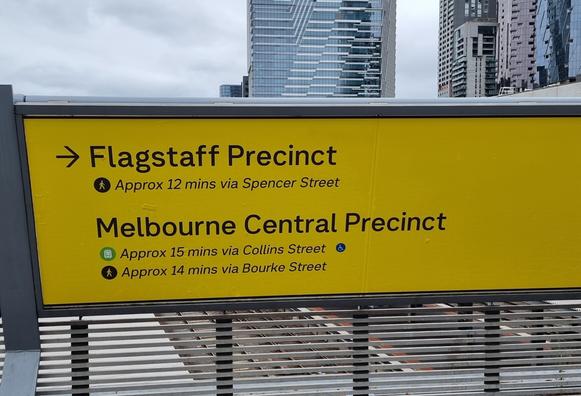
This is not the only example of really strange advice for how to get to underground City Loop stations during the works closure.

In this example, the advice for people on the Bourke Street concourse at Southern Cross to get to Melbourne Central is to walk even further away from Melbourne Central by getting a tram from Collins Street, or instead walking to Melbourne Central along Bourke Street and no advice to simply catch a tram right there next to you on Bourke Street.

Another example at Flinders Street was telling people to catch the tram one block to Collins Street (barely 200 metres away) and changing to another tram to Parliament. For that it suggested walking the whole way is quicker, which is probably true if you've given the bad advice to catch a tram one stop and then interchange.

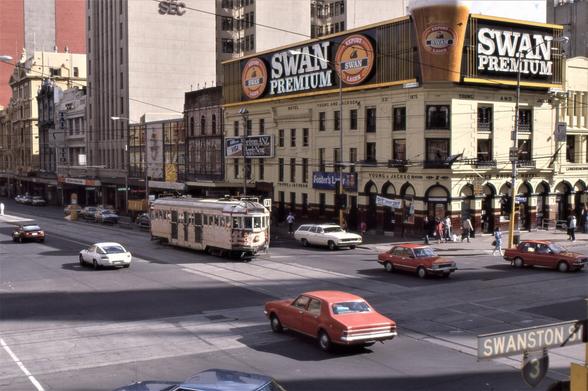
Today's historic #photo of the day: Transporting-art liveried W2 class #tram no 525 running an East Burwood bound route 75 service heads east across the Swanston Street intersection in Flinders Street, Melbourne, August 2 1987.

This is probably the most recognisable intersection in Melbourne. At right is Young and Jackson's hotel whilst not visible in this shot, Flinders Street station is at left. The pic was taken from the now demolished podium above the former Princes Bridge station.

Ask your doctor if hiding under your bed until the world is normal is right for you
@timrichards I like that they haven’t even bothered trying to explain the mess that is the Frankston line at the moment…!

Learned something today: there is no automation on the Luna Park #melbourne rollercoaster, it has someone on board manually applying the breaks. Here’s an interesting interview with one of the people who do that

After having watched probably hundreds of Tom Scott videos from around the world, felt very surreal watching one filmed here in Melbourne

https://youtu.be/2nQ-rijlX3o

This rollercoaster doesn't stop automatically

YouTube

This actually isn’t surprising at all, but it still needs to said over & over — the biggest barrier to more urban biking in cities is the fear of cars.

“A study confirms that if we are serious about getting people on bikes, they need a safe place to ride.”

Via @lloydalter #TreeHugger #bikes #cities #urbanism #cars #BikeLanes
https://www.treehugger.com/fear-of-cars-biggest-biking-barrier-study-6979522

Biggest Barrier to Biking Is a Fear of Cars

If we are serious about getting people on bikes, they need a safe place to ride.

Treehugger

My top five walkability killers for cities and larger towns.

1. Separated land uses.

When different uses are prevented from being near each other, distances become larger and walking unattractive. Some separation of land use intensity is permissible.

2. Minimum car parking requirements.

A silent killer. Mandated parking tends to fragment traditional built forms, force buildings further apart, and increase costs. This fuels horizontal sprawl in search for cheaper land. Direct impacts are greater distances and proliferation of crossovers (driveways) making walking unsafe and unattractive.

3. Horizontal sprawl.

When cities and towns are permitted to expand outwards without mandating 10-minute city policies, distances become larger and walking unattractive.

4. Vehicle-oriented road design.

It's fine for roads to cater for cars, but if their default function is the movement and storage of vehicles, walking becomes unsafe and unattractive.

5. Vehicle-oriented built form.

Things like suburban shopping centres, drive-throughs, and service stations. As with previous points, these increase the distances between destinations and degrade the walking environment with crossovers. Walking becomes unsafe and unattractive.

All these points are interlinked. There's also a tangent I'd like to explore into how the monopolistic tendencies of capitalism encourage these bad outcomes, but I need to think about that issue some more.

#UrbanPlanning
Whenever they tell you a change is impossible, show them Utrecht.

An urban freeway with many lanes can become a green park with a beautiful canal. Instead of a car sewer, the water flows.

Catharijnesingel, Utrecht. Winner European Urban Public Space Award 2022 by OKRA landschapsarchitecten

https://www.archdaily.com/992550/okra-receives-the-european-urban-public-space-award-2022

OKRA Receives the European Urban Public Space Award 2022

The Dutch firm OKRA landschapsarchitecten has been awarded the European Prize for Urban Public Space 2022.

ArchDaily

Today's historic #photo of the day: A class #tram no 293 running a route 111 service to Port Melbourne at Graham Street, Port Melbourne, Vic, 35 years ago today, January 2 1988.

The railway from Melbourne to Port Melbourne, Australia's first passenger carrying steam railway opened in 1854 and operated until October 10 1987 when it was closed. After conversion, much (but not all) of the route re-opened on December 18 1987 as a light rail line integrated with Melbourne's extensive tram network.