Christian Czymara

726 Followers
331 Following
1.4K Posts

@gorodzeisky @migrationresearch @communicationscholars @computationalsocialscience

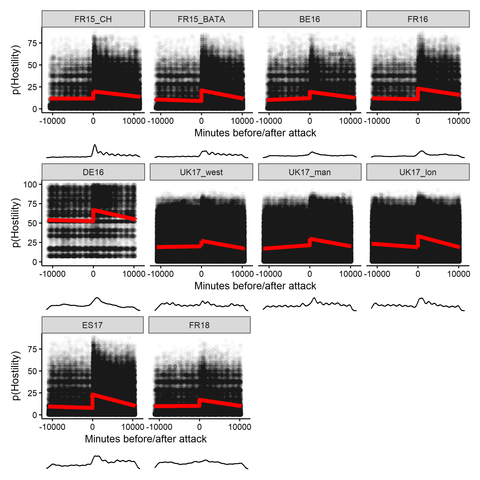
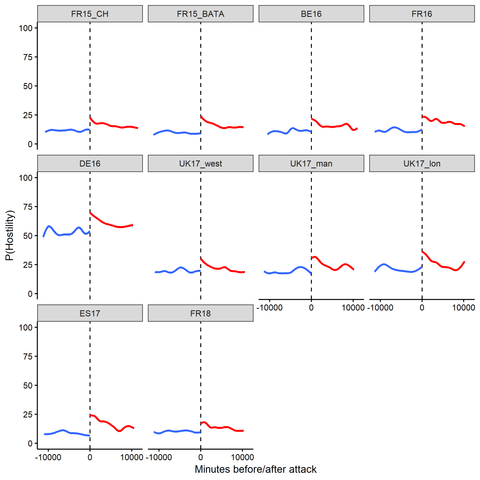
2/3 On average, we find a 10 pp increase in online hostility at the time of the attack. This effect diminishes approximately seven days after the event. There is some heterogeneity across the 10 attacks, but the overall pattern is similar in all cases, see parametric and non-parametric modelling:

Hostility on #Twitter increases after Jihadist terror attacks.
New study w/ @gorodzeisky in the Journal of #computationalSocialScience , analyzing ~4.5M Tweets from ~1.2M users before and after ten major attacks across five European countries. Available in #openaccess πŸ”“ at:

https://link.springer.com/article/10.1007/s42001-024-00272-9

@migrationresearch @communicationscholars @computationalsocialscience

Hostility on Twitter in the aftermath of terror attacks - Journal of Computational Social Science

This study investigates the relationship between major Jihadist terror attacks and manifestations of ethno-religious hostility on social media. Analyzing approximately 4.5 million time-stamped Tweets from 1.2 million users across five European countries, the study focuses on content discussing migration and related topics in the weeks before and after ten significant terror attacks. The findings show a notable and robust increase in hostile Tweets after an attack. An interrupted time series analysis demonstrates a 10% point surge at the time of the attack, followed by a gradual decline. Accordingly, the impact of such attacks on online hostility diminishes approximately seven days after the event. Further analyses reveal that while attacks have the strongest effect on Tweets about Muslims and Islam, the attacks also increase hostility in Tweets about migration in general. We find that the overall attack effect is driven by both intra-user changes in Tweeting and changes in the composition of users posting after an attack. The findings underscore the importance of understanding the interplay between terrorist events and online discourse, shedding light on the dynamics of ethno-religious hostility in the digital realm.

SpringerLink

Google Scholar had a nice surprise today:

#academicchatter

Political elite discourses increase far-right voting by activating exclusionary national identities. New study w/
@acmay (@GESIS) published in #NationsAndNationalism based on Manifesto, #EVS & #ISSP data.

Paper available in πŸ”“ #OpenAccess at: https://onlinelibrary.wiley.com/doi/10.1111/nana.12985

Replication material: https://osf.io/ntexg/

@politicalscience
@sociology
@migrationresearch @communicationscholars

Real-world developments such as migration rates, crime, and terrorism predict immigration news in right-wing media. Moreover, these developments also shape the content within immigration news.

In a study recently published in Mass Communication and Society, I analyze more than two decades of news coverage within Germany's largest right-wing newspaper to show this.

πŸ”“Open access at: https://www.tandfonline.com/doi/full/10.1080/15205436.2023.2240307

Replication material: https://osf.io/bwh78/

@communicationscholars @politicalscience

How did #rightwing #media discourses on cultural #threat, #politics, and #nationalism change in the last 20 years? In a study just published in German Politics, Leo Bauer and I analyze almost 57,000 articles published in Germany's largest right-wing newspaper, check it out: https://www.tandfonline.com/doi/full/10.1080/09644008.2023.2231353

@politicalscience @communicationscholars #polcom #polsci @RRResRobot

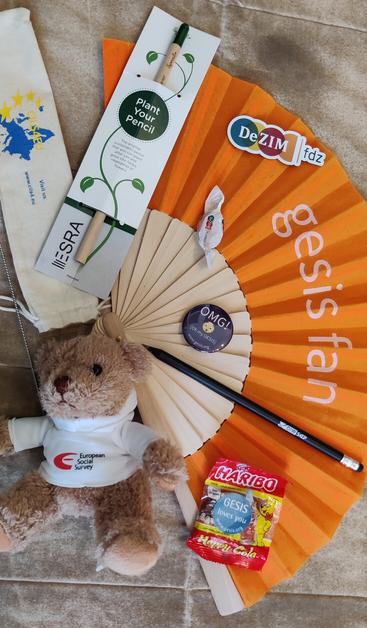
Merch at #ESRA23 is pretty strong:
Had a great time at this year's BIGSSS Summer Schools in Computational Social Science. Interesting research, great people, and a cat 😺
Thanks @janlo and organizers!

#Terror attacks hardly influence #trust in political #institutions. In a new study published in the European Journal of Political Research #EJPR, Christof NΓ€gel, Amy Nivette and I combine causal inference and meta-analysis methods to study rally-around-the-flag effects using 15 years of data from the European Social Survey.

Paper πŸ”“#openaccess: https://ejpr.onlinelibrary.wiley.com/doi/10.1111/1475-6765.12612

- Replication material & preregistration: https://osf.io/e2mn8/

@politicalscience @migrationresearch @sociology @criminology

Our study on the impact of terror attacks on ethnic insulting in #YouTube comments is now published in Journal of Ethnic and Migration Studies 49 (2), a special issue on Computational Approaches to #Migration and Integration Research.
πŸ”“ Our article is available in open access at:
https://www.tandfonline.com/doi/full/10.1080/1369183X.2022.2100552

Make sure to check out the other papers of this fantastic special issue at: https://www.tandfonline.com/toc/cjms20/49/2

@migrationresearch @communicationscholars @commodon @sociology @politicalscience

Catalyst of hate? Ethnic insulting on YouTube in the aftermath of terror attacks in France, Germany and the United Kingdom 2014–2017

In the last 20 years, several major terror attacks conducted in the name of political Islam hit Western Europe. We examine the impact of such terror attacks on hostile behaviour on social media fro...

Taylor & Francis