@gorodzeisky @migrationresearch @communicationscholars @computationalsocialscience
2/3 Deeper analyses reveal that the increase was strongest in Tweets about Muslims/Islam, but also concerned Tweets about migration in general. Fixed effects models show that the overall effect is in part driven by intra-user changes in Tweeting.
As always, replication material is available at: https://doi.org/10.17605/OSF.IO/ZDT5B
Hostility on Twitter in the Aftermath of Terror Attacks
This study investigates the relationship between major Jihadist terror attacks and manifestations of ethno-religious hostility on social media. Analyzing approximately 4.5 million time-stamped Tweets from 1.2 million users across five European countries, the study focuses on content discussing migration and related topics in the weeks before and after ten significant terror attacks. The findings show a notable and robust increase in hostile Tweets after an attack. An interrupted time series analysis demonstrates a 10% point surge at the time of the attack, followed by a gradual decline. Accordingly, the impact of such attacks on online hostility diminishes approximately seven days after the event. Further analyses reveal that while attacks have the strongest effect on Tweets about Muslims and Islam, the attacks also increase hostility in Tweets about migration in general. We find that the overall attack effect is driven by both intra-user changes in Tweeting and changes in the composition of users posting after an attack. The findings underscore the importance of understanding the interplay between terrorist events and online discourse, shedding light on the dynamics of ethno-religious hostility in the digital realm.
Hosted on the Open Science Framework
@gorodzeisky @migrationresearch @communicationscholars @computationalsocialscience
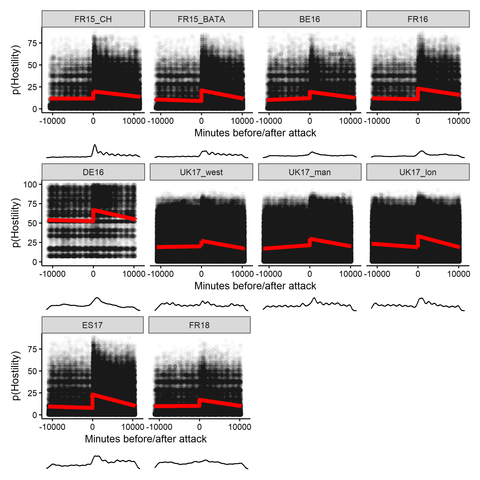
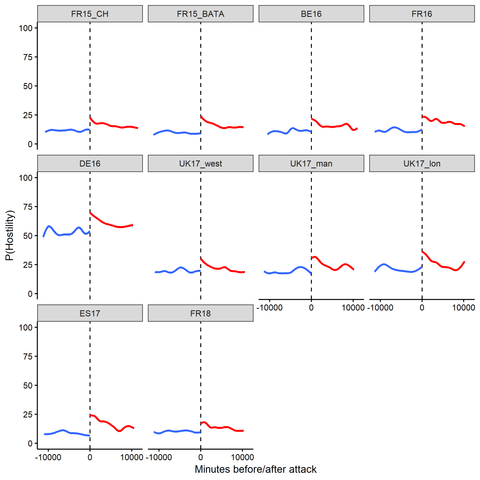
2/3 On average, we find a 10 pp increase in online hostility at the time of the attack. This effect diminishes approximately seven days after the event. There is some heterogeneity across the 10 attacks, but the overall pattern is similar in all cases, see parametric and non-parametric modelling:
Hostility on #Twitter increases after Jihadist terror attacks.
New study w/ @gorodzeisky in the Journal of #computationalSocialScience , analyzing ~4.5M Tweets from ~1.2M users before and after ten major attacks across five European countries. Available in #openaccess 🔓 at:
https://link.springer.com/article/10.1007/s42001-024-00272-9
@migrationresearch @communicationscholars @computationalsocialscience


Hostility on Twitter in the aftermath of terror attacks - Journal of Computational Social Science
This study investigates the relationship between major Jihadist terror attacks and manifestations of ethno-religious hostility on social media. Analyzing approximately 4.5 million time-stamped Tweets from 1.2 million users across five European countries, the study focuses on content discussing migration and related topics in the weeks before and after ten significant terror attacks. The findings show a notable and robust increase in hostile Tweets after an attack. An interrupted time series analysis demonstrates a 10% point surge at the time of the attack, followed by a gradual decline. Accordingly, the impact of such attacks on online hostility diminishes approximately seven days after the event. Further analyses reveal that while attacks have the strongest effect on Tweets about Muslims and Islam, the attacks also increase hostility in Tweets about migration in general. We find that the overall attack effect is driven by both intra-user changes in Tweeting and changes in the composition of users posting after an attack. The findings underscore the importance of understanding the interplay between terrorist events and online discourse, shedding light on the dynamics of ethno-religious hostility in the digital realm.

Terrorist attacks rarely increase trust in political leaders
Research suggests that institutional trust increases in times of political crises. Christof Nägel, Amy Nivette and Christian Czymara test this notion for jihadist terror attacks in Europe. Their results imply that political leaders should not take these dynamics for granted
Our research on the (non-)impact of Jihadist terrorism on institutional trust, co-authored with C. Nägel and @amynivette is now published in the European Journal of Political Research @ejprjournal vol. 63, issue 2, pp. 411-432, and is accessible 🔓open access.
@ecpr @politicalscience @criminology
https://ejpr.onlinelibrary.wiley.com/doi/10.1111/1475-6765.12612
Published in 2015: C. Ziller and T. Schübel. “`The Pure People"" versus ""the Corrupt Elite"""? Political Corruption, Political Trust and the Success of Radical Right Parties in Europe”. In: Journal of Elections, Public Opinion and Parties 25.3 (2015), pp. 368-386.
Google Scholar had a nice surprise today:
#academicchatter

 Paul Schütze
 Radical Right Research Robot
 petersuber
 GESIS Data Services