| Website | https://braiduk.org/ |
| https://www.linkedin.com/company/98665671/ | |
| https://www.instagram.com/braid__uk/ |
| Website | https://braiduk.org/ |
| https://www.linkedin.com/company/98665671/ | |
| https://www.instagram.com/braid__uk/ |
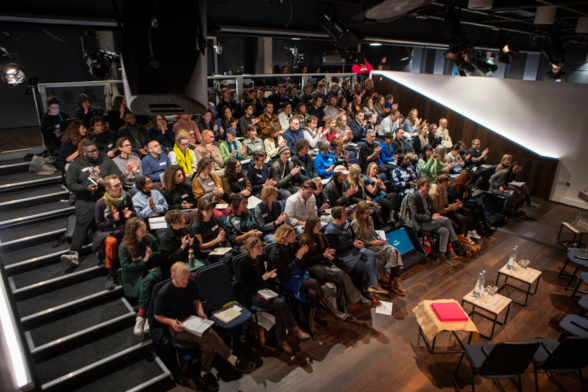
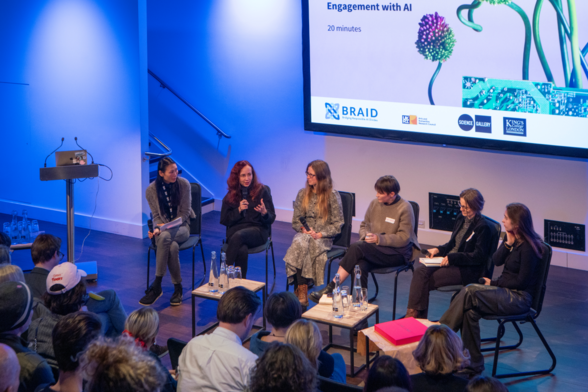
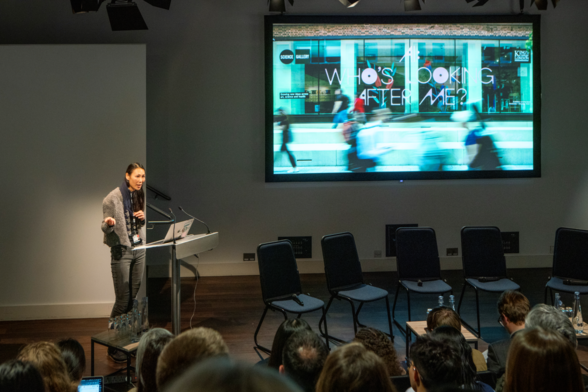
Thanks to everyone who attended the AI & Arts event we co-hosted with Science Gallery London. It was a thought-provoking, wonderful couple of days and it couldn’t have been made possible without your enthusiastic participation.
Image credits: Science Gallery London.
Fascinating new article from BRAID research associate Fabio Tollon - 'Is there room for genuine human agency in a world populated by almost incessant technological distraction and influence?'
You'll want to grab a cuppa for this one 🧠
https://link.springer.com/article/10.1007/s43681-023-00366-6#Fun
Is there room for genuine human agency in a world populated by almost incessant technological distraction and influence? It often feels as though our technological landscape is pulling us in a number of directions, and that our agency is more a function of us reacting to the world as opposed to us exerting our will. In this paper I, explore what it would mean to take these contextual factors seriously and bake them into an account of agency. That is, what if agency is reactive all the way down? This is a proposal made by Rüdiger Bittner, who argues that the reason(s) for action are responses to states of affairs in the world. This is in contrast to ‘standard’ views of agency, which explain actions with things like beliefs and desires. Ultimately, I find such a reactive account of agency implausible. However, I think it reveals a potential solution to the ‘new’ problem of all-pervasive technologies: a reactive account does not see these technologies necessarily as a threat, but rather focusses our attention on the ways in which they change and shape our available context and our possibility to act. While I argue the reactive account goes too far, what I take from it is that our environment offers us various possibilities for action (in the form of affordances), and that we ought to take this seriously in our thinking both about agency and about the impacts of technology. Moreover, there is something to learn from our tendency to ‘fall’ for various ‘temptations’ in our environment, and this justifies further reflection on not only the design of different technologies, but whether such technologies ought to exist at all.
Today is the last chance to submit an expression of interest for BRAID fellowships! Make sure you don't miss out: https://braiduk.org/fellowships
How can we broaden the range of voices in the AI safety debate and help foster responsible AI?
We're working with
@braid_uk and the
@AdaLovelaceInst to ensure the arts and humanities are heard.
See what experts at our launch event had to say:
https://bbc.co.uk/rd/blog/2023-10-responsible-ai-trust-policy-ethics
#AISafety #ResponsibleAI #arts #humanities #AI #ArtificialIntelligence
Hi, this is our #introduction 👋
BRAID UK is a #ahrc funded program led by the University of Edinburgh and run with @BBCRD and @AdaLovelaceInst
We envision a responsible, ethical, accountable #AI ecosystem, supported by #arts and #humanities research.
We believe that we can do good with AI, rather than simply not doing harm.
If you want to learn more about the future of #ResponsibleAI follow us here & sign up to our newsletter at https://braiduk.org
"Do you know what happened when we tried to engineer safe automobiles by relying on ‘experts’ with deep but dangerously narrow technical knowledge?"
On why #interdisciplinary #ResponsibleAI is needed.
#ArtificialIntelligence #FrontierAI #AISummit #BletchleyPark
On September 4, the UK government announced plans to host the first global “AI Safety Summit” at historic Bletchley Park on the 1st and 2nd of November. The announcement made clear that the fo