76 Followers
287 Following
508 Posts

#python #rust #golang #infosec #security #containers #kubernetes #openshift #networks #linux #fedora #arch #debian #foss #devsecops

Running a startup focussed on DevSecOps for the Cyber Resilience Act (#CRA) #cyberresilienceact

Creator and maintainer of https://pypi.org/project/netflow, the netflow/IPFIX library for Python

Creator of https://addons.thunderbird.net/en-US/thunderbird/addon/arcus/, a Rust-based encryption addon that uses rage and WebAssembly

Co-founder of @fsfwdresden and Bits&Bäume Dresden

Talk about nftables and WireGuard (in german) https://www.youtube.com/watch?v=PoMUtc-YLno

🧑‍💻 formerly Software & Security freelancer
🔑 formerly Product Owner for Security and Operations @ @sovereigncloudstack
👨‍🎓 formerly computer science @ TU Dresden
💰 formerly information security @ #finance sector in Frankfurt

#Europe 🇪🇺
#Philosophy
#Environment
#Photography

Bloghttps://bitkeks.eu/blog
Languagesde / en / es
@CyReVolt @kunde_x
Es wird entsprechend dem CRA einen Weg geben, auch als Privatperson Produkte zu melden. Falls du das meinst..? Stichwort "freiwillige Meldung"

Open source projects will tell you they have no choice but to allow slop, because doing anything else is a form of gatekeeping that will exclude too many potential contributors.

Nothing could be further than the truth, though. When the review queue is a non-stop machine gun of giant, bogus drive-by patches, the good contributions will inevitably fall through the cracks.

Eventually, the contributors you actually want—those who care about the long-term health of the code base, building institutional knowledge, improving their craft, mentorship—will simply leave, because they will realize their limited time and energy is better spent elsewhere.

A blanket ban on LLM contributions is not impractical, idealistic, or too radical—it's just common sense.

“But burning gas has 95% efficiency!”

Yes and a heat pump for heating and cooling has 300–500% efficiency.

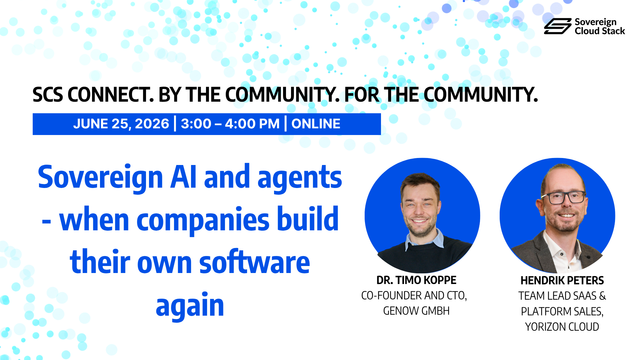
🎙️ SCS Connect: Souveräne AI und Agents, wenn Unternehmen ihre Software wieder selber bauen
Dank Low-Code und AI-gestützter Entwicklung bauen Firmen ihre Kernanwendungen wieder selbst. Die Herausforderung steckt im Fundament: Backend, Daten und eine verlässliche AI-Schicht.
Dr. Timo Koppe (genow) und Hendrik Peters (Yorizon Cloud) zeigen, wie das mit Sovereign Cloud Stack zusammenkommt.
📅 25. Juni 2026, 15 bis 16 Uhr, online.
👉 https://sovereigncloudstack.org/event/scs-connect-souveraene-ai-und-agents-wenn-unternehmen-ihre-software-wieder-selber-bauen/
#SovereignCloudStack #SovereignAI #OpenSource
Don't you like how "tab closed" firefox notification an android prevents you from closing the latest tab?

Or how "insert from clipboard" overlay covers "switch to private tab" button despite quite a lot of free space a bit lower?

How is stuff like this even possible??? 

Important heads-up to FOSS maintainers by Daniel from curl:

"Any project that has not scanned their source code with AI powered tooling will likely find huge number of flaws, bugs and possible vulnerabilities with this new generation of tools."

Since I'm working for Alpha-Omega currently, please reach out to me if you could use some support regarding this. We're setting up various programs to help FOSS maintainers in the times of "high-quality chaos".

https://daniel.haxx.se/blog/2026/05/11/mythos-finds-a-curl-vulnerability/

Mythos finds a curl vulnerability

yes, as in singular one. Back in April 2026 Anthropic caused a lot of media noise when they concluded that their new AI model Mythos is dangerously good at finding security flaws in source code. Apparently Mythos was so good at this that Anthropic would not release this model to the public yet but instead … Continue reading Mythos finds a curl vulnerability →

daniel.haxx.se

Final Call ⏰

Jetzt noch schnell registrieren und an allen Sessions des 21. Deutschen IT-Sicherheitskongresses teilnehmen. 🚀

👉 kostenlose Anmeldung über unsere Website: https://www.bsi.bund.de/IT-Sicherheitskongress

#Cybersecurity #BSIKongress2026 #CybernationDeutschland #designoffices

Cloud-Dienste informiert auswählen, statt nur auf deren Sicherheit zu vertrauen – mit dem C5:2026 veröffentlichen wir die nächste Generation unseres Kriterienkatalogs für sichere Cloud-Dienste.

Der C5 übersetzt komplexe Sicherheitsanforderungen an zukunftsfähige Cloud-Dienste in prüfbare Kriterien. Für Organisationen bedeutet das u.a. belastbare Informationen für das Risikomanagement und marktübergreifende Transparenz & Orientierung bei der Auswahl von Cloud-Anbietern.

https://www.bsi.bund.de/dok/1196008

Ab Dezember 2027 stärkt der CRA mit einheitlichen und verbindlichen Sicherheitsanforderungen an Produkte mit digitalen Elementen die Cybersicherheit in der EU. 💪 Hersteller sind in der Pflicht, über den gesamten Supportzeitraum dieser Produkte deren Cybersicherheit zu garantieren. Mit unserer TR-03183 und dem IT-Sicherheitskennzeichen bieten wir Herstellern praktische Hilfen: https://www.bsi.bund.de/dok/1125620

🚀 Kleiner Beschluss mit großer Wirkung: Der Deutschland-Stack übernimmt Open-Source-Standards für Cloud-Dienste!

🔎 Der Deutschland-Stack setzt auf interoperable, transparente und anbieterneutrale Standards – und nutzt dafür u.a. die Standards des Sovereign Cloud Stacks (@SCS).

💬 „Das macht es für die Verwaltung deutlich einfacher, zwischen verschiedenen Anbietern zu wechseln“ so @fkr.

Hier findet Ihr alle Hintergründe ➡️ https://osb-alliance.de/pressemitteilungen/verwaltung-kuenftig-mit-transparenten-standards-fuer-cloud-dienste

#OpenSource #DeutschlandStack