Institute for AI

@UniStuttgartAI@bawü.social
87 Followers
31 Following
50 Posts
The aim of the Institute for Artificial Intelligence at the University of Stuttgart (@Uni_Stuttgart) is to research fundamental questions about AI, to reflect on the benefits for society, and to promote the transfer of AI applications to business and society.
Websitehttps://www.ki.uni-stuttgart.de
Wikidatahttps://www.wikidata.org/wiki/Q131785081
Blueskyhttps://bsky.app/profile/unistuttgartai.bsky.social
LinkedInhttps://www.linkedin.com/company/institute-for-artificial-intelligence-at-university-of-stuttgart/about/

We are hiring! The Institute for Artificial Intelligence at the University of Stuttgart (@Uni_Stuttgart) is looking for a PostDoc to work on Foundation Models for Knowledge Graphs.

The position focuses on automating the management of data and knowledge by combining machine learning, logics, and natural language understanding. You will define new projects, mentor students, and contribute to real-world applications.

Full-time (100% TV-L E13), 2 years. Application deadline: April 16, 2026.

Apply via careers.uni-stuttgart.de — details here:
https://www.ki.uni-stuttgart.de/institute/news/PostDoc-working-on-Foundation-Models-for-Knowledge-Graphs-for-2-years-100-TV-L-E13/

#Hiring #PostDoc #KnowledgeGraphs #FoundationModels #AI #NLP #MachineLearning #SemanticWeb #AcademicJobs

PostDoc working on Foundation Models for Knowledge Graphs (for 2 years, 100% TV-L E13) | News | Mar 24, 2026 | Institute for Artificial Intelligence | University of Stuttgart

Per Roboter mittendrin: Telepräsenz in der Wissenschaftskommunikation

<p>Durch Telepräsenzroboter kann Wissenschaftskommunikation inklusiver werden, davon ist Maria Wirzberger überzeugt. Im Interview spricht die Wissenschaftlerin über unausgeschöpfte Potentiale, Zugangshürden und offene Forschungsfragen.</p>

Wissenschaftskommunikation.de
AccessGuru: Leveraging LLMs to Detect and Correct Web Accessibility Violations in HTML code | Video | Institute for Artificial Intelligence | University of Stuttgart

Nadeen Fathallah's talk at the The 27th International ACM SIGACCESS Conference on Computers and Accessibility, which was conducted from October 26 - 29, 2025 at Denver, Colorado, USA Date: 2025-10-26 to 2025-10-29Speaker: Nadeen Fathallah

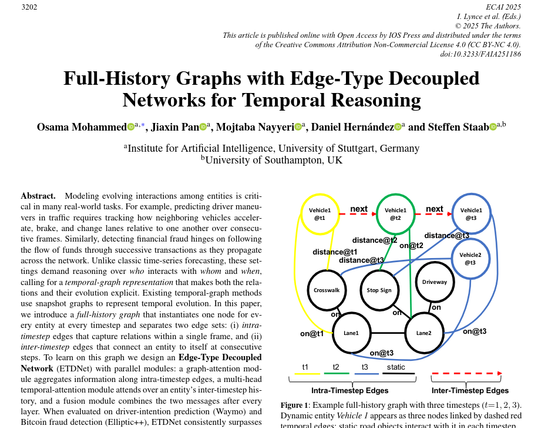
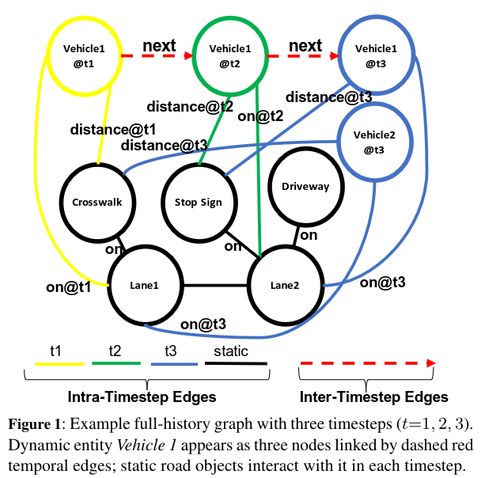
How to represent scenes that change on the time to perform tasks on them? Tomorrow, @osamamohammed will present a paper by the researchers of @UniStuttgartAI, O. Mohammed, J. Pan, M. Nayyeri, me, and S. Staab at the European Conference on Artificial Intelligence, #ECAI2025. This paper shows the benefits of combining all scene snapshots into a single full-history graph to then apply machine learning methods on such a graph structure.

https://doi.org/10.3233/FAIA251186

#AI #MachineLearning

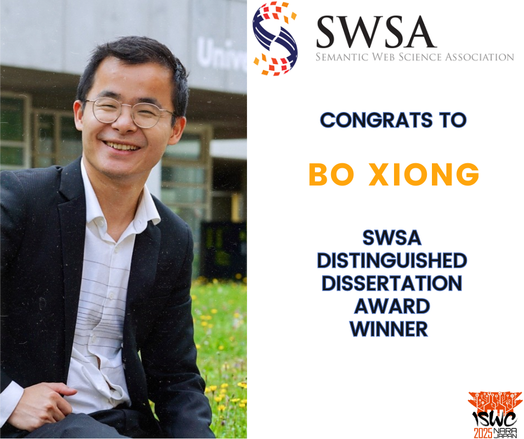
🎓 #SWSA Distinguished Dissertation Award 2025 goes to
Bo Xiong!

Recognized for his brilliant thesis: “Geometric Relational Embeddings” 🧠

👏 Congrats Bo - see you at #ISWC2025 in #Japan!

#DistinguishedDissertationAward #SemanticWeb #KnowledgeGraphs #AI #ResearchExcellence

@anligentile @maribelacosta @K_e_n_F @GenAsefa

🌊 Had an amazing time at NeSy 2025 @nesyconf.org in Santa Cruz! Very well-organized conference, great talks, inspiring discussion and of course enjoying the beautiful beach and Bay Area vibes. 🏖️✨ #NeSy2025 #neurosymbolicAI #SantaCruz

Additions with unique digits: A tale of puzzling and AI

The other day, Markus Krötzsch and I were catching up when one of his kids came in. She told us about a puzzle her math teacher gave her:

How many integer sums are there where the equation uses each digit at most once?

The simplest example is 1+2=3, but 12+47=59 also works. On the other hand, 1+9=10 isn’t a solution because the digit ‘1’ appears twice (in the first number and the sum).

1/19

Advances in temporal graph reasoning to be presented at #ECAI

Researchers from the AI Institute at the University of Stuttgart @Uni_Stuttgart will present a paper tackling key challenges in temporal graph learning. The work, titled “Full-History Graphs with Edge-Type Decoupled Networks for Temporal Reasoning,” will be presented at #ECAI2025, a premier conference in artificial intelligence.

Full-History Graphs with Edge-Type Decoupled Networks for Temporal Reasoning

Temporal graphs are key to understanding dynamic systems—from traffic flow to financial fraud. ETDNet introduces a dual-branch temporal graph neural network that decouples spatial (intra-frame) and temporal (inter-frame) edges.

This design avoids over-smoothing and allows effective long-range reasoning. ETDNet improves driver-intention prediction (75.6% joint accuracy on Waymo) and illicit-transfer detection (88.1% F1 on Elliptic++), while outperforming transformers and memory-bank baselines with fewer parameters and faster training.

O. Mohammed (@osamamohammed), J. Pan, M. Nayyeri, D. Hernández (@daniel), S. Staab. Full-History Graphs with Edge-Type Decoupled Networks for Temporal Reasoning. Proceedings of the 28th European Conference on Artificial Intelligence (ECAI2025). https://arxiv.org/abs/2508.03251

#AI #MachineLearning #TemporalGraphs #TemporalReasoning #ECAI

MultiADS: Defect-aware Supervision for Multi-type Anomaly Detection and Segmentation in Zero-Shot Learning

In manufacturing, quality control remains a critical yet complex task, especially when multiple defect types are involved. MultiADS introduces a system capable of detecting and segmenting a wide range of anomalies (e.g., scratches, bends, holes), even in zero-shot settings.

By combining visual analysis with descriptive textual input and using a curated Knowledge Base for Anomalies, MultiADS generalizes to unseen defect types without requiring prior visual examples and consistently outperforms state-of-the-art models across several benchmarks, offering a robust and scalable solution for industrial inspection tasks.

Sadikaj, Y., Zhou, H., Halilaj, L., Schmid, S., Staab, S., & Plant, C. MultiADS: Defect-aware Supervision for Multi-type Anomaly Detection and Segmentation in Zero-Shot Learning. International Conference on Computer Vision, ICCV 2025, Hawai, Oct 19-23, 2025, #ICCV2025. https://arxiv.org/abs/2504.06740.

#AI #AIResearch #ComputerVision #AnomalyDetection #ZeroShot

MultiADS: Defect-aware Supervision for Multi-type Anomaly Detection and Segmentation in Zero-Shot Learning

Precise optical inspection in industrial applications is crucial for minimizing scrap rates and reducing the associated costs. Besides merely detecting if a product is anomalous or not, it is crucial to know the distinct type of defect, such as a bent, cut, or scratch. The ability to recognize the "exact" defect type enables automated treatments of the anomalies in modern production lines. Current methods are limited to solely detecting whether a product is defective or not without providing any insights on the defect type, nevertheless detecting and identifying multiple defects. We propose MultiADS, a zero-shot learning approach, able to perform Multi-type Anomaly Detection and Segmentation. The architecture of MultiADS comprises CLIP and extra linear layers to align the visual- and textual representation in a joint feature space. To the best of our knowledge, our proposal, is the first approach to perform a multi-type anomaly segmentation task in zero-shot learning. Contrary to the other baselines, our approach i) generates specific anomaly masks for each distinct defect type, ii) learns to distinguish defect types, and iii) simultaneously identifies multiple defect types present in an anomalous product. Additionally, our approach outperforms zero/few-shot learning SoTA methods on image-level and pixel-level anomaly detection and segmentation tasks on five commonly used datasets: MVTec-AD, Visa, MPDD, MAD and Real-IAD.

arXiv.org

Making the Web More Inclusive: Enter AccessGuru

Despite the availability of accessibility guidelines like #WCAG, most websites still present barriers for users with disabilities. This paper introduces AccessGuru, a system that leverages Large Language Models (#LLMs) to automatically detect and correct accessibility violations in HTML code.

AccessGuru is guided by a novel taxonomy of syntactic, semantic, and layout violations and combines rule-based tools with LLM reasoning over code and visuals.

It reduces violation scores by up to 84%, outperforming existing tools, and achieves 73% similarity to human-generated semantic corrections. A benchmark dataset of 3,500 real-world violations is also released to support future research.

This work demonstrates how LLMs can meaningfully automate accessibility efforts and foster a more inclusive Web.

Fathallah, N. (@nadeenfathallah), Hernández, D. (@daniel), & Staab, S. (2025). AccessGuru: Leveraging LLMs to detect and correct web accessibility violations in HTML code. The 27th International ACM SIGACCESS Conference on Computers and Accessibility #ASSETS2025. http://arxiv.org/abs/2507.19549.

#AI #AIResearch #LLMs #Accessibility #HTML #PromptEngineering

AccessGuru: Leveraging LLMs to Detect and Correct Web Accessibility Violations in HTML Code

The vast majority of Web pages fail to comply with established Web accessibility guidelines, excluding a range of users with diverse abilities from interacting with their content. Making Web pages accessible to all users requires dedicated expertise and additional manual efforts from Web page providers. To lower their efforts and promote inclusiveness, we aim to automatically detect and correct Web accessibility violations in HTML code. While previous work has made progress in detecting certain types of accessibility violations, the problem of automatically detecting and correcting accessibility violations remains an open challenge that we address. We introduce a novel taxonomy classifying Web accessibility violations into three key categories - Syntactic, Semantic, and Layout. This taxonomy provides a structured foundation for developing our detection and correction method and redefining evaluation metrics. We propose a novel method, AccessGuru, which combines existing accessibility testing tools and Large Language Models (LLMs) to detect violations and applies taxonomy-driven prompting strategies to correct all three categories. To evaluate these capabilities, we develop a benchmark of real-world Web accessibility violations. Our benchmark quantifies syntactic and layout compliance and judges semantic accuracy through comparative analysis with human expert corrections. Evaluation against our benchmark shows that AccessGuru achieves up to 84% average violation score decrease, significantly outperforming prior methods that achieve at most 50%.

arXiv.org