Institute for AI

@UniStuttgartAI@bawü.social
87 Followers
31 Following
50 Posts
The aim of the Institute for Artificial Intelligence at the University of Stuttgart (@Uni_Stuttgart) is to research fundamental questions about AI, to reflect on the benefits for society, and to promote the transfer of AI applications to business and society.
Websitehttps://www.ki.uni-stuttgart.de
Wikidatahttps://www.wikidata.org/wiki/Q131785081
Blueskyhttps://bsky.app/profile/unistuttgartai.bsky.social
LinkedInhttps://www.linkedin.com/company/institute-for-artificial-intelligence-at-university-of-stuttgart/about/

Advances in temporal graph reasoning to be presented at #ECAI

Researchers from the AI Institute at the University of Stuttgart @Uni_Stuttgart will present a paper tackling key challenges in temporal graph learning. The work, titled “Full-History Graphs with Edge-Type Decoupled Networks for Temporal Reasoning,” will be presented at #ECAI2025, a premier conference in artificial intelligence.

Full-History Graphs with Edge-Type Decoupled Networks for Temporal Reasoning

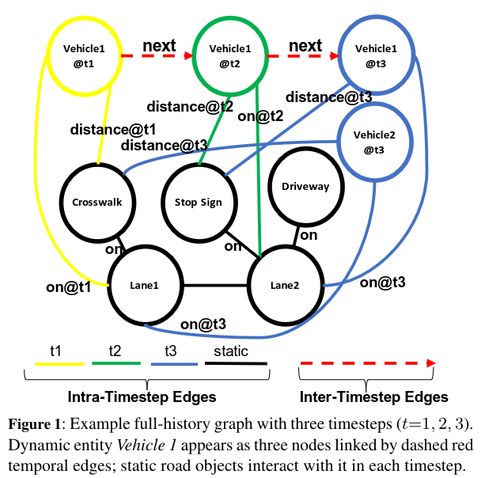
Temporal graphs are key to understanding dynamic systems—from traffic flow to financial fraud. ETDNet introduces a dual-branch temporal graph neural network that decouples spatial (intra-frame) and temporal (inter-frame) edges.

This design avoids over-smoothing and allows effective long-range reasoning. ETDNet improves driver-intention prediction (75.6% joint accuracy on Waymo) and illicit-transfer detection (88.1% F1 on Elliptic++), while outperforming transformers and memory-bank baselines with fewer parameters and faster training.

O. Mohammed (@osamamohammed), J. Pan, M. Nayyeri, D. Hernández (@daniel), S. Staab. Full-History Graphs with Edge-Type Decoupled Networks for Temporal Reasoning. Proceedings of the 28th European Conference on Artificial Intelligence (ECAI2025). https://arxiv.org/abs/2508.03251

#AI #MachineLearning #TemporalGraphs #TemporalReasoning #ECAI
🎉 Researchers from our AI institute at the University of Stuttgart @Uni_Stuttgart will present two papers tackling real-world challenges with AI:

- "Making the Web More Inclusive: Enter AccessGuru" (#ASSETS2025).

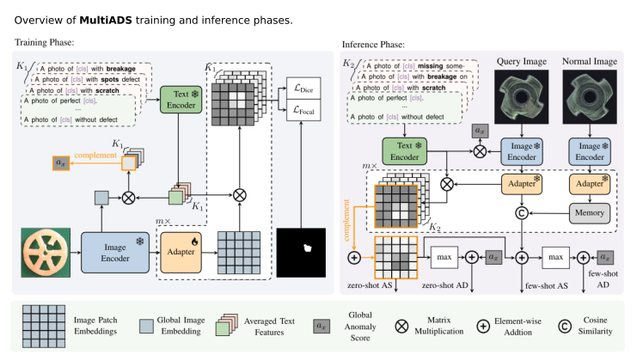
- "MultiADS: Defect-aware Supervision for Multi-type Anomaly Detection and Segmentation in Zero-Shot Learning" (#ICCV2025).

https://www.ki.uni-stuttgart.de/institute/news/Two-Papers-Addressing-Real-World-Problems-Through-AI-to-be-presented-at-ICCV-and-ASSETS/

#AI #AIResearch

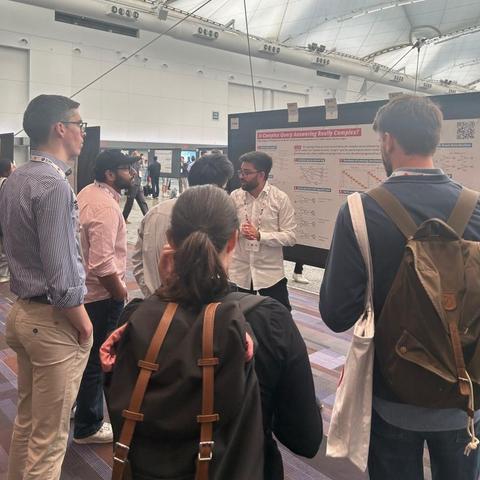
Is complex query answering really complex? A paper at the International Conference on Machine Learning (#ICML2025) presented by Cosimo Gregucci, PhD student at @UniStuttgartAI @Uni_Stuttgart, discussed this question.

In this paper, Cosimo Gregucci, Bo Xiong, Daniel Hernández (@daniel), Lorenzo Loconte, Pasquale Minervini (@pminervini), Steffen Staab, and Antonio Vergari (@nolovedeeplearning) reveal that the “good” performance of SoTA approaches predominantly comes from answers that can be boiled down to single link prediction. Current neural and hybrid solvers can exploit (different) forms of triple memorization to make complex queries much easier. The authors confirm this by reporting the performance of these methods in a stratified analysis and by proposing a hybrid solver, CQD-Hybrid, which, while being a simple extension of an old method like CQD, can be very competitive against other SoTA models.

The paper proposed a way to make query answering benchmarks more challenging in order to advance science.

https://arxiv.org/abs/2410.12537

#KnowledgeGraphs #QueryAnswering #ArtificialIntelligence #MachineLearning #Benchmarking #CQA

@royaheeee @daniel @yuqichengzhu.bsky.social

Here are some pictures of the conference #WWW2025.

How easy is to persuade a large language model?

The Interchange Forum for Reflecting on
Intelligent Systems (IRIS @Stuttgart_IRIS @Uni_Stuttgart) invites all interested students and university staff to their next IRIS colloquium on March 26 at 2 PM in the room UN 302.101, where Mara Seyfert will talk about uncertainty and robustness against persuasion in large language models.

#LargeLanguageModels #AI #GPT #GPT4 #RobustnessAgainstPersuasion #AIResearch #MachineLearning #LLMs #ArtificialIntelligence #TechTalk #RobustAI #DataScience #AIethics #Innovation

Controlling a computer with your head or foot: Semanux, a spin-off from the Analytic Computing department of the Artificial Intelligence Institute of the University of Stuttgart (@Uni_Stuttgart), has taken a major step forward by becoming part of the Alfa Group of companies from Karlsruhe. This move strengthens Semanux’s ability to develop groundbreaking solutions for hands-free computer control, making digital accessibility more intuitive and inclusive.

https://www.ki.uni-stuttgart.de/institute/news/Semanux-Joins-Alfa-Group/

https://www.beschaeftigte.uni-stuttgart.de/en/news/Accessible-computer-operation-Further-success-for-spin-off-from-the-University-of-Stuttgart/

https://semanux.com/en/blog/2024-11-28-semanux-becomes-part-of-the-alfa-corporate-group

Semanux Joins Alfa Group | News | Feb 21, 2025 | Institute for Artificial Intelligence | University of Stuttgart

Unsupervised Model Monitoring through Explanation Shift - Transactions on Machine Learning Research (TMLR) paper introduces a novel instrument of explanation distributions.

The benefits of machine-learned models only apply if the training and the test data come from the same distributions. In many application scenarios, distribution shifts outdate the learned models—often surprisingly quickly. Model monitoring is required not to build your application on wrong assumptions. In the best world, up-to-date validation data would allow for fully informed model monitoring. In realistic scenarios, such up-to-date validation data is frequently missing, requiring methods for unsupervised model monitoring.

Established unsupervised model monitoring approaches check for shifts of input data or predicted outcomes, but both lead to too many false positives and negatives.

Attribution approaches (e.g., Shapley Values) evaluate how a learned model picks up or ignores features of an input data record. An explanation distribution, thus, represents how a learned model handles data. The core novelty of our approach is to introduce this notion of explanation distribution and check for shifts of explanation distributions from training to test data, i.e., monitor a potential explanation shift.

Check out the paper: Carlos Mougan, Klaus Broelemann, Gjergji Kasneci, Thanassis Tiropanis, Steffen Staab. Explanation Shift: How Did the Distribution Shift Impact the Model? In Transactions on Machine Learning Research, 2025. https://openreview.net/forum?id=MO1slfU9xy

Also on https://www.ki.uni-stuttgart.de/institute/news/Unsupervised-Model-Monitoring-through-Explanation-Shift/

Explanation Shift: How Did the Distribution Shift Impact the Model?

The performance of machine learning models on new data is critical for their success in real-world applications. Current methods to detect shifts in the input or output data distributions have...

OpenReview

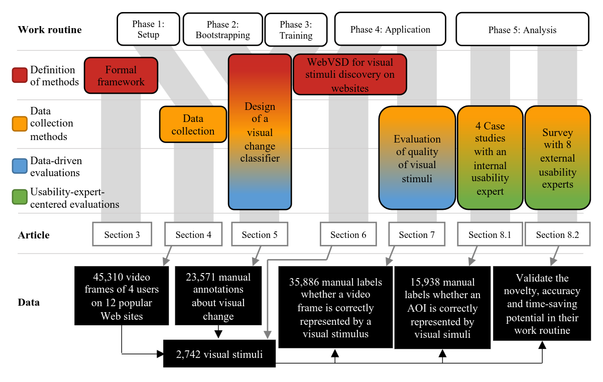
I know what you did on my user interface! No, we have not invented a new method to spy on you. Rather, we suggest a novel paradigm that helps usability experts understand in which situations users interacting with a rich Website progress smoothly and in which they don't. The key to understanding users' problems is summarizing comparable situations that various users encounter at different points of their website journey.

Because of the complexity of modern Web GUIs, this requires the analyses of videos recording user interactions on websites. Our novel approach to discovering visual stimuli employs machine learning to judge the similarity between recorded situations. Our paper, accepted on ACM Transaction on the Web accepted our paper about a novel paradigm for studying Website users, evaluates several case studies to demonstrate the effectiveness of our proposed method. It also surveys usability experts who confirm the usefulness of our suggested approach.

The paper results from a long-running collaboration between (i) Steffen Staab from Analytic Computing, (ii) Raphael Menges from Semanux GmbH, a spin-off from Analytic Computing, (iii) Christoph Schäfer and Tina Walber from EyeVido GmbH, a spin-off from Staab’s former research group at University of Koblenz and now a part of Tobii AB, the leading manufacturer of remote eye trackers, and (iv) Chandan Kumar, a team lead at Fraunhofer IAO, and previously a postdoc at Analytic Computing.

Read more: https://www.ki.uni-stuttgart.de/institute/news/I-know-what-you-did-on-my-user-interface/

The paper: https://doi.org/10.1145/3715881

I know what you did on my user interface!! | News | Feb 6, 2025 | Institute for Artificial Intelligence | University of Stuttgart

ACM Transaction on the Web accepted our paper about a novel paradigm for studying Website users

Machine learning turns volunteers’ lower-quality #OpenStreetMap data into quality indicators for official, authoritative data. Novel method and case studies accepted for publication in ACM Transactions on Spatial Algorithms and Systems (#TSAS).

Fighting fires, containing floods, or police missions, these and other situations require the availability of high-quality map data. Authoritative data exhibits such high quality at entry time, but expert geographers update it only every few years by scanning the whole environment, leading to many stale and misrepresented geographical regions. Volunteered map data, such as open street maps, contains many mistakes, as it is not captured by experts. However, volunteers are often very motivated to refresh map data quickly. We suggest to combine the best of both worlds and exploit machine learning to point experts to regions that need attention of data curation.

Insitute website: https://www.ki.uni-stuttgart.de/institute/news/Machine-learning-turns-volunteers-lower-quality-open-street-map-data-into-quality-indicators-for-official-authoritative-data./

Paper: https://dl.acm.org/doi/10.1145/3715910

Machine learning turns volunteers’ lower-quality open street map data into quality indicators for official, authoritative data. | News | Feb 4, 2025 | Institute for Artificial Intelligence | University of Stuttgart

Novel method and case studies accepted for publication in ACM Transactions on Spatial Algorithms and Systems.

A new NAACL paper proposes a principled way to estimate the uncertainty of knowledge graph link predictions.

A knowledge graph is a set of relationships between entities. For example, the relationship "Alice is diagnosed with common cold" relates the entities "Alice" and "common cold" stating a diagnosis. The link prediction task consists of predicting a missing entity in a relationship. For example, the x in "Alice is diagnosed with x" can be filled with "common cold" or "lung cancer."

Existing methods provide a score to every entity so that one can select the first k entities with a higher score. However, they do not provide uncertainty information, are not calibrated, and lack probabilistic information.

In a paper accepted at the 2025 Annual Conference of the Nations of the Americas Chapter of the Association for Computational Linguistics (NAACL 2025), "Conformalized Answer Set Prediction for Knowledge Graph Embedding," Yuquicheng Zhu (@yuqichengzhu.bsky.social), Nico Potyka, Jiarong Pan, Bo Xiong, Yunjie He (@royaheeee), Evgeny Kharlamov, and Steffen Staab, study how many entities we need to guarantee coverage of the actual answer at a pre-defined confidence level (e.g., 90%). The more entities we need, the more uncertain the model is about its predictions.

Read more on https://www.ki.uni-stuttgart.de/institute/news/New-NAACL-paper-proposes-a-principled-way-to-estimate-the-uncertainty-of-knowledge-graph-link-predictions/

New NAACL paper proposes a principled way to estimate the uncertainty of knowledge graph link predictions | News | Jan 29, 2025 | Institute for Artificial Intelligence | University of Stuttgart

Researchers from the Institute for Artificial Intelligence will present their work at the 2025 Annual Conference of the Nations of the Americas Chapter of the Association for Computational Linguistics in Albuquerque, New Mexico, April 29–May 4, 2025.