
Kou Murayama

@KouMurayama
743 Followers
159 Following
74 Posts
Psychology, education science, cognitive neuroscience, statistical methods. Key words: #Motivation, #curiosity, #rewards, #metacognition, #memory. Love #rstats. Prof at the University of #Tübingen. Made in Japan. German learner.
Lab websitehttps://motivationsciencelab.com/
ORCIDhttps://orcid.org/0000-0003-2902-9600
Google Scholarhttps://scholar.google.com/citations?user=r0AJphIAAAAJ&hl=en

RT @JPubEcon
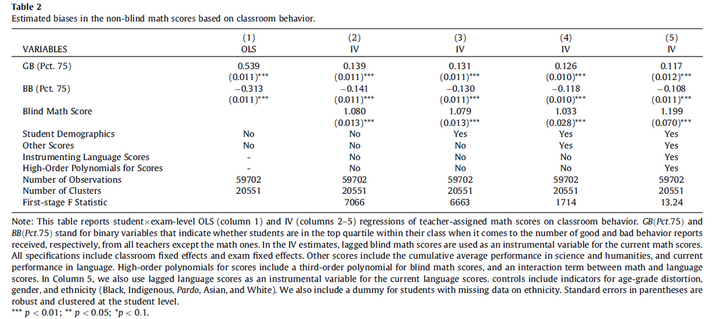
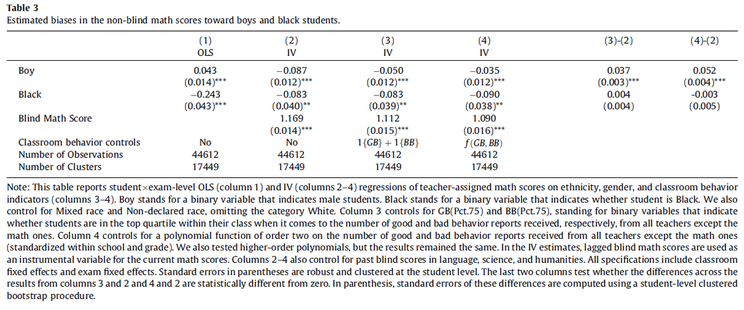
Teachers take classroom behavior into account when grading achievement exams.

This is an inefficient way of assessing students’ knowledge, explains part of grading discrimination against boys, and reveals a causal effect of noncognitive skills that is unrelated to proficiency.
The question is essentially whether to control total study time or not. The puzzle is that total study time is a consequence of math/history study times, so controlling for it should produce post-selection bias, but I would be tempted to call the latter a causal effect as well.

🤔 Which is causally correct?

RQ: Studying math influences history grade?

A: Increasing math study time by 1 hr has no influence on history grade.

B. Wait, if you study math more, you lose time to study history. So causal effect is negative.

#causalinference

Junior Research Group Leader (100%, E 14 TV-L1) or Postdoctoral Research Fellow (100%, E 13 TV-L1) | Universität Tübingen

This is really a nice paper for behavioral scientisits on the critical discussion of interpretable machine learning. Very easy to follow. One concrete take --- many feature importance metric represent marginal, rather than partial effects.

https://psyarxiv.com/xe83y/

By Mirka Henninger, Rudolf Debelak, Yannick Rothacher, & Carolin Strobl

#ML #psychology #AI #edutooter

So Mastodon seems to have great #neuroscience discussions but I still don't see active discussion on #psychology, #education or #researchmethods. I suspect I don't use #mastodon in an appropriate way. Any advice?

The German word "hören" means "to hear". But it has funny relatives:

anhören = to listen
zuhören = to listen (a bit more active than anhören)
umhören = to ask around
abhören = to wiretap, to auscultate
überhören = to not hear
erhören = to hear and react to (eg. a plea or a prayer)
gehören = to belong to
angehören = to be a member of
satthören = to get enough of hearing

Should I rather aufhören*? OK.

Enjoy our language!

___________________________

*aufhören = to stop

#TheGermanWord

#Causalinference meets #measurementmodels. Must read by VanderWeele. All measures are formative, all measures are reflective, but both are fallacy.

https://journals.lww.com/epidem/Fulltext/2022/01000/Constructed_Measures_and_Causal_Inference__Towards.17.aspx?context=FeaturedArticles&collectionId=1

He claimed the importance of examining item-specific causal effects. Sorry for the self-promotion, but this is indeed what we also recently argue for ...

https://psyarxiv.com/s6erz/

Please use our 'Naturalistic Neuroimaging Database' (NNDb v2). It consists of N=86 people who did a battery of behavioural tests and watched one of 10 full-length #movies during #fMRI. It has 46,249,600,000 voxels or 6.69 days worth of data to play with. 🥳

Data: https://openneuro.org/datasets/ds002837/versions/2.0.0

It is also available on Neuroscout: https://neuroscout.org

Read the paper: https://www.nature.com/articles/s41597-020-00680-2

We are now collecting a 3T NNDb with adolescents and adults, and before/after #psychedelics.

OpenNeuro

How does cognition change through life? In this paper, they had children and adults to do a correlated spatial bandit task. They modeled the task with a UCB-GP (upper confidence bound heuristic on top of gaussian process inference of the reward). They were able to explain and track the change in hyperparameters throughout life, and showed that finding the right set of hyperparameters corresponds to a type of meta-learning, which they modeled through stochastic optimization. Lots of great ideas in here. https://psyarxiv.com/9f4k3/