Has everyone moved over to Threads?
KatieGagnon
- 33 Followers
- 37 Following
- 48 Posts
Taphophile, vampire hunter, archaeology/forensics/funeral history/medical history/history nerd, natural burial advocate, oddities collector, all around weirdo extraordinaire living with hounds. As seen on TV.
New book: Vampire's Grasp: The Hidden History of Consumption in New England, the long awaited followup to Food for the Dead: On the Trail of New England Vampires. And there I am in the acknowledgements, with the absolute best company! There's a bit of an update on the Griswold Vampire case I've been working on for years.
#vampire #vampires #newengland #newenglandvampirepanic #history #histadon #weirdhistory #quackmedicine #medhistory #folklore
#vampire #vampires #newengland #newenglandvampirepanic #history #histadon #weirdhistory #quackmedicine #medhistory #folklore


My favorite vampire, JB55!
Evaluating the Usefulness of Human DNA Quantification to Predict DNA Profiling Success of Historical Bone Samples
#dna #history #genealogy #vampire #science
Genes | Free Full-Text | Evaluating the Usefulness of Human DNA Quantification to Predict DNA Profiling Success of Historical Bone Samples https://www.mdpi.com/2073-4425/14/5/994

Evaluating the Usefulness of Human DNA Quantification to Predict DNA Profiling Success of Historical Bone Samples
This study assessed the usefulness of DNA quantification to predict the success of historical samples when analyzing SNPs, mtDNA, and STR targets. Thirty burials from six historical contexts were utilized, ranging in age from 80 to 800 years postmortem. Samples underwent library preparation and hybridization capture with two bait panels (FORCE and mitogenome), and STR typing (autosomal STR and Y-STR). All 30 samples generated small (~80 bp) autosomal DNA target qPCR results, despite mean mappable fragments ranging from 55–125 bp. The qPCR results were positively correlated with DNA profiling success. Samples with human DNA inputs as low as 100 pg resulted in ≥80% FORCE SNPs at 10X coverage. All 30 samples resulted in mitogenome coverage ≥100X despite low human DNA input (as low as 1 pg). With PowerPlex Fusion, ≥30 pg human DNA input resulted in >40% of auSTR loci. At least 59% of Y-STR loci were recovered with Y-target qPCR-based inputs of ≥24 pg. The results also indicate that human DNA quantity is a better predictor of success than the ratio of human to exogenous DNA. Accurate quantification with qPCR is feasible for historical bone samples, allowing for the screening of extracts to predict the success of DNA profiling.
Prohibition era prescription for whiskey, 1931
Prescriptions for alcohol during prohibition had to be written on Rx slips/pads issued by the US Treasury Department's Bureau of Industrial Alcohol
#history #medhistory #weirdhistory #quackmedicine
Prescriptions for alcohol during prohibition had to be written on Rx slips/pads issued by the US Treasury Department's Bureau of Industrial Alcohol
#history #medhistory #weirdhistory #quackmedicine

George Tiemann and Company Button Trigger Spring Lancet, mid 19th century
It was claimed the spring-lancet provided greater precision in nicking a vein so blood could flow steadily from the incision. Bloodletting was basically a general removal of blood from the body according to humoral theory, and the localized draining of blood from an inflamed area. The former was meant to prevent illness, while the latter thought to treat it. #medhistory #history #histadon #quackmedicine
It was claimed the spring-lancet provided greater precision in nicking a vein so blood could flow steadily from the incision. Bloodletting was basically a general removal of blood from the body according to humoral theory, and the localized draining of blood from an inflamed area. The former was meant to prevent illness, while the latter thought to treat it. #medhistory #history #histadon #quackmedicine


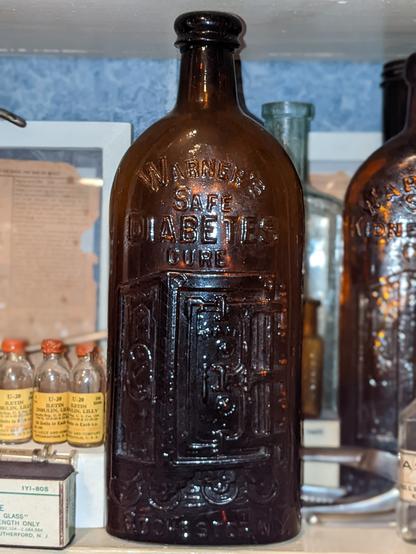
Around 1907 Warner’s Safe Cure Co. was forced to remove the word “Cure” from their bottles and labels along with all patent medicine proprietors. Around 1908 the word “Cure” was changed to “Remedy.” Eventually the company was forced to remove the word “Safe” from bottles and labels and to make the Diabetes Remedy “non-alcoholic.” Initially offered in 1879, this "Diabetes Cure" was about 15% alcohol. #diabetes #diabetesawarenessmonth #worlddiabetesday #medicalhistory #quackmedicine #weirdhistory
Latest from Boston Globe Magazine - "A vampire panic gripped New England in the 1800s"
https://www.bostonglobe.com/2023/10/27/magazine/the-vampire-panic-that-gripped-new-england/
#vampire #newengland #history #weirdhistory #tuberculosis
https://www.bostonglobe.com/2023/10/27/magazine/the-vampire-panic-that-gripped-new-england/
#vampire #newengland #history #weirdhistory #tuberculosis

The land used for #MementoMori #Cemetery in Farmington #CT was donated to the town between 1661 and 1695 by the husband and son of Mary Barnes (d. 1662), the last woman executed for #witchcraft in Connecticut #witch #witchtrials #history #weirdhistory
Memorial at the Windsor, CT town green -
Alse Young, the first person executed for witchcraft in the American colonies. She was hung in Hartford in 1647. Lydia Gilbert was charged with witchcraft in 1654.
#history #newengland #connecticut #witch
Alse Young, the first person executed for witchcraft in the American colonies. She was hung in Hartford in 1647. Lydia Gilbert was charged with witchcraft in 1654.
#history #newengland #connecticut #witch
Perry Davis Vegetable Pain Killer - Formulated in 1839 in RI is believed to be the first nationally advertised remedy specifically for pain rather than a particular disease or ailment. The "vegetable elixir" was marketed globally. The ingredients were mainly opiates, ethyl alcohol, and herbs. "Perry Davis Vegetable Pain-Killer" was a registered trade brand name, there was no legal requirement to make its ingredients public on the bottle.) #medicalhistory #history #quackmedicine #oddities
