
Kate Jeffery

@Katejjeffery
313 Followers
125 Following
37 Posts
Neuroscientist, slowly reverting to my Scottish roots. For my science network, please follow me on @Katejjeffery@ fediscience.org instead
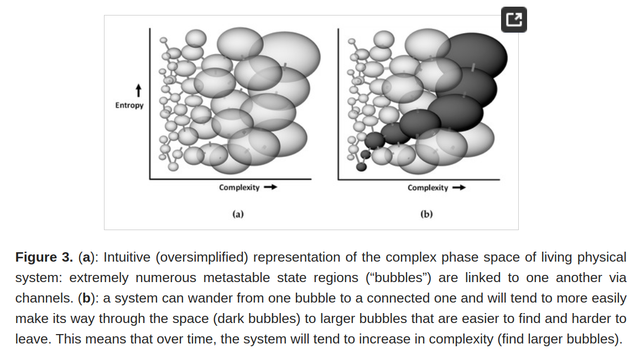
@gershbrain There's an inspiring paper by @Katejjeffery, Pollack and Rovelli 2019 "On the Statistical Mechanics of Life: Schrödinger Revisited" https://www.mdpi.com/1099-4300/21/12/1211 that argues how life, and specifically complex structures, opens up the space of possible variations in the organization of components and therefore more entropy. And that statistically this implies life is entropically favoured.
#entropy #science
On the Statistical Mechanics of Life: Schrödinger Revisited

We study the statistical underpinnings of life, in particular its increase in order and complexity over evolutionary time. We question some common assumptions about the thermodynamics of life. We recall that contrary to widespread belief, even in a closed system entropy growth can accompany an increase in macroscopic order. We view metabolism in living things as microscopic variables directly driven by the second law of thermodynamics, while viewing the macroscopic variables of structure, complexity and homeostasis as mechanisms that are entropically favored because they open channels for entropy to grow via metabolism. This perspective reverses the conventional relation between structure and metabolism, by emphasizing the role of structure for metabolism rather than the converse. Structure extends in time, preserving information along generations, particularly in the genetic code, but also in human culture. We argue that increasing complexity is an inevitable tendency for systems with these dynamics and explain this with the notion of metastable states, which are enclosed regions of the phase-space that we call “bubbles,” and channels between these, which are discovered by random motion of the system. We consider that more complex systems inhabit larger bubbles (have more available states), and also that larger bubbles are more easily entered and less easily exited than small bubbles. The result is that the system entropically wanders into ever-larger bubbles in the foamy phase space, becoming more complex over time. This formulation makes intuitive why the increase in order/complexity over time is often stepwise and sometimes collapses catastrophically, as in biological extinction.

MDPI

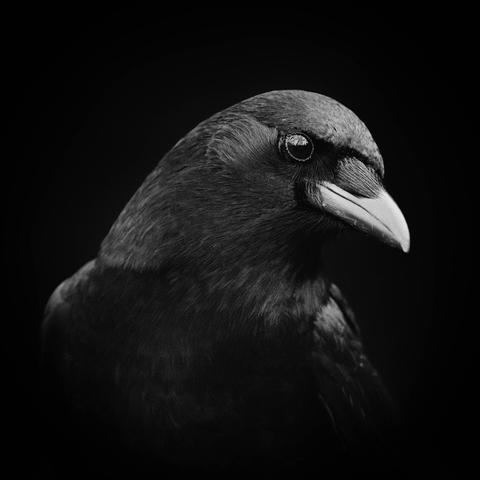
For the holiday, a thread on how to befriend crows.

--

Befriending crows is a wonderful thing.

I have many crow friends at home and at work. They bring joy at unexpected moments and can rescue a miserable day even without shaking down the dust of snow that Robert Frost described.

This thread is an updated version of one I posted at the bird site in July 2019.

#birding #birdwatching #birds #urbanbirding #crows #corvids #crow #corvid #crowfriends
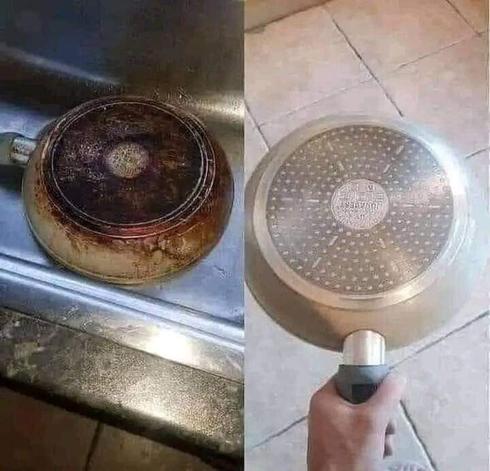
For those wondering, ′′ how did i do it?":
I Boiled 10l of water, added 2 tablespoons of vinegar, 1 teaspoon of sodium bicarbonate, two cups of coke and half cup of lemon juice then stirred well .
Waited 3 minutes, put the pan in the solution for 45 minutes, then added a quarter cup of chlorine bleach to the mixture.
Then I brushed it with a firm toothbrush and put it back into the liquid for another 25 minutes.
I took it out, rinsed it and it looked exactly the same, so I threw it away and went out and bought a new one.
New Zealand's new anti-smoking policies take effect 1/1/23--3 big interventions:
1. illegal to sell combustible tobacco products to ppl born in 2009 or later
2. reducing # of licensed tobacco retailers from 6k currently to 600 maximum
3. lower cigarette nicotine content to below addictive levels.
https://www.sciencemagazinedigital.org/sciencemagazine/library/item/23_december_2022/4068251
#PublicHealth #PopHealth #Policy #Health #Medicine
Science Magazine - The final puff

Smoking kills. Ayesha Verrall has seen it up close. As a young resident physician in New Zealand’s public hospitals in the 2000s, Verrall watched smokers

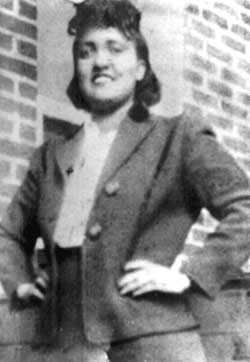
Henrietta Lacks was a poor, Black, young mother diagnosed cervical cancer in 1951. When her cells were collected w/o consent, scientists saw they multiplied fast.

“HeLa” cells changed #science. They’re used globally to study viruses, drugs, hormones, genes, diseases & develop vaccines. Lacks passed away at 31 w no recognition.

Rebecca Skloot’s beautiful book about her life & legacy is changing that. Now her statue will replace Robert E. Lee in VA. https://www.nytimes.com/2022/12/20/us/henrietta-lacks-statue-roanoke-virginia.html?smid=nytcore-ios-share&referringSource=articleShare #history #HistoryRemix

A Statue of Henrietta Lacks Will Replace a Monument to Robert E. Lee

The statue, scheduled to be erected next fall in Roanoke, Va., is part of a local project to recognize Black history in community spaces.

Dear twenty-something app developers with perfect eye-sight: Stop putting tiny light grey on dark grey text. Someday you will understand.

15 countries, 29 coauthors, 1 billion plus observations... Our paper on gender pay gaps is out in Nature Human Behavior.

It shows that gender gap is not just a consequence of sorting in different occupations and workplaces. Even in jobs narrowly defined (4 digit occupation in the same workplace), gender gaps are high and amount to half of the baseline gender gap.

And it comes with a goodie: open access (being 29 helps to cofund it...)
https://www.nature.com/articles/s41562-022-01470-z

Within-job gender pay inequality in 15 countries - Nature Human Behaviour

Using data from 15 countries, Penner et al. find that women earn less than men who are working for the same employer in the same occupation. These results highlight the continued importance of equal pay for equal work.

Nature
Our lab has a new PhD opportunity in collaboration with Olena Riabinina and Melissa Bateson ! If you or someone you know would like to investigate how stress affect bumblebee brains and behaviour please get in touch and apply: https://www.findaphd.com/phds/project/the-effect-of-stress-on-pollinator-behaviour/?p150422
#phdpositions #bee #pollination #animalbehaviour
The effect of stress on pollinator behaviour at Newcastle University on FindAPhD.com

PhD Project - The effect of stress on pollinator behaviour at Newcastle University, listed on FindAPhD.com

www.FindAPhD.com
Here’s a really nice analysis of the collapse of Twitter, by @Pwnallthethings
https://www.pwnallthethings.com/p/twitter-was-special-but-its-time
Twitter was special. But it's time to leave

Tweets were always short-lived. Turns out Twitter was too.

PwnAllTheThings
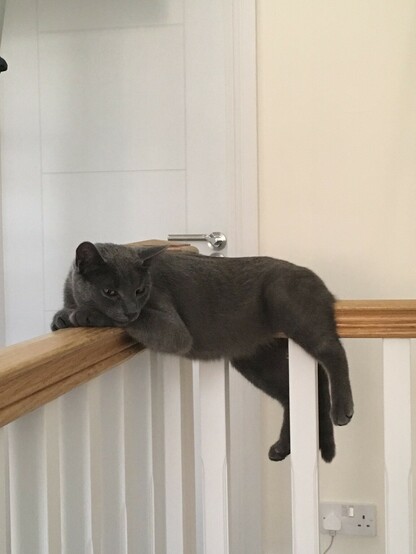
To follow through on my promise of cats here’s Oskar, our Russian Blue. I found this photo in an album I didn’t know my phone had created called “Cats”, which has 431 entries, mostly Oskar in various sleeping poses. Am quite impressed that the AI recognised this one as a cat tbh #cats #catsofmastodon