

Joscha Wullweber

192 Followers
185 Following
120 Posts
Heisenberg-Professor of PolEcon, Transformation and Sustainability, Director of [tra:ce], Univ. Witten/Herdecke. Strong focus on IPE, global finance, central bank politics, money.
Websitehttps://www.uni-wh.de/wullweber
ResearchGatehttps://www.researchgate.net/profile/Joscha_Wullweber
Bookhttps://www.sup.org/books/title/?id=37352&bottom_ref=subject
vegan

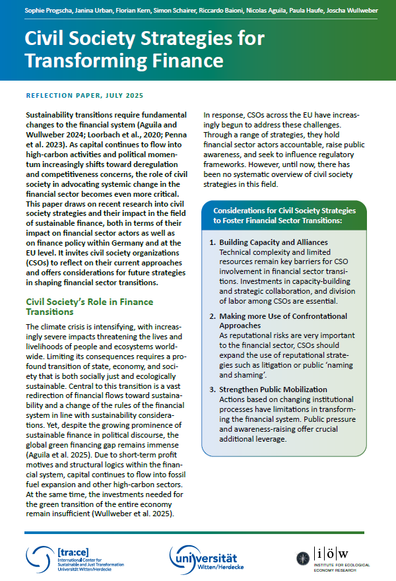
How can civil society help transform the financial system so that it supports a socio-ecological #transformation? 💰️👩‍🔧

A new reflection paper by Sophie Progscha, Janina Urban, Florian Kern, Simon Schairer, Riccardo Baioni, Nicolas Aguila, Paula Haufe and @JWullweber analyses how civil society organizations in the EU are already trying to influence #finance and which strategic gaps remain.

Download “Civil Society Strategies for Transforming Finance” 👉️ https://www.ioew.de/fileadmin/user_upload/BILDER_und_Downloaddateien/Publikationen/2025/Progscha_Civil_Society_Strategies_for_Transforming_Finance.pdf

@bmftr_bund

🤝 Wir haben uns zwei Tage Zeit genommen, um uns am Werbellinsee inhaltlich zu #KI, #SustainableFinance und #Forschungspolitik auszutauschen, unsere Zusammenarbeit zu stärken und zwischendurch in den See zu springen.

🙏 Danke an @JWullweber für den Input zu nachhaltiger #Finanzpolitik!

PS: Sehen wir uns auf unserer Jubiläumstagung #40ioew am 9. Oktober 2025 in Berlin? 👉 https://www.ioew.de/veranstaltung/wandel-am-limit-und-jetzt

Orientierungsrahmen Sek II - Engagement Global

#Climate protection, #environmental health, and social justice: The new german “Education for Sustainable Development” framework shows how global issues can be taught in an interdisciplinary way. Together with other experts, the WBGU Secretariat provided scientific advice for the project.

@bmz @JWullweber

#klimaschutz #Umweltgesundheit und soziale Gerechtigkeit: Der neue Orientierungsrahmen „Bildung für nachhaltige Entwicklung“ zeigt, wie globale Fragen fächerübergreifend unterrichtet werden können. Die Geschäftsstelle des WBGU hat das Projekt rund sechs Jahre lang wissenschaftlich beratend begleitet.

@bmz @JWullweber

Two of our main findings in the #policy #report#Financing the #green #transition
1. The main barrier to financing the necessary activities for the sustainable transition is their lack of bankability.
2. High greenhouse gas-emitting activities remain bankable and thus continue to attract financing. Green investments require de-risking policies and better financing conditions. For GHG-emitting investments, policies should increase risk and decrease returns in order to reduce their bankability

Im neuen Politikpapier „EU-Wasserpolitik im Aufbruch“ empfiehlt der WBGU, die EU-Wasserresilienzstrategie zu ergänzen: Zentral ist klimaresilientes Wassermanagement, das auch im Boden gespeichertes „grünes“ Wasser berücksichtigt. Sinnvoll wäre zudem eine EU-Wasseraußenpolitik.

http://www.wbgu.de/pp14

@JWullweber

In its new policy paper on EU #water policy, the WBGU recommends taking up the EU water resilience strategy and supplementing it. Key is a #Climate-resilientWaterManagement that includes “green” water stored in the soil. An EU foreign policy on water would also be useful.

http://www.wbgu.de/pp14_en

@JWullweber

Opportunities in European water policy: Making the most of the EU Water Resilience Strategy

Europe is suffering from drought and flooding more and more frequently; the situation is also worsening in many places around the world. New strategies to combat the water emergency are therefore urgently needed.

Public launch of our policy report "#Financing the #green #transition: Increasing #bankability, phasing out carbon #investments and funding 'never bankable' activities". Monday 30.6., 11:00 (CET) via Zoom. Comments: Silke Stremlau, Sustainable Finance Advisory Committee https://www.uni-wh.de/en/financing-the-green-transition-increasing-bankability-phasing-out-carbon-investments-and-funding-never-bankable-activities
Policy Report Launch: Financing the Green Transition

Presentation of the policy paper on improving bankability, exiting carbon investments and financing activities that were never bankable.