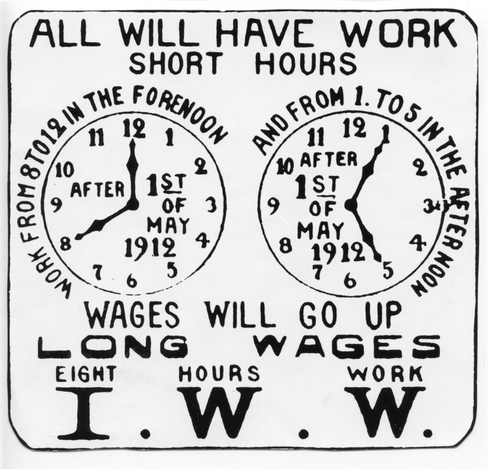
Today in Labor History March 15, 1917: The U.S. Supreme Court approved the 8-hour workday under the threat of a rail strike. Philadelphia carpenters struck for the 10-hour day in 1791 and by the 1830s, it had become a general demand of workers. In 1835, Philadelphia workers organized the first general strike in North America, led by Irish coal heavers, in the struggle for a 10-hour day. However, by 1836, labor movement publications were calling for an 8-hour day. In 1864, the 8-hour day became a central demand of the Chicago labor movement. In 1867, a citywide strike for the 8-hour day shut down the city's economy for a week before falling apart. During the 1870s, eight hours became a central demand of the U.S. labor movement, with a network of 8-Hour Leagues forming across the nation.
In 1872, 100,000 workers in New York City struck and won the eight-hour day. On May 1, 1886 Albert Parsons, head of the Chicago Knights of Labor, led 80,000 people down Michigan Avenue in the first modern May Day Parade, with workers chanting, "Eight-hour day with no cut in pay." Within days, 350,000 workers went on strike nationwide for the 8-hour day. On 3 May 1886, anarchist August Spies, editor of the Arbeiter-Zeitung (Workers Newspaper), spoke to 6,000 workers. Afterwards, they marched to the McCormick plant in Chicago to harass scab workers. The police arrived and opened fire, killing four and wounding many more. On May 4, workers protested this police violence at a meeting in Haymarket Square. An unknown assailant hurled a bomb at the police. The authorities rounded up hundreds of labor activists and anarchists. They convicted 8 in a kangaroo court and executed four of them, including Parsons and Spies.
According to the Bureau of Labor Statistics, the average American currently works 8.8 hours every day. This, of course, does not include commute time which, for many Americans, can add another two or more hours a day to the time they give away for free to their bosses. Nor does it include work we take home. The scam of being a “salaried” employee is commonly exploited by bosses, who argue that we are paid based on the responsibilities completed, regardless of how long it takes to complete them.
Read my full article on Lucy Parsons, which goes deeper into the Haymarket affair and the struggle for the 8-hour day: https://michaeldunnauthor.com/2024/03/24/lucy-parsons/
#workingclass #LaborHistory #anarchism #EightHourDay #SCOTUS #generalstrike #haymarket #police #policebrutality #mayday #deathpenalty #IWW #union

 CaliCarol
 No Palantir In NHS S Yorkshire
 Central Bylines
 Autonomie und Solidarität
 Ⓥ Gregory Trolliet Ⓐ🔻 🇵🇸
 David Castleton (Author)
 Leah McElrath
 Working Class History
 MikeDunnAuthor