
Ayvee
- 0 Followers
- 67 Following
- 79 Posts
Dutch 30-something dyke with Long Covid.
She/ Her
Profile pic is a cartoon rendition of Batman’s Poison Ivy by artist Aimee Major, where she sits in front of a flesh eating plant, thorny vines curling around her.
The header is a photo of the sky at dusk filled with long strips of clouds red from the setting sun.
✌🏻#queer
😴😶🌫️ #LongCovid
 Steve Dustcircle 🌹
 Frieke
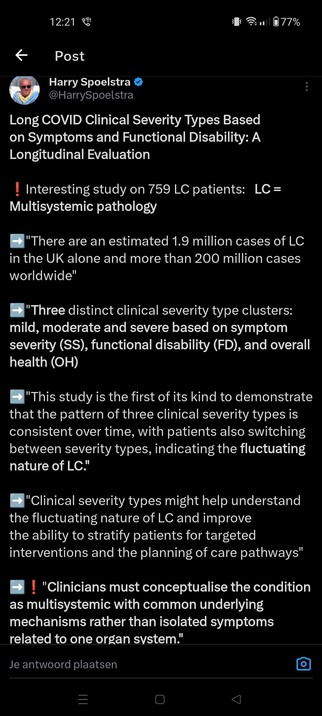
This article is a first for me. Compares mild moderate severe LongCovid. I added the highlights from dr. Harry Spoelstra (follow him for science news with comment on the birdsite)
#LongCovid #PostCovidSyndrom #pasc
@longcovid https://www.mdpi.com/2077-0383/13/7/1908
#LongCovid #PostCovidSyndrom #pasc
@longcovid https://www.mdpi.com/2077-0383/13/7/1908
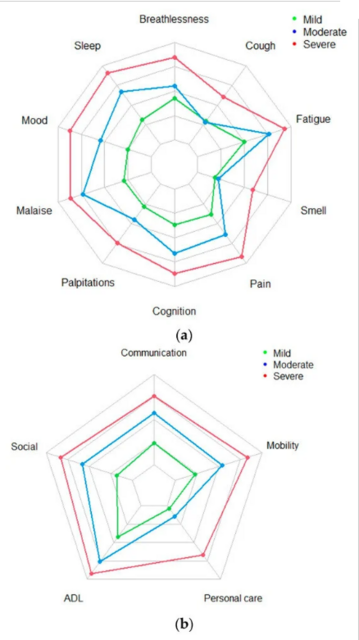

Long COVID Clinical Severity Types Based on Symptoms and Functional Disability: A Longitudinal Evaluation
Background: Long COVID (LC) is a multisystem clinical syndrome with functional disability and compromised overall health. Information on LC clinical severity types is emerging in cross-sectional studies. This study explored the pattern and consistency of long COVID (LC) clinical severity types over time in a prospective sample. Methods: Participants with LC completed the condition-specific outcome measure C19-YRSm (Yorkshire Rehabilitation Scale modified version) at two assessment time points. A cluster analysis for clinical severity types was undertaken at both time points using the k-means partition method. Results: The study included cross-sectional data for 759 patients with a mean age of 46.8 years (SD = 12.7), 69.4% females, and a duration of symptoms of 360 days (IQR 217 to 703 days). The cluster analysis at first assessment revealed three distinct clinical severity type clusters: mild (n = 96), moderate (n = 422), and severe (n = 241). Longitudinal data on 356 patients revealed that the pattern of three clinical severity types remained consistent over time between the two assessments, with 51% of patients switching clinical severity types between the assessments. Conclusions: This study is the first of its kind to demonstrate that the pattern of three clinical severity types is consistent over time, with patients also switching between severity types, indicating the fluctuating nature of LC.
 Dr. Lucky Tran
Another advocacy win! After pushback from disability and Long COVID advocates, the Census Bureau halted survey changes that would artificially reduce disability numbers by 40%, and limit access to resources for housing, schools, program benefits etc.

Census Bureau pauses changing how it asks about disabilities following backlash
Facing growing backlash, the U.S. Census Bureau has paused plans to change how it asks people about disabilities in its most comprehensive survey. The move would have overhauled how disabilities are defined by the nation’s largest statistical agency. Census Bureau Director Robert Santos said Tuesday that the bureau plans to meet with advocates in the disability community and determine what changes to the questions are needed to better capture the range of disabilities. He says the bureau also will keep the current questions about disabilities on the 2025 American Community Survey. Disability advocates had complained the changes would artificially reduce their numbers.
Only 2 chapters in but wanted to share. What a wonderfully written, touching and validating book. #ChronicallyIll #disabled #LongCovid
 DoNoHarm BC
From our friends at @protect_bc - the first local billboard for #LongCOVID is live in New Westminster, BC 🙌
If policy makers aren’t warning British Columbians of the long-term, severe outcomes of Covid infection and reinfection, PoP BC and allies will.
Why pay for a Long Covid billboard? Find out at http://protectbc.ca

Home - Protect Our Province B.C.
PoP BCHomeWho We AreLive BriefingsArchived BriefingsAnnouncementsNewsPOP BC BlogPoP BC In the NewsOpen LettersPress ReleasesNewslettersTake ActionHomeWho We AreLive BriefingsArchived BriefingsAnnouncementsNewsPOP BC BlogPoP BC In the NewsOpen LettersPress ReleasesNewslettersTake ActionPoP BC:Protect Our ProvincePhysicians, nurses, health scientists, health policy specialists and community advocates working together to advocate for evidence-based health policies in BC.Open Letter to Government“There is no… Continue reading Home
 Zweistein2Stein 📌👇🏻
 Hacker Memes
“There is a reality outside the world, that is to say, outside space and time, outside man's mental universe, outside any sphere whatsoever that is accessible to human faculties.”
- Simone Weil
 NASA
NASADragon Aurora over Iceland https://apod.nasa.gov/apod/ap240114.html #APOD

 Eric Topol
Brain injury, loss of grey matter, and cognitive dysfunction at 1-year in people initially hospitalized compared with controls #LongCovid
https://researchsquare.com/article/rs-3818580/v1 preprint
"cognitive deficits...equivalent in magnitude to 20 years of aging"
Image
https://researchsquare.com/article/rs-3818580/v1 preprint
"cognitive deficits...equivalent in magnitude to 20 years of aging"
Image

Post-COVID cognitive deficits at one year are global and associated with elevated brain injury markers and grey matter volume reduction: national prospective study
The spectrum, pathophysiology, and recovery trajectory of persistent post-COVID-19 cognitive deficits are unknown, limiting our ability to develop prevention and treatment strategies. We report the one-year cognitive, serum biomarker, and neuroimaging findings from a prospective, national long...
 MEActNOW
Fantastic work by RobWust and colleagues showing lower exercise capacity in #LongCovid patients is related to local and systemic metabolic disturbances as well as myopathy, and tissue infiltration of amyloid-containing deposits in skeletal muscles.
