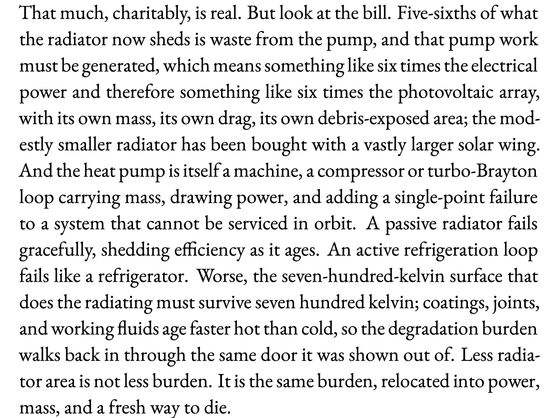

I think this is well worth reading. I've been a bit frustrated by some over-confident claims that data centres in space are literally impossible due to the cooling issues alone, and other claims that those issues are fairly minor. I am nowhere near close to being familiar with all the real-world engineering nitty gritty; I understand a fair bit of thermodynamics, but that is not enough to really settle things. FWIW, the arguments here seem well grounded in physics and the technological/economic/legal issues raised strike me as plausible.

https://robtow.substack.com/p/spacex-ipo-orbital-data-centers-and

SpaceX IPO, Orbital Data Centers, and Three Card Monte: The Cloud Is Not Above the World

Rob Tow · Nova Lux, New Mexico, USA, Sol III · 17 June 2026

Rob Tow

Can we make the radiators much smaller by running them, say, twice as hot, and actively pumping heat from the electronics into these hotter surfaces?

Yes, of course we can, the laws of thermodynamics are fine with that. However ...

@gregeganSF I always feel like the obvious "solution" for radiators for solar-powered things in space is the opposite side of the solar panel. If we assume the solar panel is black, that has to shed 685 W/m2 (since we radiate heat from the front and back faces), equivalent to a temperature of ~330 K, which electronics are perfectly fine running at.

Of course in reality the solar panels will not be perfectly black, neither in shortwave nor in longwave radiation, but the back side should still be able to radiate the solar panel+electronics (and with a modest heat pump, also life support on crewed spacecraft) waste heat without needing too high a temperature.

You still pay the mass penalty for heat pipes of course, but you avoid increasing the area exposed to drag and debris.

@zuthal @gregeganSF that's extra localized complexity in the solar arrays: now you need both a slip-ring for the power and a coaxial swivel connection for the coolant in the same joint. Not saying impossible, but there's engineering considerations to be had. systems like the ISS are able to put the radiators edge-on to the sun so they have minimized insolation heating

@gregeganSF

I had someone on Bluesky tell me they would cool orbital data centers by "bringing in cold air from space". 🤡

@gregeganSF fwiw my take, with a rusty aerospace degree, is that the obvious technical issues ARE surmountable but still immense burdens, making these things obviously much worse than terrestrial data centers.

The only thing that makes sense to me is that these people intend to test the laws around orbital offshoring, which on a surface read would seem to indicate the laws of the launching country would apply, but "so enforce it then" will be the real test.

@gregeganSF debris exposed area is new to me
@gregeganSF Similar reasoning applies to the charging rate of batteries. In that case, too-rapid charging produces unwanted, potentially stable material at the electrodes. Solar cells are a middle ground, as some perform better at high temperatures, up to a limit of course.

@gregeganSF Supposing it's physically possible, what reasons are there to want to? I have yet to see a single one mentioned anywhere.

Downsides are plentiful:
- Cooling is challenging.
- Servicing is impossible.
- Communication is slow.
- Construction is expensive.

What could possibly outweigh all that?

@mansr @gregeganSF Earthbound datacenter equipment mostly isn’t serviced today. The big companies like the ones proposing this nonsense idea build a whole rack of servers and plug it in as a single unit. When some percentage of the whole rack has failed (or after a certain number of years), they unplug the whole rack and throw it away. This is the same philosophy, just with racks which cost hundreds of times as much money to deploy.

It’s a vanity project, and pyramids have already been done. Conspicuous consumption between billionaires, like who has the biggest yacht.

@bob_zim @gregeganSF Even if you don't care about servicing, and if you solve the cooling, there's no way around the high latency for communication.

@mansr @gregeganSF The cooling is a matter of compute density. In space, you need ~2 orders of magnitude more mass devoted to cooling than you need in an atmosphere. The satellites can only have so much mass before we can’t get them into space, so they can only have a relatively small amount of compute power.

Also no way to solve the deployment cost short of building a factory on the moon or something equally absurd.

@gregeganSF
Scott Manley throws some back of the envelope maths at it with numbers derived from existing space hardware here: https://youtu.be/FlQYU3m1e80
Is It Really Impossible To Cool A Datacenter In Space?

YouTube
SpaceX IPO, Orbital Data Centers, and Three Card Monte: The Cloud Is Not Above the World — Rob Tow

@gregeganSF

Agree, it's a good read — a much needed dose of healthy skepticism.

@gregeganSF The pitch for datacenters in space (such as it is) is stock-market mummery. With xAI, SpaceX, and Starlink all being the same company now, the idea is that putting datacenters for xAI (which isn’t profitable but has the aura of future profitability because AI) in space will guarantee business for the launch-platform part of SpaceX (which is profitable). It’s a human-caterpillar circle jerk.

@gregeganSF some interesting points there, but three things stood out to me about his cost calculations:
- He assumes launch costs of $1500/kg, the same as today; this basically assumes Starship completely fails to achieve its goals. He justifies this by talking about how much effort was required to refurbish the Shuttle between flights; but Starship has been designed from the ground up to avoid the Shuttle's problems (complex engines that had to be stripped down, every tile having a unique shape, boosters landing in salt water).
- He assumes each satellite must be deorbited once it's no longer at the hardware frontier. I see no reason it can't be demoted to less demanding uses, as we do on Earth.
- He assumes that satellite construction costs stay the same. I'd expect at least some cost reduction from building a million of the things!

All of these are defensible as conservative planning assumptions, but he presents them as realistic.

@gregeganSF that's a helluva essay greg, thank you