I think this is well worth reading. I've been a bit frustrated by some over-confident claims that data centres in space are literally impossible due to the cooling issues alone, and other claims that those issues are fairly minor. I am nowhere near close to being familiar with all the real-world engineering nitty gritty; I understand a fair bit of thermodynamics, but that is not enough to really settle things. FWIW, the arguments here seem well grounded in physics and the technological/economic/legal issues raised strike me as plausible.

https://robtow.substack.com/p/spacex-ipo-orbital-data-centers-and

SpaceX IPO, Orbital Data Centers, and Three Card Monte: The Cloud Is Not Above the World

Rob Tow · Nova Lux, New Mexico, USA, Sol III · 17 June 2026

Rob Tow

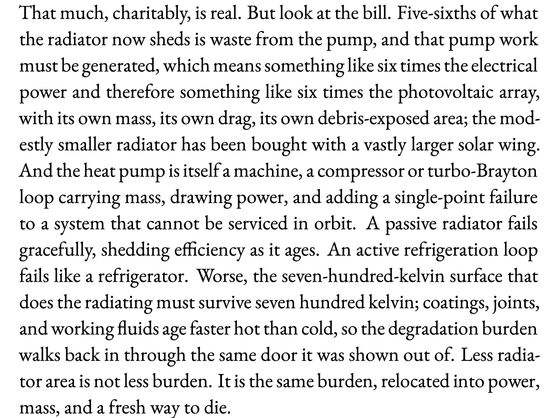
Can we make the radiators much smaller by running them, say, twice as hot, and actively pumping heat from the electronics into these hotter surfaces?

Yes, of course we can, the laws of thermodynamics are fine with that. However ...

@gregeganSF I always feel like the obvious "solution" for radiators for solar-powered things in space is the opposite side of the solar panel. If we assume the solar panel is black, that has to shed 685 W/m2 (since we radiate heat from the front and back faces), equivalent to a temperature of ~330 K, which electronics are perfectly fine running at.

Of course in reality the solar panels will not be perfectly black, neither in shortwave nor in longwave radiation, but the back side should still be able to radiate the solar panel+electronics (and with a modest heat pump, also life support on crewed spacecraft) waste heat without needing too high a temperature.

You still pay the mass penalty for heat pipes of course, but you avoid increasing the area exposed to drag and debris.

@zuthal @gregeganSF that's extra localized complexity in the solar arrays: now you need both a slip-ring for the power and a coaxial swivel connection for the coolant in the same joint. Not saying impossible, but there's engineering considerations to be had. systems like the ISS are able to put the radiators edge-on to the sun so they have minimized insolation heating