 chaz
chaz Thomas Fuchs
Meanwhile, 55 years ago
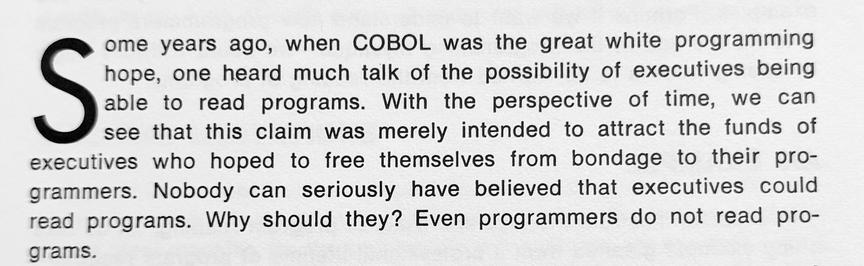
I highly recommend reading this book, it’s extremely relevant today—notably it doesn’t matter what your stance is on “AI”.
Programming is an inherently human and social activity; it doesn’t matter if you’re a solo programmer, working with a team or using chatbots, or a combination of all of this.
@grimalkina Awesome! Thanks for doing that work because wow that sounds exhausting to read older texts like that critically.
And thank you @thomasfuchs for sharing the interesting “now reading” bit. It’s great stuff and important that folks are discussing the topic more. ✨💖✨
TY for the recc. :D
@thomasfuchs an underappreciated gem, right up there with Fred Brooks' The Mythical Man Month in my estimation.
(As you point out, the book is unavoidably a reflection of the culture of its time.)

AI prompts are the latest generation in "do what I mean" programming languages.
Usually such languages sacrifice precision of expression for "common sense" understanding, and then expect the compiler (chatbot) to inject the common sense.
Sadly, I have learned there is no such thing as "common sense". The common sense of the lawyer is quite different from that of the machinist. There is only "domain knowledge". Which requires that the programmer shares this at least somewhat with the client -- or in a pinch, willing to learn it.
History has not been kind to the ambition of automating this part.
The fact that I can read and decipher cobol, plus the fact that menopause has provided neck hair, ie proto neckbeard, y’all…I may have become a Tech Final Boss. 🤣🥳😂🤷🏻♀️💃🏻
@MissConstrue @thomasfuchs @blogdiva
Ok, but...
If you're a Tech Final Boss *and* a painter, then you are required by law to program in Piet.
@weekend_editor @thomasfuchs @blogdiva
Wow, that’s wild!
@MissConstrue @thomasfuchs @blogdiva
It actually works, too.
(For some value of 'works' which does not include cognitive effort on your part.)
hell, most executives don't even read reports or emails, much less lots of code.
“Read programs” 😂🤣
As if a program is a short story, or even a novel that goes simply from A to B: often even War and Peace is simple and straightforward by comparison.
I imagine instead a sprawling 100 volume choose your own adventure in which a surprisingly large number of paths make all the pages turn blank and return you to the beginning and there are a few obscure paths that might caught the books themselves to spontaneously combust.
... and if you can prove that the programs' stories always end, you can be granted global fame as computing's greatest wizard. 😊
 🇵🇸 Amanda
 Cat Hicks
 Kirch
Kirch Billy Smith
 J. R. DePriest

 :EA DATA. SF: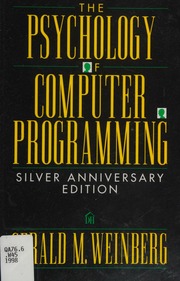
 Amin Girasol
 Angie
Angie Maciej Sypien
 Timothy Wolodzko
 Simon newslttrs.com
 Flipper 🐬🏳️🌈
 thief_of_fire
 Space Catitude 🚀
 Pxl Phile
 EndlessMason
 MissConstrue
 Weekend Editor
 Rupert V/
 Paul_IPv6
 Lars Brinkhoff
 DavidM_yeg
 Tall Simon
 Dakki Reads