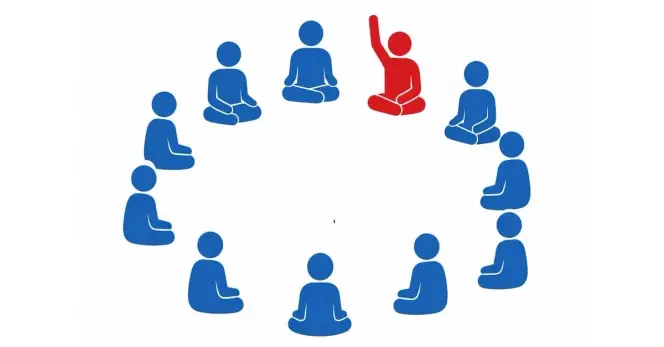
Why has autism persisted across all human populations, across cultures, and most likely across centuries?

A hypothesis: not individual advantage, but group survival.

https://dev.to/raphink/why-autism-hasnt-disappeared-a-hypothesis-1b6g

#autism #autismAwareness #ActuallyAutistic #Neurodiversity

@autistics

Why autism hasn't disappeared — a hypothesis

Why has autism persisted across all human populations, across cultures, across centuries? A hypothesis: not because of individual advantage, but because groups that contained the profile were more robust against a failure mode the majority profile generates in itself.

DEV Community
@avuko what's your take --considering the exchange we had recently on cognition as a survival skill.

@raphink Thanks for asking!

It matches what I can see in myself and others, although I think we have to be careful to describe autism as playing a role in prehistoric hierarchical groups.

Not because autism didn't play a role since the beginning, but simply because for most of our time here on earth, humans were likely not living in hierarchies, or at least not in ones we'd recognise as such. 1

But still, those who see more, feel more, experience more, and think more certainly had a function and role. Where what we now call ADHD* seems to me to be the people who work to truly see people and weave the group together, and where ASD* type personalities seem to me more the people who truly see the world.

There is another interesting phenomenon with autism (I personally include the full spectrum). People have what the literature apparently calls "Positive Assortative Mating" for adults with ASD. 2 That is to say: we find each other, and then we make babies, and then there are even more of us!

All in all is doesn't function like a disorder or a deficit, but more like a genetic benefit. Makes sense that benefit would also be for the tribe.

Maybe to counter group-think, but in my experience, we add so much more than that besides.

1 See Dr. Heide Göttner-Abendroth’s work.

2 https://pmc.ncbi.nlm.nih.gov/articles/PMC4927579/pdf/fnins-10-00300.pdf

Other work I'm (currently) basing my thinking on:
Checking your browser - reCAPTCHA

@avuko Thanks for the feedback. Did you also see the diagram in the previous post on survival instinct vs empathy?

@raphink just now. I’m gonna take some time to chew on it.

I’m more and more convinced combining our stories with the stories from people towards the ADHD side of the spectrum (which I’m not) could help us understand how we all fit together as people living, together for more than 300.000 years.

@raphink @autistics

I really like the thinking here. And the "which system fires first" concept intuitively feels bang on to me.

@raphink @autistics I've always thought of it as a bit like heterozygous advantage in sickle cell disease.

A lot of autism genes gives a major selective disadvantage but having a few may end up giving a slight advantage (the net effect of a number of positives and negatives) and thereby maintains those genes within the population.

@Psychonaut @autistics Right, but you're talking about individual selection here. My hypothesis is at the group-level: that a group might be better fit as a whole with autistics in it.

@raphink @autistics

I arrived at the same conclusion a long time ago. I describe it as two loci of power in a tribal society--the chief and the medicine person. The chief ruled through charm and violence, and the usually nonbinary medicine person would mostly stay silent. But when the chief was about to lemming the tribe over a cliff, the nonbinary person would voice an objection, and be listened to. Not out of persuasion and not out of fear, but because the medicine person was telling you something you really needed to hear if you wanted to go on living.

@raphink @autistics
There is little doubt, that given the high rates of underdiagnoses in autism and adhd, that the percentage of population of those of us with them is far higher than is currently thought. Personally I wouldn't be surprised if combined it wasn't in the 10-15% or even higher ballpark. Such a stable over time and large percentage of a population has to have come from an evolutionary advantage. At some point survival was determined by our existence and in fact this may have even led to our genetic traits being exaggerated and stabilised.
There are, if you think about it, many roles within pre-industrial societies that seem almost made for us. Solitary hunter/gathers, scouts, night guards, shamans and, in the time before the written word, the tribe's memory. Not to mention the role you pointed out.
There could also have been many times, such as during periods of scarcity, or environment instability, where the benefit of our presence could have been the difference between group survival and loss.
The fun thing, of course, is that just because it gave an advantage at one point doesn't mean that it still does. Nature as a little bit like a hoarder. It doesnt like throwing away anything that could be of an advantage. Hence the number of redundant systems and organs that are still within the human body.
@pathfinder @autistics Agreed on most of your points. There's definitely not enough of a selective push against autism to make it disappear of society at this point ;-)
@pathfinder @raphink @autistics In before half the genetic "risk variants" for ADHD and/or ASD are found to be ancient ancestral ones.
@pathfinder @raphink @autistics Douglas Brackmann and Randy Kelley in "Driven" argue that ADHD-like traits form a "Driven"-type personality which was (and still is) essential in human societies, in small percentages (10% or so). This personality is both a blessing and a curse and is still useful in modern society (think entrepreneurs), although most people of this type will eventually need to manage their mental health.
@raphink @autistics I think autism marks an evolutionary leap forward for humanity.
@arrrg @raphink @autistics
.
except it’s always been here, per this sort of conversation.
.
it’s not happy news but I think the truth is allism is an evolutionary leap towards . . . bad things
@raphink @autistics
.
just a tangent - folllowing orders from one guy is “groupthink?”
.
there are always this sort of reversal with this vector, even the root words for Autism and Allism look backwards in many contexts - like yours.
.
Here, the “Aut” serves the group while the “allo,” serve themselves, right? 😜

@punishmenthurts @autistics Following orders is not groupthink per se, but it can be a symptom of it. Examples are always wrong to some degree, any illustration is a limited compression of an idea, and so my example is just that: a one point picture of a possible systemic failure.

Yes, the aut/all inversion is playful, but it's telling that NT have historically pictured autistics as lacking empathy pathologically. My previous post aimed to present double empathy in a fairer way (https://dev.to/raphink/two-survival-systems-two-empathy-modes-5nl).

Two survival systems, two empathy modes

The double empathy problem, made concrete: not a deficit on one side, but two coherent systems that are mutually opaque to each other.

DEV Community
@raphink @autistics
.
oh yeah.
.
You’re doing pretty well trying to show both types and the traps in the DEP, and I say often, that’s really difficult. Nice work. 👍
@punishmenthurts @autistics Thanks. Did the diagram speak to you?
@raphink @autistics
.
it’s not bad. I tend to globalize, and I fancy I’ve reduced the equation a little more yet.
.
I don’t think we start from threat, I think there’s just better or worse ideas?
.
and I think Allistics are simply pathologically hyper social. Also new, I think they’re about as old as their history and civilization.
.
😬😇

@punishmenthurts @autistics There can definitely be better and worse ideas, contextually.

The premise of starting from threat is that the root of autism has been established to be neurological, not psychological. So this information-seeking behaviour is pre-conscious --and the associated anxiety physiological.

@raphink @autistics
.
alright, I get that.
@raphink @autistics
.
Yeah, I’m good with that. I see my objection is . . . off scale, out of context.
.
But back to my context, LOL - it’s been on my mind that I’m no good in a fight, in a survival situation, that everything I think is designed for a society that is already surviving or something, that I am designed for a human world not constantly engaged in bloody survival.
.
That their orientation that way is the cause of their situation, not a prophylaxis, not a solution. 💜
.
separate conversation, separate causal stream to a degree.