RE: https://hachyderm.io/@mitchellh/116580433508108130

Hearing the feelings in this rant, which does touch a nerve, I can’t help think about how different the developer community reaction to the LLM push might be if the focus were on quality instead of efficiency.

1/

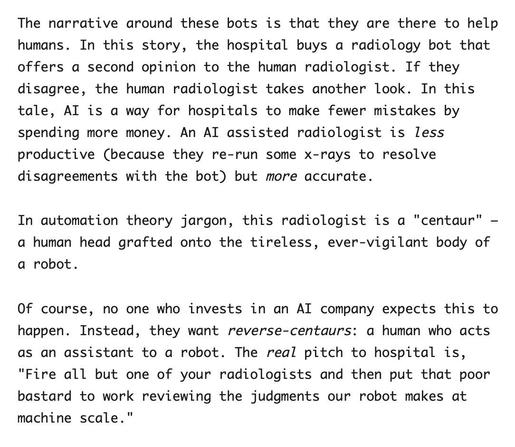
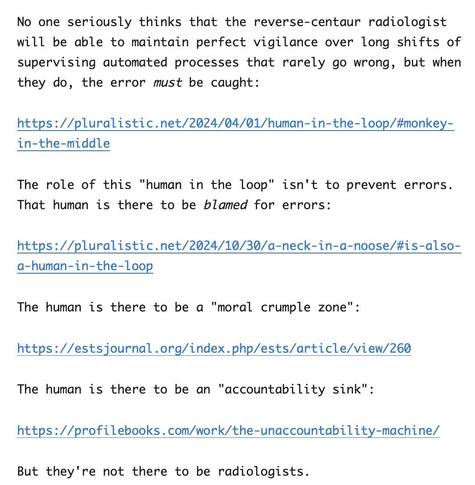
There’s a classic thought experiment about quality vs efficiency for machine learning in medical diagnosis. I can’t remember where I first heard it, but @pluralistic laid it out in a blog post:

https://pluralistic.net/2025/03/18/asbestos-in-the-walls/

2/

Consider those two different versions of the radiologist’s role: one as a valued human augmented by a machine, doing a job they believe in better than they’ve ever done it — and the other as a cog in a corporate process whose job is to perpetually deal with the machine’s mistakes.

Consider the parallels in software development. All vibe coding and “agentic” stuff points to the second: developers as slop wranglers, as accountability sinks, as exhausted and expendable workers on a code assembly line.

3/

I can image a developer parallel to the first, too: the human still using all their skills and experience, but with the machine catching mistakes, providing context and validation and vigilance that is •orthogonal to• testing and type checking and code crafting and — the big one! — actually •thinking• about the problem.

That’s a regime I imagine developers would feel a lot better about. And I know there are people out there pursuing it! But they’re not the ones dominating the conversation.

4/

The trouble is, as Doctorow points out, that this vision makes AI a multi-billion dollar industry, not a multi-trillion dollar industry.

Even if you can claim that your ML / LLM thinger can reduce software bug rates or failure rates by 10x — which would be •wild• — demand for that is simply not going to fund data centers the size of Manhattan.

But make the claim of •speeding up• by 10x — an even wilder claim, but one some people are desperate to believe! — and all the money in the world will beat a path to your door.

5/

This is, if I understand it correctly, the same contrast that the OP’s distinction between MTBF and MTTR points to:

MTBF = quality (It rarely breaks)

MTTR = efficiency (It breaks all the time but we recover so fast!)

6/

I can’t think of another time when software devs had to be •forced• en masse to use a new technology that was supposed to help them. Usually we’re kind of stupid for the shiny new things: jamming them in when they solve nothing, doing unnecessary rewrites just to use the new hotness because it’s so cool and fun. Usually we’re the one trying to shove it down mgmt’s throat (or sneak it by them) rather than the reverse.

But not this time.

7/

Why? The common explanation is that software devs are worried about job security and don’t want to be replaced. And…maybe? But again: past technologies promising greatly improved dev speed we’ve embraced headlong with no regard to large-scale employment effects.

I wonder if this quality vs efficiency thing upthread isn’t a big part of the explanation here.

8/

The “efficiency” pitch I’m describing upthread isn’t really “go faster;” it feels more like “making good things doesn’t matter, what you cared all along about doesn’t really matter, and we don’t think •you• matter.

We always just wanted to built absolute shit, and you always tried to stop us. But now at long last we can.”

9/

I’m kind of speculating here. I get off the LLM coding bus at several earlier stops:

⁃ The energy and water usage are an environmental disaster (so I mostly avoid it for the same reasons I try to reduce my driving).

⁃ The data sourcing is an ethical disaster (so I prefer to avoid it for the same reasons I try to buy fair trade products).

⁃ The people who profit from it at the top are largely horrible (so I’m about as interesting in debating its pros and cons at length as am I debating the work capacity of a Cybertruck).

10/

But that’s me; I don’t think my ethical concerns are shared widely enough for companies to have to be ramming AI down developers’ throats the way they are. The token quotas etc are a symptom of something large and deep.

Maybe that post about MTBF vs MTTR helps explain it.

/end

@inthehands This, but applied to translation, is why en masse translators are not grabbing at LLMs either. They produce something almost, but not entirely, quite unlike an actual translation. They can't remember context, they don't do consistency even inside a single sentence, let alone an entire article, their "suggestions" pollute the human brain the instant you see them so you can no longer imagine how you'd have approached that sentence... And the bias inherent in their corpuses is horrific.

I could go on and on, but I'm so tired of the whole thing, and particularly of being the canary in the coal mine for an entire world still blithely going "well it's fine for translation" when we've been dead on the floor of the cage for YEARS at this point.

@janeishly @inthehands good quality translators I know have moved on to other work in stead of following the race to the bottom on the payment/word rate that all intermediaries use.
@wiert @janeishly @inthehands Have lost their work as a result of agencies insistence on llms (personal experience).

@wiert @janeishly @inthehands I used to be a professional translator with two university degrees in the field. I quit my 15-year translation career a few years ago because idiots think "AI" translations are good enough and just need a low-cost pass by a "translator".

I saw quality drop considerably across the board, and can guarantee you: this is going to get people hurt and killed. A bad translation in a TV manual is annoying. A bad translation in medicine (my speciality at the time) or complex machinery docs can be deadly.

People are going to find out the hard way.

@thomholwerda
I refuse to believe that anyone who's actually used google translate before can seriously believe that it can replace human translation.

@fish4203 @thomholwerda

The thing is, if you don't speak the language that you're translating into (which most users don't), then you don't really know that the translation was bad until it bites you in the ass.

For a lot of things, it does *just work™*. It's the problem with all AI-- you can't trust it without already having enough expertise to verify it, and if you have that expertise it is usually faster to do it yourself from scratch rather than using AI output as a starting point.

@thomholwerda @janeishly @inthehands for sure. Seen similar thing in historic fields. Shared history is going be different in different languages.

@thomholwerda @wiert @janeishly @inthehands

And the anglos who gets most of their stuff in the original language don't care at all about how scuffed all the translations are, they haven't for a decade, which is why I have had to set so much stuff with english as the main language, because the translations into my native tongue are so incomprehensible that I have to use a foreign language to actually understand what was meant.

@wiert @inthehands Yeah, but some of us sadly live in places or are of an age that mean there isn't any other work available. I'd be perfectly qualified and able to be an editor/proofreader/copywriter too, but...
@janeishly @inthehands I get that and it saddens me the market went this way..
@janeishly @inthehands Also, as in many other contexts, proven technology already exists to *assist* translators.
@annehargreaves This really bugs me (and makes me infinitely sad), because we *had* good automation tools, concordance tools, terminology tools – a whole bunch of tools that were actually useful and made human translators faster, more consistent and so on, without compromising their own inherent style or flattening the voice of the text. And now, instead, we have shit. @janeishly @inthehands
@herzleid @janeishly @inthehands Yep. Gutted. Gutted to have lost my work after so long.
@annehargreaves  💔
It's so bleak. I'm still clinging on like a fool, but Q1 this year was a disaster so I've had to start looking for other avenues for income as well.

@janeishly @mayintoronto @inthehands sadly, the Canadian civil service *has* grabbed on to AI translation, and translators have, it seems, become AI babysitters and editors.

I find it infinitely sad, because both English and French are beautiful, and yet very unalike sometimes. They flow differently, have different idioms amd metaphors. #sigh

And I feel bad for the displaced, skilled translators who loved their work. But maybe that's just me, grieving the work I loved.
#iLoveMyJob #lifeCoach

@deborahh In principle, translating government documents between English and French ought to be the thing LLMs do best. I mean, the first thing they ingested was bilingual Canadian government web sites. If they can’t do that…
@Virginicus well, there's theory and then there's what I hear from my government translator acquaintance. Apparently, theory isn't enough.
@inthehands my husband reminds me that companies don't give away anything for Free. There is always the cost, our cognitive abilities. And if it is free, a gift, do we trust the hands giving it to us? I trust musk/Thiel/altman/etc to destroy humanity, so no, I don't want this gift. Or this free extention. Or to outsource my intelligence. It's not free if it's stealing water and land rights.

@inthehands It seems most people just don't want to think about these things at all? I have close friends — lovely, caring people, who just don't want to discuss these topics. They'll use Uber, AirBnB and a whole host of LLMs because they're so convenient, and any mention of ethics gets a "yeah, I know" and then they continue buying tiny bottles of tap water to drink.

I want to somehow shake them awake without losing them as friends, and I have no idea how. Show them it doesn't have to be this way, when there are alternatives.

The em-dash in this toot was put there entirely by human hands.

@inthehands that's a very well put thread, thank you for it.

@inthehands To briefly interact with this, while devs usually do go after something shiny, it is usually the shiny things propped up by major tech corporations that make it through without much resistance - See react, express, angular, etc.

The current state of tech has a serious evangelism problem. I think most people have seen "tech evangelism" in the wild in some form prior but now I feel it reached a new level with the current marketing and push of LLMs, the inherent trust the tech corportions got for free from many of them, the way they focused on management figures to promote it instead of people who would actively scrutinise this.

Given the state where selling software solutions was becoming difficult for many and all the major corporations ensuring that everyone had to race to the bottom or devalue software as much as possible to then ensure that no one competes, it isn't exactly surprising that they wanted to turn the industry into a casino where they benefit from the licensing of the pokies and all the devs have to play the game.

Combine this with an economy that has been cooked by these people, developer distrust andtrust from other organisations only being placed in large tech corporations (or those tech corps will lobby it because they have the means to do so).

Developers who are concerned just don't really have any ability to resist internally or have the bandwidth to do so unless there are financial punishment to organisations that lean into this rubbish (which... there will be but likely for most of them, they will go bankrupt before it is too late).

There is also an asynchronous game as well, if you received slop and have to handle it, you have been given the difficult work that is also not valued and it is now at such a large volume.

@inthehands Might be fruitful to question the assumption that companies are mandating the tools in response to practitioners' resistance to them. Mandates might just be the instinctive tactic of profit-obsessed managers / leaders regardless, and this has just been an opportunity to indulge in them. Mandates express the same impositionist attitude that LLM tech does, the attitude that results in the disasters that you mention drove you away from that tech.
@inthehands There's also an issue of the *nature of the work* that the slopbot push is aiming at -
No programmer I have ever met cites *reviewing generated code* as the best part of their job. Some like reviewing code written by a *human they can talk to about it*, but reviewing *generated code*, like checking if your compiler is outputting correct assembly? That shit sucks - and if the technofash eugenicists get their wish with this, *that* is your job as a software engineer now; even if you>

@inthehands don't care about any of the other problems with this tech, even if you don't care about quality - if it does what the most flammable 5% or so of the population says it does, your job goes from "finding solutions to problems" to "reading and reviewing generated code for 8 hours a day until you retire or die"

The slopbots take away the part of the job that is actually *rewarding* and *feels worth doing*.

@inthehands As I commented in a day job email, the issue is that these things are "externalities" that aren't inputs many people in the chain care about.

Those are people that you don't get to have the conversation that the US EPA was created to deal with similar "externalities" for their own industries..

@inthehands Metrics would be a huge help in the discussions of any software technology or discussion. From the metrics aspect, Capers Jones has finally disappointed me; he's been cheerleading for AI without supporting data. I'm not sure if he is just blindly optimistic for the future of AI or just overestimating the LLMs ability to enhance reuse. To be fair, he says it's not there yet, but his message encourages the wasteful data center building.