 Dan Fixes Coin-Ops
I got 8 solar panels today, gonna go back for the others tomorrow.
The panels were in the woods.
Just, like, big piles of them in the woods. Full of rain and leaves and twigs and creatures.
I mean I guess it makes sense and I don't know what I expected, these machines are weatherproof, they're meant to live outside.
Dude wasn't there when I turned up so I got the car ready and had a look around and got my meter on some wires and yup, they work. These mossy dirty sleeping machines in the woods are silently pushing electrons trying to find something to push them through, not asleep after all, just waiting.
I've never handled a solar panel meant for roof mounting before, only those like little portable camping jobs
These things aren't light and I've got stairs in front of my house, had to carry them up balanced on my head
Ready for a little sit down now
Solar update: still waiting for the battery to get here so there's no physical update, but here's minor emotional/noticing update.
1. People (who I know IRL in America and have talked to) generally don't think about kilowatt-hours. When folk look at their electric bill they think of nothing if they're rich and dollars if they're normal and kWh only comes onto the radar if they're having solarpunk thoughts. Nobody knows how much a particular appliance or device uses, people think that a server rack pulls more current than a kettle, this is an entirely normal way to live, the world is full of things and nobody has the spare brain cycles to notice this sort of thing until it comes up. I only notice it because It Came Up. So, a caution to those who might do this, It Will Come Up and then your brain will be filled with It whether you want it or not
2. Having solar panels lying around not hooked into anything is a special sort of liminal airport waiting purgatory because you go ALL THOSE LOVELY PHOTONS ARE JUST HITTING THE DAMN GROUND, look at that smug grass
I never mentioned how cheap these panels were. They're 240 watts each, 36V, from 2011 - more modern panels you can get twice the watts in the same space, and that's why this bloke had upgraded and was selling these ones for fifty bucks each cash. $45 to me 'cause I was cheeky enough to ask for a bulk discount.
19 cents a watt is hard to beat.
They still put out over 30v each even in woodsy-light where I checked them. Now that might drop like a rock the moment I get a load across them, they're 15 years old so some of their watts have probably run away by now, but even if these end up being like 25c a watt that's still pretty damn good
I did look into newer panels, you can get them for a great price but you've typically gotta buy ten at a time and shipping would be like $400
A solar array below 1kW doesn't need a permit where I'm at. That's a good thing because I now have Anxiety about how exactly I'm gonna mount these things.
My grasping raccoon hands are dexterous and crafty but there's always a period during any new project where I don't know WTF I'm doing - this period passes as I gradually figure out what exactly TF I'm doing, but it can be very hard to remember that the IDK phase is temporary
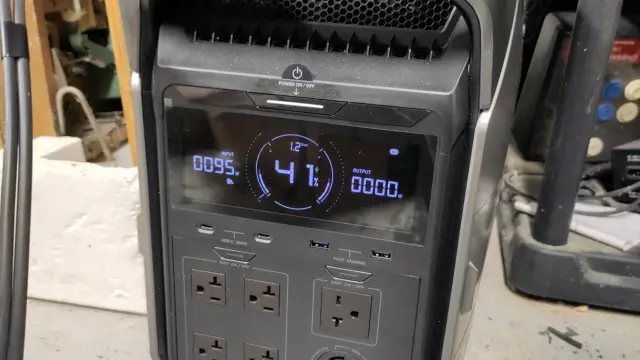
OK time for an update, so I've got an Ecoflow Delta Pro 3 in my basement, it is HUGE and HEAVY and obviously pictures and videos don't properly convey the mass and presence of this thing. I happened to be outside and saw the fedex guy coming and he was very very glad of that.
It's 50kg of battery in a pretty small space, very dense and not very conducive to positioning your body in a way that makes 50kg easy, but if you have two guys then it's all fine and you can have the fore guy use other hand for opening doors etc. Once it's out of the box it's got wheels on the back and a loooooongly-extensible handle on the front that lets you get good leverage, but it's still a put-the-cats-upstairs kinda situation. Moving it around to mates during big-storm-aftermath will probably be a two-man job because although moving it is OK, lifting it into and out of a vehicle is gonna be a back-tweaker and this thing's all plastic on the outside, it can't take a drop of any distance at all under its own weight.
~~~ SOLAR UPDATE ~~~
1. I don't enjoy drilling through brick. I also don't enjoy that there isn't, like, an Incredibly Standard Box That Literally Everybody Uses that goes on the outside of your house and takes standard MC4 solar connectors. Like, there's these things they call GLANDS that are supposed to go on RV's and some people put on their houses, or you can penetrate the wall with a standard L-shaped wire conduit guy, or you can just leave a window open and stuff a wire through it, but there isn't a Definitive MC4-outside-to-inside solution that everyone agrees on, so for the time being I'm using a gland. Which will work, but feels... inelegant. I don't like ambiguity, which leads me to:
2. These panels use Tyco Solarlok connectors, which are obsolete and also wired up backwards to how you'd expect because of reasons. So to get these lads to go into normal MC4 connectors, I've gotta either cut off some original plugs and crimp new ones on (not a fan of that) or find some new Tyco connectors and use them to make up an adapter harness (not a fan of that either because electrically-speaking, more connectors = more troubles, but this seems the better option overall).
I am glad that I figured out that these panels were from the "IDK LOL" era of connectors and polarity because honestly I thought there was something wrong with my brain
Like "Alright this still doesn't make sense so let's map the whole thing out, so the female plastic has male metal and vice versa and people could be talking about the plastic or the metal when they say male or female, plugs marked positive containing sockets hook into sockets marked negative containing pins so there's potential for me to get confused there as well, hole flow is opposite to electron flow, what the hell do I have my leads backwards in my meter or something," no. Once I realised the panels were weird and needed to be corrected everything else made perfect sense.
You've gotta agree to the TERMS before you can use the ecoflow app and so there's a link to read the terms and it just straight-up 404's
There's a button with an icon that looks like it's supposed to show graphs and stuff, press it, black screen
Ya this is going local-only haha
I got a watts readout on my phone and charts and graphs and shit and one nice thing about that is MAN AM I HYPERAWARE OF THE WEATHER NOW
Like I'm not usually this aware of the weather when I'm not IN the weather y'know, I feel like A Part Of The World and that's kinda nice
2026: 🦝 Every time something scary happens in politics I put up another solar panel
2027: 🦊 Dude why are you smiling so big, did you not just see the news today
🦝 I took some of those little panels out of calculators and I put them on my FUCKING TEETH
I'm like this with everything tbh. Whenever the world gets scary I gotta go nuts-and-bolts and do Repairman Things With My Hands which is why lately I've been most enjoying working on, like, bikes, 20-year-old ereaders, solar panels, all stuff that's either low-power or make-power
I've talked about this before on here but when I was teaching the new pinball techs how to not be scared of complicated machines I told them the most complex intimidating system you've ever seen is made up out of smaller and simpler systems that are connected together, and those subsystems are made out of yet smaller and simpler subsubsystems, and you don't fix an arcade you fix machines, and you don't fix machines you fix coils and switches and connectors, we work on the things that systems are made of because that's what we can reach with our hands and understand with our heads, and if all the little bits work how we want them to then the big thing has no choice but to work how we want it to
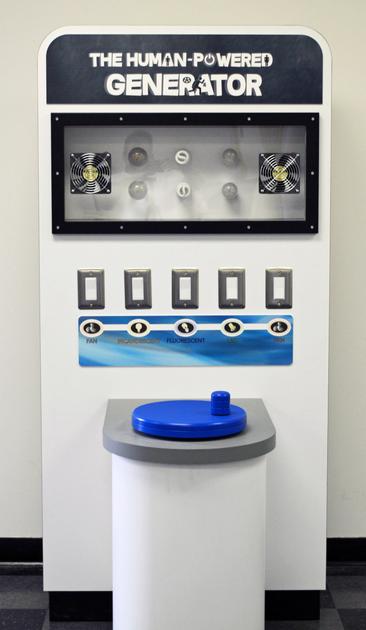
When you were a kid did you ever go to a science museum with a hand-crank generator and a buncha lightbulbs?
So how this works is you'd spin the crank and it'd rotate pretty freely y'know, you could feel magnets kinda resisting you a little bit but you'd take your hand off the crank and it'd carry on a bit, it wasn't hard to turn. And then you'd flip the light switch on and turn the crank again but this time you'd be trying to light up a little bulb, and it'd fight you. The same crank would give you hot biceps and a sweaty forehead. Some of these machines had more bulbs in parallel with switches between them and you could build up speed and have your mate flip a switch and you'd FEEL it! Not, like, understand the principles, not be able to rattle off Ohm's law or whatever, you'd really FEEL it, you'd KNOW it in your body
I think that was a good machine and we really need more of them. We need to feel the burn in our biceps so that we understand viscerally what electricity means, what power actually is, what really happens when we boil a kettle
Alright so remember how I said these were 240 watt panels, well I misspoke, they're actually rated for 230 watts on the label.
Now the label, fucking LIES. If it says 230 watts on a panel what it means is, you'll get 230 watts under like Ideal Laboratory Conditions, noon on the solstice at the equator on a really clear day kinda thing, you're never gonna get that IRL. Plus, these panels are like 15 years old. So I figured, well, if I can get 150 or 180 out of them then I'm still quids-in for how cheap they were secondhand, and if I have two in series then a bit of shading on one is gonna pull down the other, so 300 watts would be a result. With that in mind, screenshot in the next post
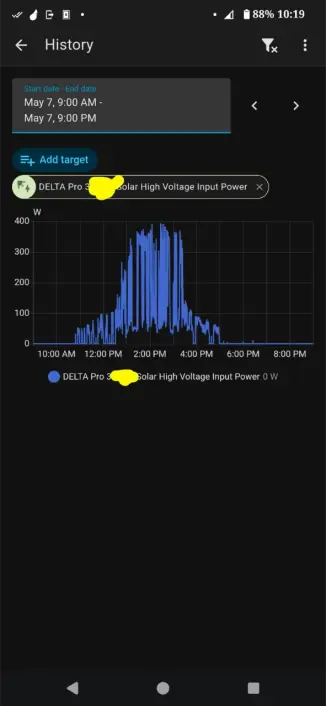
So panels that were optimistically rated for 230 watts 15 years ago are still spitting out about 200 watts without much effort at all!
This is FANTASTIC because even though panels hold up way better than I expected, **rich buggers still replace them** because you can get 400 or 500 watt panels now that take up the same room, meaning that the secondhand market is full of panels that are cheap AND good! It's a raccoon's paradise!
Alright I've actually plugged stuff into the battery now
My amp, projector, kodi box, home assistant pi and basically everything in the big shelf downstairs are all sun-powered now
Knowing how electricity is normally generated makes these things even more magical
Like we all know that electricity is made by moving magnets around coils of wire or vice versa, and that's how I think of electricity, it's a big steel shaft in some really good bearings and at the end of that shaft is like a bunch of fins that get spun by steam or whatever or maybe it's like a portable generator with a 2-stroke engine to spin the shaft and there's all this metal moving and it all probably makes a terrible racket
These two old panels off a bloke on facebook marketplace are just sat quietly in front of my house and there's four blokes on exercise bikes' worth of electricity coming out of them. There's no noise at all and nothing's moving, there's nothing to oil, there's no fluids to replace, it's just, fucking, some Elvish thing that gathers mana when it's in nature. It's absolutely magical
Watched a video from a bloke who's also dipping his toe into solar. He's not doing a battery, just these Ecoflow Stream microinverter things. I think this is what people mean when they talk about balcony solar.
Anyway how these work is there's no battery, you plug a solar panel (which puts out lowish voltage DC) into your hundred-quid microinverter box which bumps it up to mains AC voltage, and then there's a wire coming from that box and you just PLUG IT STRAIGHT INTO THE WALL. Like you literally plug it into a normal outlet and it just energizes the circuit that this outlet is part of, anything that's on that same circuit gets the juice from the panel. You don't need to turn the circuit off at the breaker or anything, all the smarts in the microinverter box just Figure It Out and when there's sun the circuit gets powered from the sun and when there's not it gets power from the mains like normal and you just leave it, you don't have to mess with it.
So like, what does this even do? Without a battery there's only benefit if you use the power while it's being made, you can't save it up for later. Well, the idea is you plug it into the same circuit that powers things that are on all the time, like your fridge or whatever. There's also a lot of benefit if you've got stuff like, I dunno, a dishwasher that you can load it up and close it before you go to bed and then tell it "Do the dishes in x hours" and time that to start at like noon tomorrow when there's lots of sun to power it for free.
So like, it's not as good as a battery obvs, but the good and interesting part about it is how CHEAP it is. A hundred quid! You'll have your money back in like two years, and then it'll keep sneaking beer tokens into your pocket for, hell, decades probably. And that's for like the fancy Ecoflow brand, I bet there's cheaper ones that're just as good.
Anyway then he said what he was powering with his panels and it's this big nerd cabinet full of networking gear and computer shite and it's like THREE HUNDRED WATTS 24/7 CONSTANT DRAW and I got all Northern like 'OW MUCH?!
I've got a nerd rack as well, it's got the router and a switch and TWO computers that are on all the time and an external hard drive that's constantly spinning and amp on standby and a projector and three game consoles and VR lighthouses and all their associated shitty tiny inefficient power adapters and its baseload is thirty watts.
ARM, mate, you want some Acorn RISC Machine in there, reduce the instruction set of yer computing, you'll save a packet
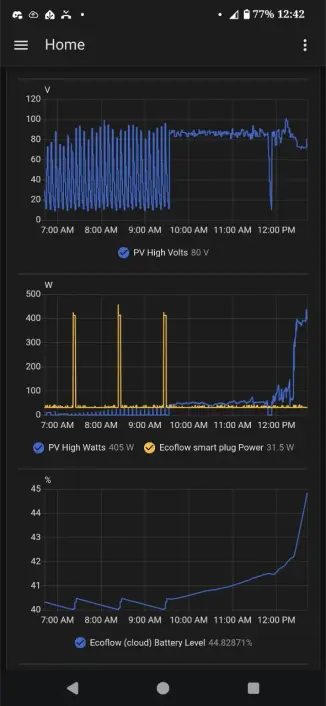
Now, this isn't what I expected from adding a third panel to the series. When you put panels in series the volts add up, the amps stay the same, and since everything's gotta flow through Every Panel, if one panel gets some shade you're buggered. I meant to put three in parallel (put the third one out yesterday) but I couldn't make the leads quite reach, so I put them in series for now and ordered some more adapters etc.
I thought I'd be getting more like 600 watts for a little bit of the day and then partial shade on one panel would screw me, but there must be some kinda quirk of circumstance I didn't account for 'cause the opposite has happened - two panels in series didn't start producing much until about half eleven or noonish, but three in series started producing earlier in the day, enough earlier that the battery started charging much sooner than it has been off two panels.
I've got the battery set up so that it won't go below 20% or above 80% charge until I tell it Yo Emergency Time, just for the sake of the cells' longevity. But I've also got it set so that if it goes below 40% it pulls from the grid at 400 watts. The rack draws 30ish watts and it looks like it's mostly passing that straight through from the mains and occasionally taking a short 400 watt burst as it charges up enough to meet its own demand for the computery doodads wot makes it go.
The headscratcher here is in the two-panel days, the time period before the sun actually hit the panels, when it was light outside but not Direct Sun kinda thing, I'd get watts in the low 20's until like noon, and now I'm getting like 50 watts during that same time. Adding one extra panel shouldn't go from 20 to 50 - I'm not gonna complain, that's the difference between the battery discharging and it charging for several hours, but I am gonna say that the moral of the story is that messing around with maths and theory will only take you so far, you've gotta plug things in and fiddle with it physically before you know what to expect!
Also if you're wondering why it's passing 30w of power from the mains straight through to my load while it's also drinking 400 watts from the sun, while I was writing that last post the battery percentage crossed 45% and then it cut off the mains, so right now my rack is battery powered and the battery's still charging and the smart plug it's plugged into is at zero amps.
I expected 600 watts instead of 400 but it looks like I'm getting more, like, 450 watts but for much longer in the day and bonus trickle-charging in the morning
Have we talked costs yet, have we added all this up yet
I don't think we have, not properly anyway, right. Two grand for the battery. That's the big "Oof" chunk but honestly, if I didn't have refrigerated meds to worry about, if I just wanted to Play With Solar And Save Money, I could've done it for way less. Here's my notes from when I was comparing the different all-in-one batteries (next post)
---this is taken STRAIGHT from my notes file in my personal wiki (it's dokuwiki-powered!) and I'm sure other people have done better comparisons, also this is only looking at fairly-big batteries, you can get smaller ones for WAY less money, so take this as it comes---
Growatt Infinity 2000:
* $650 for 2 kWh, so $325/kWh
* 2.4kW output
* 1200W solar charging: 12v to 150v
* 20ms UPS
* Inverter losses: 34 watt
* server fuckery, see https://www.splitbrain.org/blog/2023-11/03-growatt_and_home_assistant
Ecoflow Delta Pro 3:
* $2300 for 4kWh, so $575/kWh
* 4kW output
* 2600W solar charging via two ports: 30-150v to 15A (1600W), 11-60V to 20A (1000W)
* 10ms UPS
* Can do 240v
* Can be controlled locally via BLE: https://github.com/rabits/ha-ef-ble
* Inverter losses: 50 watt
Oupes Mega 2:
* $760 for 2kWh, so $380/kWh
* 2.5kW output
* 2100W solar input, 18-140V to 15A (manual suggests 6 240W panels at 148V OCV in series)
Oupes Guardian 6000:
* $1700 for 4.6kWh, so $369/kWh
* Can do 240V
* 3.6kW output
* 2100W solar charging at 18-130V/15A
Jackery Explorer 2000 V2:
* $800 for 2kWh, so $400/kWh
* 2.2kW output
* Only 400 watts solar input? Fuck off
Pecron E3600LFP
* $1050 for 3kWh, so $350/kWh
* 3.6kW output
* 2400W solar charging via 2 ports, both 32-150V to 20A
* 20ms UPS
* Inverter losses: 46W
* BUT: for $2200, nearly same price as the Delta Pro, get two of these and run 240v and have 6kWh of storage.
* BUT: quite loud!
Bluetti Elite 300
* $1100 for 3kWh, so $366/kWh
* 2.4kW output
* 1200W solar input, 12-60V panels
* 10ms UPS
Anker Solix F3800
* $2000 for 3.8kWh, so $526/kWh
* 6kW output
* Can do 240V
Anker Solix F3000
* $1400 for 3kWh, $466/kWh
* 2400W solar charging via two ports, high and low like on the Ecoflow: 11-165V@17A for 1600W and 11-60V@17A for 800W
And the panels were $45 each off Facebook marketplace, I bought 16 of them 'cause I was figuring they'd be WAY more degraded than they are, but the whole solar-panels-degrading-a-lot thing turned out to be a another BIG FAT SMELLY LIE to go on the PILE of BIG FAT SMELLY LIES THAT PEOPLE TELL ABOUT SOLAR PANELS. $720. But dude threw in a bunch of 8-gauge wire as well.
I already had nice big crimpers that can do MC4's, but if you don't then maybe about $30 or $40. I've spent maybe a hundred bucks on this-and-that bits-and-bobs like connectors and conduit and drill bits and shit.
The next chunk of money will be in permanent mounting for these rather than leaning them jankily against the front wall of my house; some folk might buy pre-made racks but I plan to raccoon the fuck out of it with leftover chunks of timber that I've got lying around the place.
We're under three grand and it's Working, but you can absolutely start dipping your toes in for WELL under a grand if you don't currently have designs on doing The Whole Ass Entire House, and you know what, if you buy a tiny little battery and a single solar panel and just plug one thing into it then a) you're doing more than most folk and b) if you get Bit by the solar bug and change your mind about the whole-ass-entire-house thing, it's not like your one solar panel instantly becomes junk, you can incorporate it into whatever future plans
Two things to note about these all-in-one solar-generator doodads:
1. This is The Most Expensive Way to do it, because these boxes have charge controller, battery and inverter all in one convenient lump that you can lug around, go camping with, take to your friends when they've got a power outage, all that stuff. The true Way Of The Raccoon involves buying all those components separately and screwing them to a sheet of chipboard for like a third of the money.
2. If you look at the battery capacity you can get in, say, an Anker Solix C1000, they're $450 off Amazon, and you see only one kilowatt-hour and do Sad Face because that's half a grand and it won't even run a fridge for a full day, remember that you can also pull 600 watts into that battery from the sun as long as it's shining
 Chuck
Chuck
 Andrew (Television Executive)
 John Wilson
 Stephen
 Games That I Missed
 Robin (going slightly mad)
 Steve Gisselbrecht
Man. You are one wordy motherfucker. [admiring]
 <10%
<10%Depends: the power flows back to the distribution board and all round the property. Then it goes out to the grid. If you have an old spinny disc meter it might run backwards, otherwise the meter stops while you're producing more than you use. If you've an export meter then it doesn't go backwards, it clocks up on the export side instead...
But a battery is expensive - is it worth the expense?
@OneInterestingFact the maths on whether a battery is worth it is VERY different in the UK versus the US. Over here in the US, at least in Pittsburgh where I'm at, we have a LOT of power outages 'cause they don't bury the wires and sometimes those outages can go on for a very very long time. Combine that with massive American-style freezers that are most efficient when they're nearly full, and Costco-style cheaper-in-bulk shopping, and you might have half a battery's worth of food in the deep freeze at any given time.
Plus if anyone in the house uses medication that has to be kept refrigerated, you might have two grand's worth of meds in the fridge. All things that change the answer to whether it's worth it to get a battery, but my gut tells me in the UK it's not worth it but in the US it probably is
@ifixcoinops you've now got me wondering what the base load of all of my various computer-mabobs is. I could find out if I could remember where the little screen doohickey for my smart meter is.
I very quickly realised that knowing how much power my house is drawing on an instantaneous level isn't actually that useful for me, so I cast the little screen into the abyss
@ifixcoinops they warned me about moments like this in school.
Admittedly they told me that it would be acid being offered, but still.
 Varx
Varx fritzoids
we've got the plug-in solar panels and the one draw-back that I see is that they won't work if there is a blackout. There needs to be electricity in the system for them to then feed into it.
So I've urged my spouse to figure something out that might tide us over in case of a black out (only ever had one and it was minor) or to save up what we're not using and then use it at night (fridge, NAS).
 Arda Xi
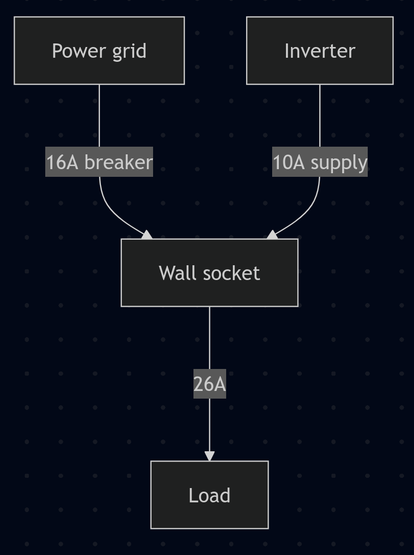
@ifixcoinops Worth noting that this might be dangerous. If you have a breaker in front of the circuit, that breaker only sees the net power going through it. But if your battery supplies say... 10A, then you could have a single load of 26A going continuously without ever tripping a 16A breaker. (Using local values here but the math stays the same, just different values).
Unless you really know what you're doing, you should never put producers and consumers on the same circuit without a fuse in between.
Unless you're doing the ring main thing of course.
@ardaxi Eh? How do you put 26 amps through a 16 amp breaker without opening the breaker?
And what's drawing the 10 amps?
@ifixcoinops The concern is that you could have one wall socket that's got wires rated for 16A loads drawing much more than that because only some of the power comes through the 16A breaker. It's also directly connected to the inverter that's on the same side of the breaker, so it can take power from that too. That gets the wires to the wall plug hotter than you'd like.
Definitely not a thing that's going to immediately burn your house down and it can be done safely if there's enough give, but I still worry about these plug things and whether people know the risks involved.
@ifixcoinops It's about the potential power draw. Here's a rough diagram where the breaker won't trip even though the circuit is overloaded.
It's not an immediate danger, the danger is that you're defeating the safety a breaker provides.
@ardaxi ohhhhh I get it now
So, like,
Mains -> busbar -> breaker -> outlet A -> three kettles and a welder in parallel -> outlet A -> breaker -> busbar -> mains, opens the breaker
but
Mains -> busbar -> breaker -> some other outlet B in parallel with a microinverter plugged in -> outlet A -> three kettles and a welder -> outlet A -> breaker -> busbar -> mains, fed partially from the microinverter without involving the breaker at all, so outlet A could theoretically pull more than the breaker's rated for, is that right?
 Erin 💽✨
@erincandescent @ifixcoinops Having Schuko connectors is one thing, that doesn't mean they're allowed to be on a shared circuit. If it's not in parallel with any loads, it's perfectly safe.
Looking into the Dutch market I'm seeing that you're allowed to put max 800W on a shared circuit. Going just 3A over seems… safe enough, I suppose.
What I'm a little concerned about is some… clever person deciding they can get multiple and just stick them in a single wall box, and actually reach dangerous levels.
It's the kind of thing that doesn't burn your house down right now, but can hide a problem until you decide to get a new washing machine and suddenly the walls start smoking, where otherwise the breaker would have tripped.
 Phil Dennis-Jordan
If it's purely a solar inverter it's a lot less likely to cause issues, yeah.
I mean sure, people can probably come up with stupid ways to set up dangerous/illegal configurations, but you don't need an inverter to do dangerous stuff with electricity. (And the grid company might start asking questions if they notice >800W backfeed.)
 Tvorsk
 Liam
LiamYears ago you might not have been able to score this kind of deal on panels though!
I'm just excited you're doing it now :)
 Farbs
Farbs@ifixcoinops Welcome to the sun watcher's club :) Just yesterday I was planning my week based on the weather forecast & when I'll be able to charge my EV without hitting the grid, and now this morning I'm shaking my fist at a foggy sky.
I know home automation is a bog pit that would swallow me whole, but an eInk display somewhere central in the house that showed battery %, solar generation, and load would be amazing.
 SnoopJ
 DTrasler Writing
 Sheddi
@Dtraslerwriting
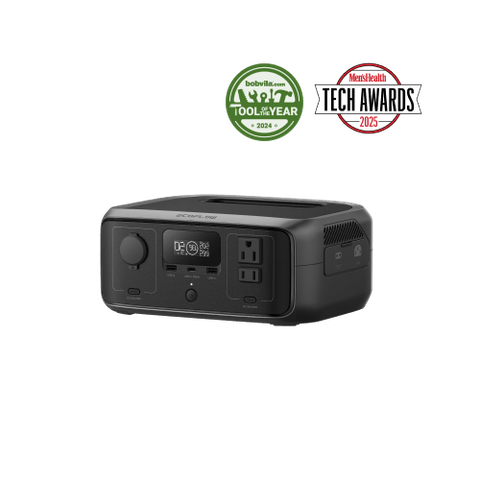
I don't know exactly what Dan's got but it's something a bit like this:
https://us.ecoflow.com/products/river-3-portable-power-station
Dan's is probably bigger and more.powerful than that one. Have a look at the various models and get a feel for the price-performance curve.
 florian


@ifixcoinops I remember having a fairly long and entirely fruitless discussion with someone who was convinced that using solar panels (or wind turbines) to generate electricity and then using that electricity to run a heater or clothes dryer was "causing global warming" because of the waste heat from the heater or dryer.
I was unable to convince them that the heat that came out of the appliance was the same energy that had been taken out of the sunlight or wind previously.
 rawe
rawe@sheddi @ifixcoinops but LED lights cost more to run vs. the old ones as they are brighter!
(btw. found all the 25W Edison light bulbs I put in front of the house "for free" at a local restaurant. One over every table...)
 christian mock