Anyone who has followed me for a while will know that I’m a regular listener to The Great Simplification by Nate Hagens.

I don’t agree with everything he says, and I think he’s probably wrong on some things, but I do think he’s an important voice, and he’s in the process of publishing a 3-part series on oil and what it does for us.

I think it’s *very well phrased* for a general audience, so I’m going to post the text of it all here in a long thread. Mute me now if you need to!…
Nate Hagens, April 2026:
#Oil101 / #Oil201 / #Oil301 preamble:

“As a result of the Strait of Hormuz closure, you’ve probably heard a lot about oil in the news lately. You might know that oil is important for filling up your car, but you’re probably not quite sure what the big deal is beyond that. It turns out that our entire modern civilization is only possible primarily because of oil, and the resulting products from it…

…“This series is a way of seeing oil from a systems perspective. My hope is it might help contextualize the massive historical moment that we’re witnessing unfold.

This episode is the first of 3 on the subject. In this one, we’ll cover the basics of oil, what it is, and how it benefits society. Things we should’ve been taught in school but weren’t.

The second will expand to look at how our systems and institutions depend on oil, and how this knowledge can help us understand our present moment…

…“The final part will take the lens of the first two and help us explore what all this means for the future of humanity and earth.”

Series setup ends.

- - -

What follows is a 14-post transcript of part 1 of the series:

https://www.thegreatsimplification.com/frankly-original/135-oil-101

Oil 101: What You Actually Need to Know About Oil - The Great Simplification

This week’s Frankly is the first in a three-part series on the role oil plays in modern civilization, prompted by the recent flow disruptions and geopolitical conflict surrounding the Strait of Hormuz.

The Great Simplification

#Oil101: 1/14

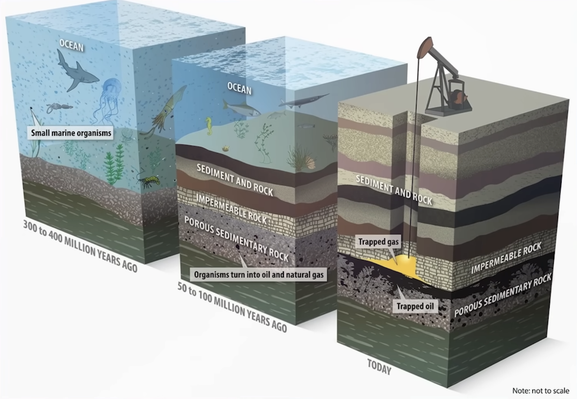
“Most people’s mental image of oil comes from a cartoon of dead dinosaurs turning into goo, which we put in our car.

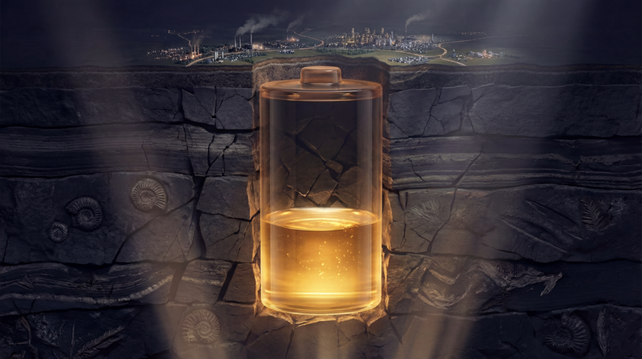
In reality, oil formed from dead marine phytoplankton, algae that captured solar energy tens of millions of years ago, that was then compressed by heat and pressure over geological time, creating a super energy-dense liquid substance, which we refine.

It was a solar battery that took millions of years to charge, and we’re draining it in centuries…

#Oil101: 2/14

…“And coal and natural gas are a similar story.

So how much work does this ancient sunlight actually do for us?

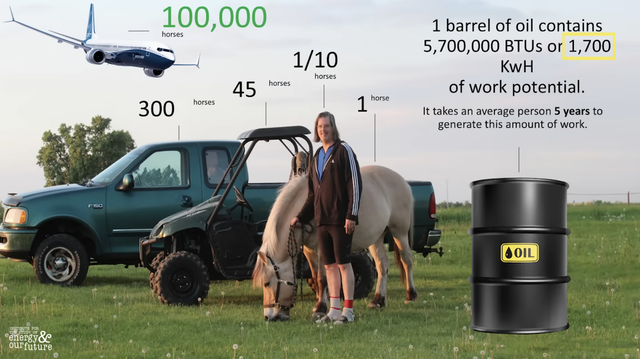
A barrel of oil replaces 5 years of human labor for around $100. It used to be $50.

A single barrel of oil contains 1,700 kilowatt hours of work potential. A healthy human being doing physical work generates around 0.6 kilowatt hours per day, depending on how strong a person is or what the task is, or how many hours a day they work or how efficient they are…

#Oil101: 3/14

…“Anywhere from 1 to 20 years of human labor is replaced when a barrel of oil is combined with machines. So for an average human 5 years is a solid approximation.

This incredibly powerful economic subsidy is indistinguishable from magic on human timescales. Here’s a way to actually feel this…

#Oil101: 4/14

…“The next time you drive, imagine running out of gas and pushing your car home. Even with 3 or 4 friends a single gallon of gasoline that cost you $4 would take you and your buddies weeks to replace with human muscle and would be hella unpleasant in the process.

We never think about this. We just swipe the credit card and go places. And all we pay is the cost of pulling it out of the ground, not the millions of years to create it, not the environmental cost of burning it…

#Oil101: 5/14

…“This makes oil absurdly cheap relative to the work it performs.

Economic textbooks and business school classes teach that energy’s contribution is its dollar price tag, in effect. The cost share of oil is equal to the value it provides, but the cost we pay is orders of magnitude smaller than the value it provides for us. This is the deepest subsidy in the history of civilization, and it’s mostly invisible except in energy crises like now…

#Oil101: 6/14 #climateDiary

…“That is a single 42-gallon barrel of oil.

Now multiply it by the total amount we burn every year, and we’ll see what this looks like at scale.

We use around 100 billion barrels of oil-equivalent of fossil hydrocarbons per year, globally.

At around 5 years of labor per barrel, that’s 500 billion human labor year equivalents – running, working alongside around 5 billion actual human workers.

100 fossil-powered ghost workers for every living one…

#Oil101: 7/14

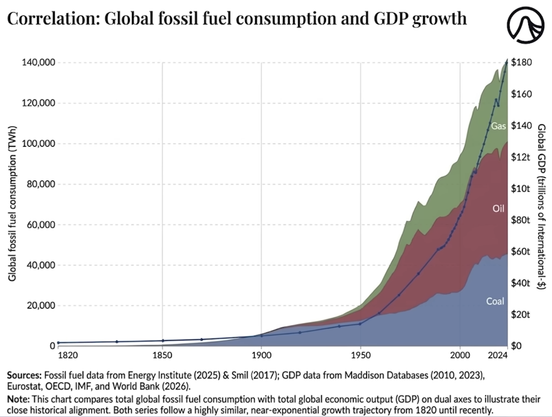
…“This giant labor subsidy when combined with machines is primarily what explained and underpinned the explosion of wealth globally.

It boosted wages.

It boosted corporate profits.

It slashed the price of goods and transportation, so things show up at your door the next day in a brown truck.

It’s supercharged agriculture to increase our population from 1 billion to 8 billion, and it dramatically increased per capita consumption…

#Oil101: 8/14

…“On top of that. Every economic miracle of the last 150 years was underwritten by this invisible workforce.

What does this actually look like at an individual level?

Oil alongside gas and coal has made the average person significantly richer than historical royalty.

The average American uses roughly 40 barrels of oil equivalents of oil, gas, and coal combined, compared to a global average today of around 10 barrels of oil per person…

#Oil101: 9/14

…“That level of energy service with the associated billions of helpers surpasses what kings and queens had access to a few centuries ago:

- hot water on demand
- refrigeration
- personal travel by car
- global travel by plane
- year round, fresh food
- climate-controlled sleep conditions

all from ancient sunlight, powering the research, the innovation, the manufacturing, the infrastructure, the factories, the transport, the supply chains, and the commerce all around the world…

#Oil101: 10/14

…“And yet almost no one sees it.

That’s because we swim in energy the way a fish swims in water.

Every product, every service, every bit of GDP first requires an energy conversion, no exceptions.

The average American home has around 40 items constantly plugged in, draining power around the clock, even when they’re turned off.

But because energy has become abundant and growing our entire lives, we have become… energy blind…

#Oil101: 11/14

…“I got my master’s at the University of Chicago and my 3 Nobel Prize winning professors never once mentioned the word energy as a contributor to economic productivity because during their lifetimes, the supply just kept growing.

So they treated this exceptional period of human history as if it were normal based on ingenuity and technology…

#Oil101: 12/14

…“Here’s one way to feel how blind we are to this.

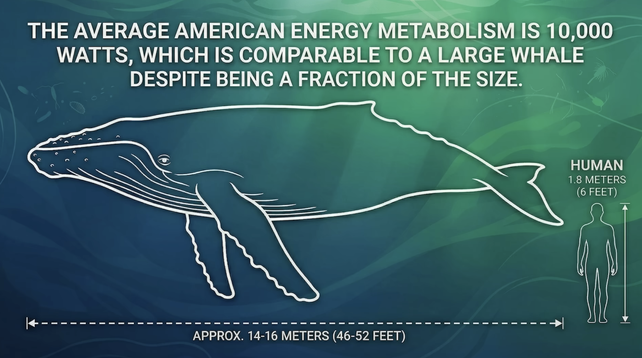
Your body needs around 2,000 kilo calories a day to stay alive. But the average American – when you count all the energy consumed on their behalf through heating and transport and manufacturing and lighting, and food systems and supply chains – uses roughly 200,000 kilo calories a day. A hundred times more than our bodies require…

#Oil101: 13/14

…“Most of us wake up in a climate-controlled room and we flick on a light switch and turn on hot water for a shower, and we make a coffee and put on synthetic clothes. All possible from oil and hydrocarbons.

You are living at a metabolic rate that no organism in the history of life on Earth has ever sustained, and almost none of it is visible to us in our cultural stories in the media…

#Oil101: 14/14

…“This all sounds like a miraculous gift, and in many ways it is.

Here’s the kicker.

This ultra cheap energy in the form of coal, gas, and especially oil, will not be available to us forever at today’s price and scale, and it may well be gone sooner than we expect.

We’ll explore this in part 2 of our intro trilogy on oil.”

- - -

End of transcript of part 1 of https://www.thegreatsimplification.com/frankly-original/135-oil-101

Oil 101: What You Actually Need to Know About Oil - The Great Simplification

This week’s Frankly is the first in a three-part series on the role oil plays in modern civilization, prompted by the recent flow disruptions and geopolitical conflict surrounding the Strait of Hormuz.

The Great Simplification

#Oil101 Postscript:

The irony that I’ve corrected, edited and then posted the above with ease due to The Great Simplification’s team using an LLM to translate their audio signal into text is not lost on me.

Part 2 in the series is already out, but I’ll defer that until tomorrow.

Have a good Saturday. Please integrate the above into the awareness of you and yours 💚

…The transcript above represents 10 minutes of audio across 14 posts for #Oil101.

I’ve just prepped the equivalent for part 2, which is close to 50% longer, and in segmenting it into coherent blocks it will make 27 posts.

I’ll post it tomorrow under the #Oil201 hashtag if you want to follow along – or the opposite, to mute it!

…I said yesterday I would do this, so here goes. Follow or mute or ignore #Oil201.

As a follow-on to #Oil101 above, the following 27 posts are the words of Nate Hagens from the 14 minutes of https://www.thegreatsimplification.com/frankly-original/136-oil-201

Oil 201: What Happens When the Oil Stops Flowing - The Great Simplification

This week’s Frankly is the second in a three-part series on the role oil plays in modern civilization, prompted by the recent flow disruptions and geopolitical conflict surrounding the Strait of Hormuz.

The Great Simplification

#Oil201: 1/27

“In the last part [#Oil101], we explored what oil is and how it’s effectively acting as invisible fossil pixie dust through many of our lives.

But the parallel associated risk is that we have built everything: our institutions, governments, stories and expectations about the future on this cheap energy input. And now its scale and affordability is no longer guaranteed…

#Oil201: 2/27

…“When energy prices spike, entire systems can become fragile and often break because oil’s been so cheap, pretty consistently. The economic logic has been to imagine and then engineer thousands of mechanical processes around that cheapness.

The industrial evolution is really the story of adding hundreds or thousands of units of fossil energy to tasks that humans used to do by hand…

@urlyman
All of this reinforces my belief that we should be putting far more effort into energy demand reduction. For example, we’ve had the technology to produce housing that needs little or no energy input for decades; it’s a scandal that we’re still building dwellings with massive energy bills.

https://en.wikipedia.org/wiki/Passive_house

#passivHaus

Passive house - Wikipedia

@KimSJ The big big problem now are data centers and all the people using LLMs as if it had no environmental footprint ... We could stop that artificial growth of energy/water abuse easily ... @urlyman
@urlyman Yes, problematic - I wish he'd just write it down. Inter alia, the energy use would be much lower.
@urlyman
Still I'll maybe explore the transcripts - certainly can't be arsed to watch videos or listen to audio files Text you can skim, ho back, start at the conclusion, quote.
@markhburton or just keep following me! 😉
@urlyman @markhburton
Thank you hugely for putting in the effort to post this thread.
@urlyman Part 3 just arrived in my podcast client.

@urlyman thank you for this thread! It got me wanting numbers.

- So one 42 gallon oil barrel: 1,700 kWh. How physically big is that oil barrel?
- The 200,000 kcal the average American might use every day: 232.5 kWh. 1 barrel then covers ~7 people.
- A 400w solar panel might produce 2 kWh a day, sunshine dependent of course. Of course solar farms have bigger and many more panels than that!
- A single wind turbine can produce (more or less) 10,000 kWh a day, covering more than 40 Americans.

@urlyman I'm not sure I'm taking any particular conclusions from this, but I needed a numerical basis for comparison.

Otherwise it feels like "ooooh gosh, lots of energy in that oil, guess we're reliant on it" but also we use energy extracting it, transporting it, refining it into the fuels and substances we find useful, and obvs the pollution created by burning it.

I feel like the turn is coming. Business is investing in more and more renewables because it's going to mean cheaper energy :)

@sarajw to answer your first question, I found a source that says a barrel of oil is about 90cm tall and about 58cm in diameter. Dunno if that’s right.

In part 2, Nate gets into the landscape that your other questions sit in, though not the direct answers.

I suspect he may address them more directly in part 3, which is not yet out.

Go ahead and listen to https://www.thegreatsimplification.com/frankly-original/136-oil-201 – it’s only 14 minutes – or wait for me to post its words tomorrow! 💚

Oil 201: What Happens When the Oil Stops Flowing - The Great Simplification

This week’s Frankly is the second in a three-part series on the role oil plays in modern civilization, prompted by the recent flow disruptions and geopolitical conflict surrounding the Strait of Hormuz.

The Great Simplification

@urlyman interesting! Don't have time right now but thank you for the link and the transcription today.

:)

@urlyman

...analysts say the war should accelerate the deployment of cleaner technologies in the long run, as governments around the world look to cut reliance on fossil fuel imports from volatile regions.

“Broadly speaking, it’s positive for renewables,” says Miguel Stilwell d’Andrade, chief executive of Portugal-based global renewables developer EDP. “It just reinforces the idea that we need to be more [energy] independent and renewables are more immune to shocks.”

https://archive.ph/BzYDy

@sarajw I certainly hope we can manifest the self-restraint it will take for that dynamic to play out.

The reality is that all renewables are themselves currently dependent upon fossil fuel inputs, a conundrum nearly everyone is understandably keen to look past.

So the key challenge will be to eschew the vast arrays of one-time hydrocarbon use that is in service to the highest of energy and resource throughputs, in favour of those which are less extravagant *and* to restrain the rebound effect

@urlyman mmmm. Yep hard to create metal parts without hot furnaces that can't really be electric.

@sarajw

Re: Wind Turbines - that's interesting to learn.

I've read before, the *average* US household uses slightly more than 10,000 kWh/yr.

@urlyman

@urlyman
As an adjustment to those figures, most of us are not used to or trained to hard work nowadays, and few of us are a naval team doing Field Gun, or riding the Tour de France, but when work was done by muscle I think there was more than we expect.

https://www.bikeradar.com/news/tadej-pogacar-v02-max-study

That's very much the top end.

442 watts for 40 minutes: Study estimates Tadej Pogačar‘s power output on Tour de France climbs | BikeRadar

The phenomenal numbers required to compete at the top level

BikeRadar