…Ok. So far, so bleak.

The rest of #Oil301 is mostly just ramming home the point about *where we are* without actually getting into “what comes after”.

Crucially, it’s that last bit that @adamgreenfield narrates so beautifully on his recently launched Lifepod: https://lifepod.transistor.fm/episodes/s01e00-an-introduction-to-lifepod/transcript
Lifepod | Transcript: S01e00 An introduction to Lifepod

Host Adam Greenfield welcomes you to Lifepod with an overview of the show’s themes and central concerns, rooted in his book Lifehouse: Taking Care of Ourselves in a World On Fire (Verso, 2024). In ...

Lifepod

#Oil301: 8/n

…“We’ve been drawing down the principal of the main input to our economies, but our universities, stories, institutions and media treat it as if it were interest.

The geology of shale has punishing rapid depletion, constant drilling just to stay *flat*.

What’s less discussed is that shale is as much a financial phenomenon as a geological one.

Cheap money made expensive oil temporarily viable. And when capital tightens or interest rates rise, the financial scaffolding collapses”

#Oil301: 7/n

…“The current growth-based financial system and its Byzantine array of financial claims is all predicated on having more ‘affordable’ energy every year, and the entire structure of debt, interest and repayment assumes a future that is bigger and materially richer than today.

When the energy supply contracts, those monetary claims don’t just take a time out. They crack, along with the associated bonds and currencies and markets…

#Oil301: 6/n

…“As events in the world cause oil to get more expensive or less available, or both, we will respond out of necessity by governments and central banks, offering guarantees, writing checks, printing more money.

Yes, we can and will print money.
But we cannot print energy.

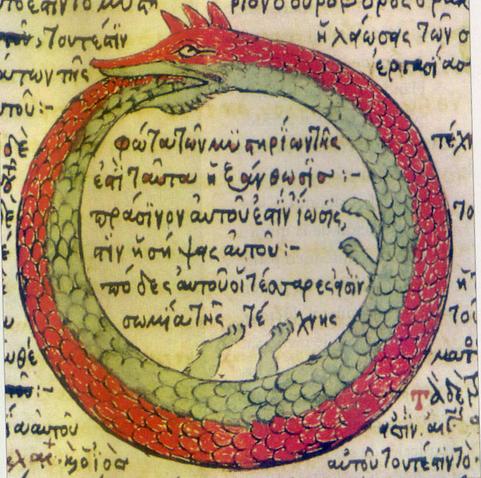
We can only extract it faster, and extracting it faster requires us to print more money. It’s kind of a biophysical Ouroboros.

https://en.wikipedia.org/wiki/Ouroboros

Ouroboros - Wikipedia

#Oil301: 5/n

…“The down slope has implications for every dimension of civilization, but especially our economic system. The economy runs on energy and material flows full stop.

We think it runs on money, but money is just a marker, a claim on the real physical work. And when money is created, it does so without referencing how much oil or gas or forests or copper or orangutans or butterflies exist in the world…

#Oil301: 4/n

…“This is the lens that’s missing from virtually all mainstream economic and political discussions and analysis.

We are making long-term plans, taking on long-term debts, building long-term institutions and financial systems, all based on the assumption that the energy and material largesse at the top of the carbon pulse is a permanent plateau.

It isn’t.

It goes up and it will come down, likely soon…

#Oil301: 3/n

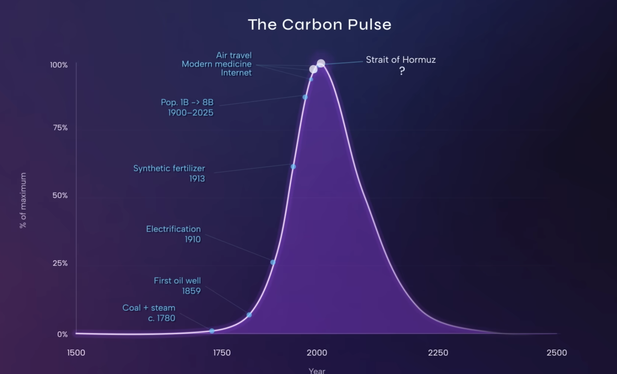
…“The carbon pulse gave us abundant cheap energy to power modern civilization population growth from 1 billion to 8 billion – industrial agriculture, global supply chains, modern medicine, electrification, the internet, air travel, and the complexity of modern governance.

The human economy measured by people times, goods and services per person is now 1,000 times bigger than 500 years ago…

#Oil301: 2/n

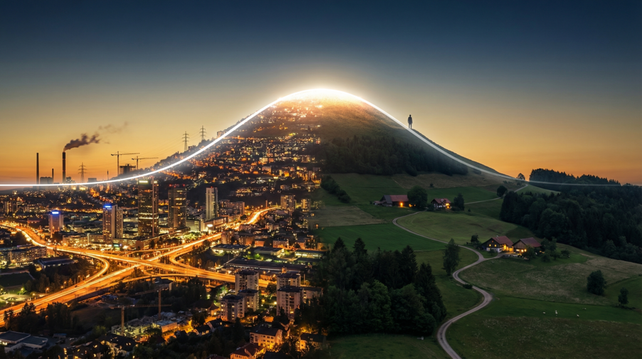
…“Humans have discovered, accessed and burned through an extraordinary one-time inheritance of ancient stored sunlight. I call this…

the carbon pulse…

a bell curve stretched out over around 300 years.

We’re somewhere near the peak right now, and what’s unfolding in the Strait of Hormuz may prove to be a marker of that peak or an accelerant past it on the way up…

From Nate Hagens:
The World After Cheap Energy
https://www.thegreatsimplification.com/frankly-original/137-oil-301

#Oil301: 1/n

“This is the third and final part of this series, briefly covering the basics of oil. From what it is, to how we’ve built our civilization around it and why it can’t last. And now in this one, we’ll look to the future of our systems in a world with less. Everything I’ve described is part of a single phenomenon for a brief window in geologic time…

Oil 301: The World After Cheap Energy - The Great Simplification

Today’s Frankly is the final installment in a three-part series on the role oil plays in modern civilization, prompted by the recent flow disruptions and geopolitical conflict surrounding the Strait of Hormuz.

The Great Simplification

…Coming back to this thread with just a few excerpts from #Oil301’s 2,000 words or so. The whole of it would make another 27 posts, but I’ll be taking a detour and ending up in a better place.

But first, to tie this in with the above…