 Cory Doctorow
Today's threads (a thread)
Inside: Process knowledge; and more!
Archived at: https://pluralistic.net/2026/04/08/process-knowledge-vs-bosses/
1/

Today's threads (a thread)
Inside: Process knowledge; and more!
Archived at: https://pluralistic.net/2026/04/08/process-knowledge-vs-bosses/
1/
@pluralistic There's an excellent point at the end here that I never really considered before:
"And of course, the people who value process knowledge the least are the AI bros who think you can replace skilled workers with a chatbot trained on the things they say and write down, as though that somehow captured everything they know."Online posts and chats and documentation and everything else a chatbot might train off of are generally written to explain the output and structure of a thing to someone else. And while that generally means they'll be on the simpler side, easier to digest, it also is usually a very lossy process. I'm most familiar with how it works with programming, but I'm sure it applies to anything technical enough. And by "technical" I mean basically anything which involves process knowledge. So most positions outside the Board and the C-Suite.I agree and think this has always been the case. The process is one thing, the skills and knowledge to apply it can only be learned through experience.
Example- I have some reprints of 19th blacksmithing manuals. And although they might describe the process of welding an axle, or forging a wrench, it always assumes that, as the reader, you know what a welding heat is, about the correct temperature for drawing down, how to make the tools required to make the tool (first forge an eye punch of 1 inch) and so forth.
If you have never got your hands dirty doing the work, whether smithing, working front line support or deep in the code base (something I cannot do but admire), you simply don’t know.
And as you say, from that lack of knowledge comes the ignorance that leads to a misunderstanding of value and need.
@j_bertolotti @tempusfelix @syntaxxor @pluralistic This is one of the things grade school should be *for* - ensuring adults have basic process knowledge across a range of disciplines. Cooking, woodworking, sewing and mending, visual art, dance, cleaning, music, sculpture, managing one's finances, gardening, household repair and maintenance, metalworking....
(I'm still salty that as a girl, I had to take cooking and sewing and wasn't allowed to take woodworking and metalworking. I eventually learned woodworking, but metalworking seems so *cool*!)
@Robotistry @j_bertolotti @tempusfelix @syntaxxor @pluralistic
But not just grade school - everything up to grad school!
Or at least most people should revisit most of these things most of the way through their compulsory education.
The really nice thing about having some skills, is that learning related ones becomes easier - with basic woodworking and metalworking, learning enough sewing for repairs and upcycling wasn't hard.
@HodgesC @j_bertolotti @tempusfelix @syntaxxor @pluralistic Most of the process knowledge I was thinking of is less about needing regular reinforcement so you'll always be able to do it well and more about achieving "ride a bicycle" levels of not being scared to try it or likely to put yourself in unsafe situations while relearning it.
If you haven't ridden a bike for a couple of decades, that first 5-10 minutes will be *rough*, but it'll come back to you. Same with reading a recipe, using a sewing machine or power tool, drawing.
The stuff you need every day or week or month like budgeting and buying groceries will stay smooth, and you'll have enough background information and residual knowledge to relearn the rest from youtube or wikis or manuals or practice as needed.
@Robotistry @j_bertolotti @tempusfelix @syntaxxor @pluralistic
Given all the courses to help adults to get back on their bikes for commuting, I tend think that riding a bike isn't much like riding a bike. But some form of irregular reinforcement is always helpful. I may have to do some plumbing soon for the first time in a few years, referring to a manual.
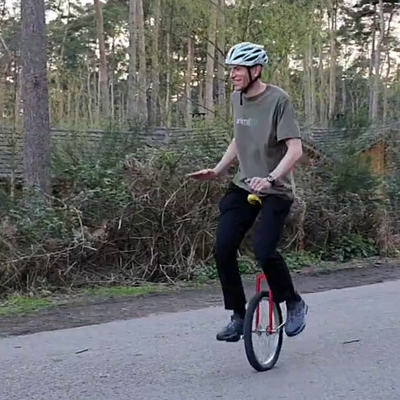
Plus, learning new stuff is fun. I started riding a unicycle a few years ago (still not good enough do more than laps of a sports hall)
 Syntaxxor 🏳️⚧️
 Aethon
 j_bertolotti
 Robotistry
 Chris Hodges