I learned a new word today, cryptogyny.

I’m going to have to sit with it for a bit.

It’s not that I was unfamiliar with the context. Practically anywhere you care to look there are women whose work has been ignored, hidden or stolen. Women who’ve not been given the credit they deserved, or very quickly been dropped.

I mean, I really would like to know why I never learned about Emmy Noether in school, right next to Albert Einstein, even though he recognised her genius.

Cryptogyny. Use it when you need to.

https://olivia.science/cryptogyny/

Via @olivia

Cryptogyny

On the systematic obfuscation of women's contributions.

https://olivia.science
@hypostase @olivia I went through a whole master degree in physics without ever hearing about Emmy Noether WTF!!!!
That woman was a fucking genius.

@forse
In physics masters courses, surely Noether’s theorem should have been mentioned? When I first heard of it, I suppose I assumed that this was a guy. There would not have been a portrait in the textbook.

@hypostase @olivia

@pietkuip

Nope.
I didn't even know about the existence of her theorem until someone mentioned it many years after my degree.

@hypostase @olivia it's because boys don't realize they can have women as role models. it is not obvious and needs to be taught.

@lritter @hypostase @olivia 💯 this is part of the problem

I grew up reading a lot of sci-fi, which at the time^ skewed extremely far towards “male / masc protagonists are the only protagonists” – many young girls & women have always been able to imagine ourselves as the hero(ine) & write ourselves into the stories out of sheer necessity (yes it’s not ideal ‘coz “if you can’t see it you can’t be it” is frequently true, but many of us managed)

but $deity forbid there’s a sci-fi story with a female / femme protagonist that becomes popular – many young boys & men get an attack of the vapours and start bleating about it being “unrelatable” 🙄 (i.e. they finally stumbled on something in the world that didn’t centre them) 😮‍💨


^ yes, still now, but a tiny bit less so

@itgrrl @hypostase @olivia true.

something messes many of us boys up and numbs our receptiveness. is it our dna? our hormones? i don't know.

i took LSD when i was 20 and it opened my heart first, made it visible to me; the heart then opened the mind. i distinctly had the intuition then that most girls don't need this. their human interfaces work "out of the box".

but i absolutely speak feelings as a second language.

@hypostase thank you so much for sharing / appreciating ☺️

@olivia it’s a really good word (also article) and just the word to have when you want to point to it, rather than just screaming, loudly, into the void because you don’t have the word that you need.

Thank you.

@hypostase @olivia this is a very important word, and reminded me of it's equal opposite:

Jineology
https://en.wikipedia.org/wiki/Jineology

The repairative study of women's contributions to society throughout history and in modernity. This being the antidote to that feels important to note.

Jineology - Wikipedia

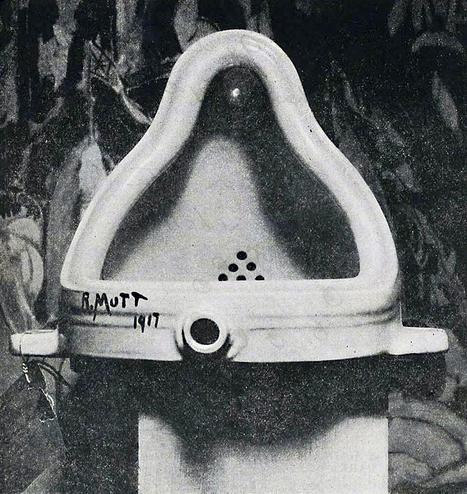
@hypostase @olivia you probably hace hears of the ready made from duchamp. Object he took out of their usual place an simply put in a museum with his signature. Like that urinal. (or more exactly one of the maybe 15 urinal, he signed a bunch).
Did you know the idea came from one of a woman he knew?
@gkrnours @hypostase no, please say more?
@olivia @hypostase I don't remember the details, just that he heard the idea of taking a random object and calling it a piece of art from a female acquaintance. Sorry.
Did Duchamp Steal Credit for 'The Fountain' from a Woman Artist? | Artnet News

Two art critics claim in a new book that Duchamp's Dadaist masterpiece was made by German artist Elsa von Freytag-Loringhoven.

Artnet News
@gkrnours
I've heard the story before, but it's not one I've actually looked at, though this article feels familiar.
@olivia
@hypostase @olivia oh yeah, that's the one. Thanks for tracking it down :)
@gkrnours @hypostase believable, I'll investigate later. But yeah, it's so common sadly

@hypostase @olivia
Cryptogyny or misogyny plain and simple? Yesterday I borrowed a book from the university library called 'Symmetry' by György Darvas, 2007.

Darvas knows why women can't measure up to men's genius (in particular, his own genius). On p. 358 he says: 'Experience shows that women are more susceptible to thought driven by emotions, while men are more driven by rational thinking. The history of science says that the most successful women in mathematics were more masculine in nature.'
Oho, so Hypatia was lynched and murdered by a mob of rational-thinking men. Darvas goes on:
'However, there is no evidence in the history of art that the majority of eminent artists might have been women.'
Darvas covers all bases! His beliefs are still all-pervasive.

@Rowena
Absolutely it's misogyny, but it's also good to have the word for the precise thing, where women's work is actively hidden, particularly in service of that misogynistic belief women are unable to do it.

It's that aspect of I know, and have always known, that in this society men take credit for women's work, but now when I want to argue back, or even think about it more precisely, I've a word for it.

Like lancing a boil, now I have the right tool, I just need to sit with it to make sure I use it properly, to drain the wound they've chosen to make.

@olivia

@hypostase @Rowena it's useful for academics too who may want to study and talk about this type of misogynistic behaviour over others too

@olivia @hypostase

Good-o. Then individual practitioners can be distinguished as cryptogynistic pimps. Not a few Nobel prizewinners are deserving of that epithet.

Olivia Guest · Ολίβια Γκεστ (@[email protected])

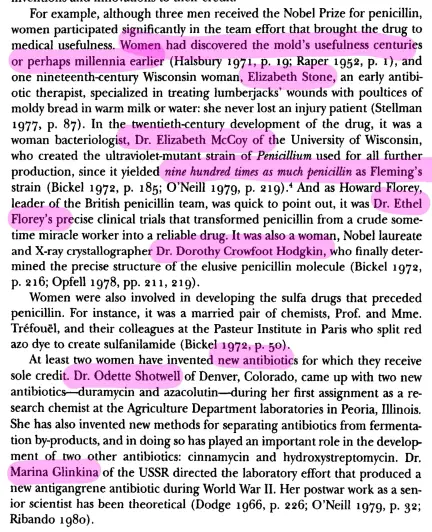
Attached: 1 image Which of course by the way OF COURSE is no excuse at all, but a systematic exclusion — mutatis mutandis for people of colour and more — cryptogyny, the hiding of women's contributions to science, technology, engineering, and medicine: "although three men received the Nobel Prize for penicillin, women participated significantly in the team effort that brought the drug to medical usefulness." https://www.jstor.org/stable/jj.5501032.6 17/

Scholar Social

@olivia @hypostase

Oh thanks! Damn good decryptogyny!

It is really sad, tho. Most of those women would have died in quiet resignation that their achievements were never even acknowledged, let alone celebrated and rewarded, or even gaslit into believing themselves unworthy. Many of us have lived experience of cryptogyny.
Society as a whole is the loser, what grows is strong-man culture.