 Björkus "No time_t to Die" Dorkus
A r e y o u r e a d y t o h a v e s o m e f u n ?
:3
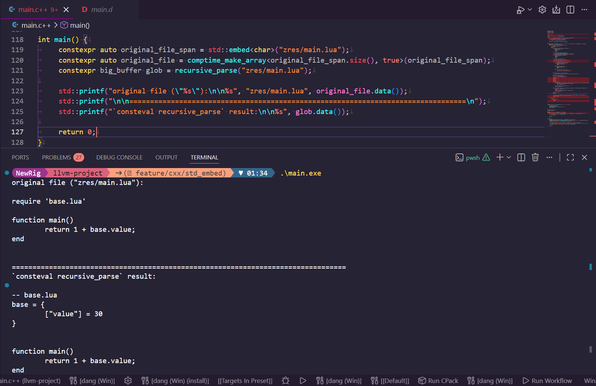
"This is going to destroy my build system"
Nope! It's able to determine everything that will be processed by the Phase 7 compile-time-computed strings by Phase 4, and presents all of that information through already-available means, meaning CMake/build2/meson/make/ninja/etc. can all understand the dependency chain here natively!
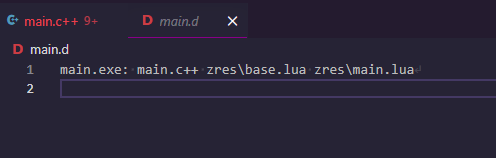
Ultimately, this means we can process files -- recursively -- at compile-time, meaning that rather than embedded shaders with #includes that can't be touched, we can process those includes and make true single blobs without extra build steps.
compile-time python with imports is VERY possible.
@uecker C++ has capabilities that can make great use of this. A perfect example is using (Generative) reflection to generate, at compile-time, the perfect FFI that maps to Python, or Lua, or JavaScript, with all of the utility that comes from having it mapped perfectly to C(++) interfaces and fully type-checked while always being generated directly from said Lua or Python or JavaScript source code.
This also applies to things like e.g. Rust and C++ interop, which has also been the topic of discussion and monetary investment. (Not that they're paying me; I wish they would, I could do a lot more for them than just std::embed.)
C doesn't have the systems in place to do things like this, so in most cases they'd just have to rely on the usual techniques used today: code generators, hand-written parsers, fresh data files and description files used to drive code generation (like e.g. SWIG). Certainly not bad, but not nearly as "automated luxury FFI" as C++ can make it.

@uecker @thephd Well, I am happy to disagree here.
No cyclic dependency is IMHO always better than any cyclic dependency.
This whole problem tends to always bite especially hard when you need to port from one build system to another (because the existing build system does not support your platform or toolchain), like trying to use an Autoconf project with MSVC.
The build system generates input for the compiler. The compiler generates input for the build system (include dependency graph). This is cyclic, and by itself causes all sorts of complications (which are all solved in current build systems, but which IMHO makes all of them more complex than they should need to be).
This is similar to what Autoconf does (which also induces a cyclic dependency).
It is also remotely similar to what C++ Modules require (but there it is way worse).
@uecker @thephd
make
ninja
cmake
msbuild
premake5
autotools
vcpkg
conan
apt
yum
rpm
...
Having a reverse dependency on the build system multiplies this nonsense, especially when cross-compiling and interacting between different build systems.
Compare this to any (really any) other language.
This is really not fixable if every build system invents its own mechanism for generating code at build time, thereby locking any project into build system vendor specific mechanisms.
@uecker @thephd If you are cross-compiling, you are running the interpreter and code generator on the build host instead of on the build target, which means, if it requires any platform-specific knowledge (like the size and alignment of fundamental types), you have to manually duplicate this knowledge into your custom interpreter.
Inside the target language itself, this information is naturally trivially available.
std::embed in the standard library that I missed or is it still not a thing? Martin Uecker
 mia (developer mode)
 manx
manx Chip Collier
 Alex Celeste, Princess Consort of Burnout
 ✧✦Catherine✦✧
 mx alex tax1a - 2020 (6)
 Nekko
Nekko Avery (She/Her)