 DrYak
DrYak myrmepropagandist
If an astronaut sent you an email or loaded your website, could you tell from the IP or anything?
 Andrew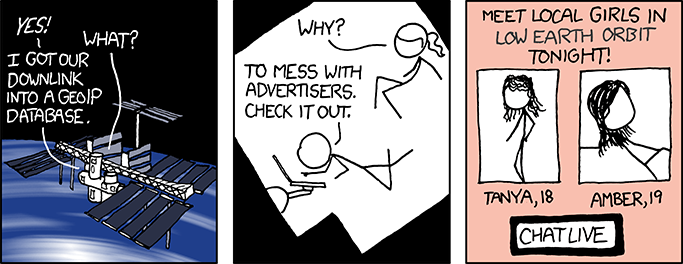
 That one Jewish network nerd
@futurebird Depends. You could most likely figure out if it came from a block ARIN says is in use by NASA. Blocks used by NASA should be documented correctly in Whois records. Most likely are. My very educated guess is that space to mail server is “internal” to NASA. Which would mean you could confirm it came from a NASA server to a high degree of certainty.
 Stéphane Charette 🇨🇦
@futurebird Assuming they have some sort of gateway and IP connectivity, how would you tell?
NASA wouldn't tell us the address range for Artemis or the ISS. And in all likelyhood if it was some sort of IPv4 or IPv6 connectivity, it would be on a non-routable 10/8 network. So in your e-mail headers or your Apache log, all you'd see is regular IPv4 or IPv6 addresses. Best you could do is say "this IP address belongs to NASA or the U.S. government."
The only way to tell would be if they had a footer in their e-mail to indicate they had types or dictated it from space.
 funnymonkey
@futurebird
Geolocation would be epic.
Geolocation would be epic.
 Trinsec
@funnymonkey @futurebird It would be out of this world!
 Roadskater, Ph.D.
@trinsec @futurebird @funnymonkey Sorry to rain n your parade, but if it's in some NASA IP range, then geolocation would report back whever that range is recorded.
I know because when after logging onto my federal agency center's VPN, if I use Google to search for something, I get a lot of suggestions in the Maryland burbs outside DC. And I'm four states away from there via Amtrak.
@roadskater
I know, I did read the other comments about this. But this cheeky comment was too good to pass on. 😋
@futurebird @funnymonkey
I know, I did read the other comments about this. But this cheeky comment was too good to pass on. 😋
@futurebird @funnymonkey
Yeah, I knew this before making the joke.
Its kinda the entire point. 
 Chris Hessert
I could tell by whether or not they were trying to sell me some 💩.
Like say, for instance, Trump merch.
 Henri Verymetaldev
Oh come on don't disturb my remove Lindsey Graham from tRump's ass party please.
It's not a minor operation but hey Oompa Loompa might not survive it.
Hopium for everyone!
 AI6YR Ben
@futurebird from space? I suspect yes, but probably goes through nasa.gov IP address range.
@ai6yr @futurebird I’m way too lazy right now to do the speed of light calculations. But my intuition is that they are going back to how some stuff worked in the 80s. Cause the latency is going to be too much for modern versions of protocols. I would love to get a look at the network drawing for how they’re doing it and what protocols they are using internally
 Matthew Miller
 Vive Levant
@sng @ai6yr @futurebird one sure thing is, despite it could handle the delay, neither RFC 1149 (https://www.rfc-editor.org/rfc/rfc1149) nor RFC 2549 (https://www.rfc-editor.org/rfc/rfc2549) would apply.
 itgrrl
@Vive_Levant @sng @ai6yr @futurebird those are two of my favourite RFCs! 😜
in seriousness though, #NASA has done a lot of work on delay-tolerant networking and there are several related RFCs including RFCs 4838 & 5050
https://www.rfc-editor.org/rfc/rfc4838
https://www.rfc-editor.org/rfc/rfc5050
#DTN
^ what??!? it’s totally normal to have favourite RFCs, shut up! 🤪
@itgrrl @sng @ai6yr @futurebird I’m sure you know, but is the rest of the fediverse aware that rfc 1149 was implemented in 2001 and a desastrously inefficient ping was successfully executed by a Norwegian LUG in Bergen ?
Desastrously inefficient success :
9 packets transmitted, 4 packets received, 55% packet loss
round-trip min/avg/max = 3211900.8/5222806.6/6388671.9 ms
 AstraLuma
@sng @ai6yr @futurebird LEO? no, it's fine
The moon? 1.3s, which isn't insurmountable but sure is annoying
@astraluma @sng @ai6yr @futurebird so long as you manage to sort out the “500-mile email” problem… 🙃
@itgrrl @astraluma @sng @futurebird Ha!
Funny story, I was attempting to figure out how to do some configuration of various Internet utilities over AREDN (ham radio mesh), and -- due to mesh and RF involved -- it pushes up against a lot of these same timeout errors. It was extremely annoying... i.e. you knew there was a node you could theoretically get to, but there was no MODERN protocol able to communicate because of those latency timeouts. I was looking to see if anyone still supported UUCP to get around the problem!! (but then got distracted, and never figured it out).
 Colorblind Cowboy
@futurebird If it was from Major Tom, your reply would bounce.
(Sorry, not helpful)
 Tim Richards
@colorblindcowboy @futurebird That reply caused me to ask Siri to play Bowie :)
 Dave Fischer
@futurebird Presumably the user agent would list "Space Linux" and "Space Chrome"...
 Nymnympseudonym
@futurebird Astronauts would be using the Near Space Network. AFAICT, it's basically a private Internet with its own routing, and AFAICT a bridge to the public Internet.
The Network uses NASA ASN 297 blocks and the DSN block 192.243.16.0/22
So... it would probably be from there, being in that range doesn't guarantee the signal came from space.
 Lúmëcolca
@futurebird
Only if you've got a 90s-style "please sign my guest book" link on your site. Astronauts are honor-bound to do so.
Only if you've got a 90s-style "please sign my guest book" link on your site. Astronauts are honor-bound to do so.
@futurebird I had to go look it up. Couldn't leave it alone.
They have something called O2O. Laser communication via infrared. Gives them 620 Mbps, which is faster than what many of us have at home, though their latency must be quite high, and presumably very steady. Forget trying to play Fortnite.
And while they have wifi onboard for their devices, they have no direct link to the internet. They cannot browse the web or scroll tik toks. Which is not surprising if you want to maintain some sort of protection, you wouldn't open it up to the internet.
I'm curious to know how many physical stations and dishes on earth are needed to maintain steady communications via O2O. Some details here: https://www.nasa.gov/goddard/esc/o2o/
@charette @futurebird O2O is being tested /demonstrated on #ArtemisII but isn’t their primary comms method, that’s either the Near Space Network (#NSN) in LEO / HEO or the Deep Space Network (#DSN) further out. IIRC there are currently two #O2O ground stations being used for mission support, plus some experiments in low-cost receivers at Mount Stromlo Observatory in Canberra, Australia (not that far from #NASA’s #CDSCC)
 Linus Gasser
@futurebird perhaps you can look at the timezone in the headers? There might be a "lunar timezone". At least for Mars they have one.
@futurebird their emails are generally batched up & sent via #NASA mail servers, and any web browsing opportunities will go through NASA proxies, so it could be tricky
it’s not that hard to generate a complete list of NASA mail servers & map those to back IP addresses in email headers, but that would likely only give you confidence that “someone at #JPL” emailed you – and if they used their NASA email address then it’s much easier to map the IPs from their email headers (back to a specific NASA mail server but it might not be specific enough to give you confidence that they were in space when they sent it 🙃)
the same technique can probably get you a reasonable subset of NASA proxy servers, but it might be difficult to map those proxies back to specific NASA orgs or business units - you’re unlikely to get any IPs in your web server logs that resolve back to (e.g.) integrity.orion.artemis.proxy.jpl.nasa[.]gov… 😜