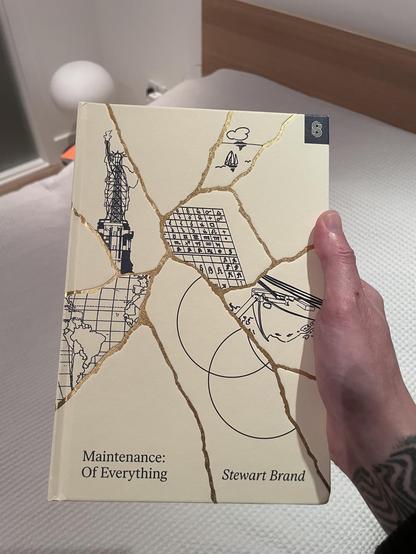
OK, it’s, admittedly, gorgeously produced. And I’m willing to give Stewart some considerable benefit of the doubt, given how primordially foundational his work has been for so much of who and what I am.

But opening it to see an ESR quote, in this day and age, feels greasy and retrograde and gross – not quite as bad as getting some DHH on you, but not far off, either. And it gets worse: I wouldn’t have bought the book in the first place had I known Stewart devotes an entire (brief) section to the design “of” Elon Musk, as if Musk had ever designed anything more elaborate than a stealthy excursion to a Black Sea hair-transplant clinic. That bit is all-but-disqualifying in itself, and tends to make me ashamed to have the book on my shelves.

The deeper issue, though, is Stewart’s narrow definition of “maintenance.” The book feels like it’s sidestepped a whole generation of discourse on the topic, to its detriment. I’ll let you know what I wind up concluding.
(Exploring the particular irony of lauding Musk’s ostensible design genius, in an era when we know his insistence on flush, electronically-actuated handles on Teslas has contributed to the deaths by incineration of multiple victims, is left as an exercise for the reader.)

The infuriating thing about this book is that when it’s good, and on the things it’s good on, it is very good indeed, and lots of fun besides.

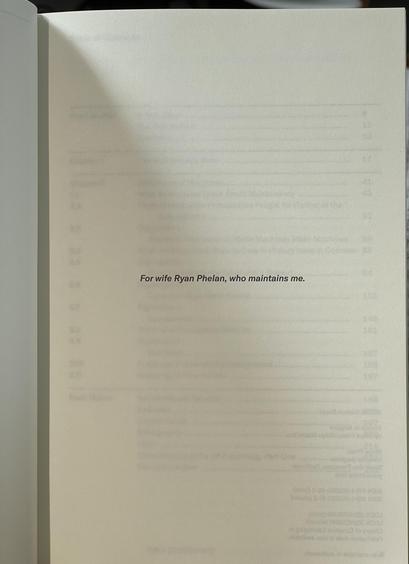
It is disqualified completely, however, by its thorough, fatal lack of attention to those inveterate maintainers known as “women,” acknowledged in its pages only on the dedication page (and even then in a way that isn’t anywhere near as charming as Brand presumably intends).

The disqualifying bits are genuinely disqualifying, i.e. I could not in good conscience recommend this book to anyone. It isn’t simply the erasure of women (though boy *howdy* that’d be sufficient), it’s Stewart’s insistence on larding the text with the occasional, entirely gratuitous comment revealing who he’s become or always was.

That said, “Maintenance” is clearly the result of a writer gifted with a lucid, unpretentious prose style addressing a subject that is important, dear to them, and which they’ve thought deeply and carefully about for many, many years.

That’s the tragedy here. We need a book shaped a lot like this one, but this is not it.

Intimately familiar with the concept of pace layering as he is, Brand correctly notes that different parts or aspects of the book will age at different speeds.

I *strongly* suspect that among the passages that will age most poorly are those celebrating the technical qualities of Tesla cars, which cannot be maintained by users in the usual sense of that word, and are increasingly understood by knowledgeable observers to be deathtraps for their drivers and passengers should they for any reason catch fire.

And then…that’s it. The book kind of just *ends*, without even so much as a STEWART BRAND WILL RETURN IN “RUST IS FOREVER.” (Maybe this is what comes of so prominently labeling the book “Part One”?)

“Maintenance” never quite recaptures the verve of its first section, on the great solo circumnavigators of 1968-1969. It’s weirdly uneven from that point onward, taking in the well-trod (Kalashnikov’s AK-47 v. Stoner’s M16), the interesting but deeply uncomfortable (a long, laudatory bit on the IDF’s improvisational genius in the Yom Kippur War, as opposed to the ostensibly culturally-determined weaknesses of the Egyptian military), and the head-scratchingly weak (you can learn how to fix anything from YouTube! and buy all the parts you need from Amazon!).

You don’t need this book. If you expect to come away from it with the kind of reorienting insights “How Buildings Learn” dispensed on just about every one of its pages, you’ll be disappointed. And you’ll wonder where all the women went.

I’ve been thinking more about what made the Yom Kippur War bit of “Maintenance” such uncomfortable reading.

It isn’t simply the neutral, red force v blue force narration of the conflict, when one of those forces is the IDF. It’s the frankly retrograde way Brand frames his analysis, which, in just about so many words, pivots on the notion that “shame is the overwhelming concern of the Arab.”

The Egyptian Army’s failures may well have been down to a culture of information-hoarding designed to prop up the social status of the knowledgeable party, and in which the class divide between officer ranks and enlisted meant the former could literally not be seen to get their hands dirty. But if want to make that assertion, in 2026 I think it’s on you to find sources establishing evidence supporting it from *within* the culture, and not rely on imperialist accounts not far removed from something T.E. Lawrence might have seen floating around the Arab Bureau in Cairo in 1915. It’s just gross.

@adamgreenfield Thanks for the notes.

As they mention Brand’s perspective on Musk, fyi
https://mastodon.social/@urlyman/116345861279043197

@adamgreenfield
The kintsugi-ness of the cover, the disjointed quality of the text, and the fact that Stewart Brand is approximately a zillion years old all point to the probability that Brand gave a lot of collected and vaguely related essays and fragments written over several decades to his editor who endeavored mightily to put it all together into a coherent and saleable form before the author could no longer help market the thing.

@mokafish That is not at all the case, as you’d be able to ascertain for yourself if you’d read the introduction, but more importantly I’d ask you to reflect on what causes you to dismiss Stewart for being “a zillion years old.”

Weigh the text for its faults, and its author for his, certainly. They are prominent enough. But the ageism is ugly.

@adamgreenfield

I don't think it's ageism to note that men of his generation aren't known for their feminist leanings

@mokafish Then say what you mean.
@adamgreenfield how would that book compare to @debcha ‘s “How Infrastructure Works”? (Which is patiently waiting on top of my pile)
@rudi Different books about different topics, with different emphases and commitments, written by very different people, possibly in dialogue with one another if you choose to assemble them that way. @debcha
@adamgreenfield @rudi Thanks for getting my book, Rudi! Very much what Adam said -- I couldn't write about infrastructure without at least considering maintenance, but it wasn't my focus. You might appreciate this 2018 article by @shannonmattern, "Maintenance and Care"? https://placesjournal.org/article/maintenance-and-care/
Maintenance and Care: Fixing a Broken World

A working guide to the repair of rust, dust, cracks, and corrupted code in our cities, our homes, and our social relations.

Places Journal
@adamgreenfield I like the sastrugi cover but based on your review I'm definitely gonna give this one a pass.
@jessamyn Kintsugi? : . )
Image of the week: The Song of Sastrugi

Sastrugi are significant features in glaciology, providing valuable insights into wind patterns, snow dynamics, and surface processes. So although at first sight they may be easy to walk over (quite literally), their patterns and features can tell us more than you might think, so next time take a moment to look and see the story they have to tell…   The Song of Sastrugi The wind’s icy breath Sweeps across the snow Its whisper leaves a mark In patterns that it sows. The snow it hears wind coming It eagerly awaits Without wind, snow is lifeless Still, in this cold place. Now snow and wind entwine A dance, a meeting brief They leave their mark so clearly Proof of their mischief. Ridges rise defiant, Grooves and shadows lie A moment forever captured Beneath the winter sky. The story of sastrugi A sculpted, windswept sea The remnants of a meeting Etched for all to see. – Emma Pearce     A little bit more info Sastrugi are sharp, irregular grooves or ridges formed on a snow surface by wind erosion. These features are typically found in our polar regions or on high-altitude glaciers and they can vary in size from a few centimetres to over a meter in height and can be several meters long. The features form when the wind erodes the snow, carving out troughs and depositing the snow in ridges. Over time, the wind-packed snow hardens, making the sastrugi more pronounced and if you’re driving a skidoo, more dangerous! Glaciologically, sastrugi are important for a few reasons. Wind direction and patterns. They can tell us about past and present wind direction and strengths. They give an indication to patterns of snow deposition and ablation processes. Sastrugi pose challenges when doing fieldwork for researchers and equipment (such as snowmobiles and snow planes) due to their rough, uneven surfaces. Using their orientation from satellite data can help plan fieldwork and have a better constraint on weather conditions.   Edited by Maria Scheel  

Cryospheric Sciences
@jessamyn No, I gotcha. They’re both perfectly cromulent words.
@jessamyn @adamgreenfield 😬 I appreciate this beautifully written review. This seems to concur with @mwichary’s recent review: https://unsung.aresluna.org/book-review-maintenance-of-everything-part-one/
Book review: Maintenance: Of Everything (Part One) – Unsung

A blog about software craft and quality

@adamgreenfield holy shit. I would read such a dedication as an insult and would probably never talk to the dedicater again 😂
@adamgreenfield I haven't read it yet, but that's disappointing to hear, if sadly familiar -- even off the top of my head, I can think of several otherwise excellent books that undermine themselves by not seriously engaging with gender issues.
@debcha My sense is that he’s surrounded himself with a tight, exclusively male knot of colleagues of many decades’ standing – G Dyson, B Eno, K Kelly – whose rather groupthinky take on what’s germane circumscribes his worldview, and whose banalities he therefore accords far too much weight to. And that has the effect of squeezing out voices and perspectives that knot cannot perceive, recognize and parse. The book is much the poorer for it.
@adamgreenfield @debcha I was captured by the endurance boat race story and don’t understand how Tesla can be included in the same book about maintenance. It should be called “is it functional and fit for purpose?”.
@dahukanna @debcha That was far and away the best material in the book – far more valuable to me than another retelling of the tired Kalashnikov v. Stoner story, or a long bit that could have been boiled down to “sometimes I search YouTube for repair instructions.”
@dahukanna @debcha The table of types of corrosion was admittedly pretty neat, though. : . )