You'll likely catch this image a million times in your various feeds: Earth as seen by Reid Wiseman from Artemis II en-route to the Moon.

My first thought? That's *really* noisy 🧐

But then I realised – it's the *nightside* of Earth, illuminated by the almost full Moon, not the Sun 🌕

The bright limb at lower-right is where the dayside starts, & the fact that you can see aurorae, airglow, & cities in Europe, Africa, & S & N America also gives the game away.

Cool.
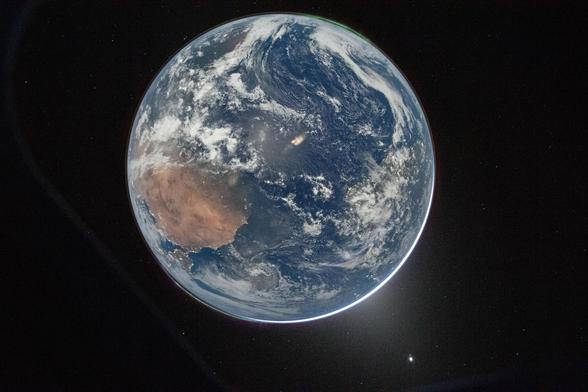
#Photography #Artemis

Two planets for the price of one 🙂

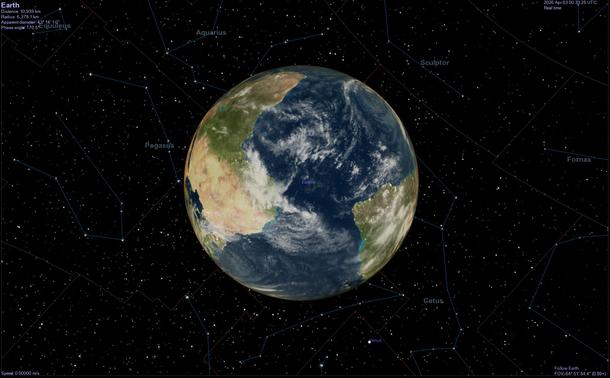
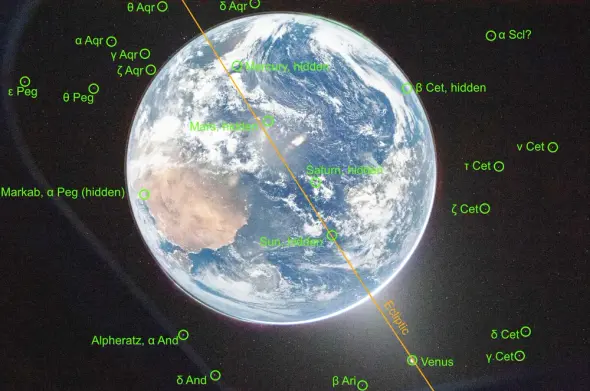
This screenshot from Celestia is pretty close to the orientation of the #Artemis II picture taken of Earth's nightside.

The stars in the background line up pretty well, & as @Nina_cried suspected, the bright object to the lower-left of Earth is Venus 👍

And as the original shot suggests, the Sun is behind Earth, slightly to the lower-right of centre, hence the bright dayside limb there.

#Space

I tried getting Astrometry.net to solve for the starfield first, but it failed (perhaps not surprisingly given the stupid big planet in the way).

So I went into Celestia, set the time to a reasonable guess for when the Artemis picture might've been taken (I ended up at 00:30 UTC last night), played with the orientation, & bingo – everything lines up.

Not completely perfect, but good enough for government work.

Ha – I promise I didn't check before fiddling in Celestia, but I see that the EXIF information in the original Artemis JPG says it was taken at 00:27:39, presumably UTC.

And putting that time into Celestia, I get a sub-latitude of -2.8º, a sub-longitude of -13.9º, and a distance of ~10,000km from the surface of Earth.

Which is niche information unless you're a planetary aurora specialist like Jonathan Nichols, who asked 🙂

michael 🌸 (@radplanets.com)

now with labels! [contains quote post or other embedded content]

Bluesky Social

@cosmos4u @Nina_cried As I said, mine was good enough for (ex-)government work 🙂

And a damn sight better than NASA's launch livestream – what a shambles, honestly 🙄

@markmccaughrean @Nina_cried Oh yes ... several livestreams directed by private space aficionados were way better - like catching SRB sep.
@markmccaughrean What do you mean by the bright limb at lower-left?
@saarmuller I mean that that's a typo – the limb at lower-right. Ugh – will edit.
@markmccaughrean And also, I think that is where the day ends (the north pole is at the bottom), very confusing.
@saarmuller The poles are where the aurorae are, broadly speaking, at upper-right & lower-left, so the terminator is more or less north-south, a little biased north, as you’d expect a couple of weeks after the equinox.
@markmccaughrean What I mean is: the bright rim is on the westside, so the end of the day, not the start of dayside. What am I missing?
@saarmuller Oh, in that sense – yes, it's the evening terminator at the end of the day, not the dawn terminator. Good point. I just meant is was the start of the dayside, as in where the dayside "is", not which time of day it was per se.
@markmccaughrean That's what I meant by "very confusing"! (Combined with the left-right error, the left WAS the start of day side, the dawn side)
@markmccaughrean you can see the lights of the cities, yes :)
@mdione Waving at my friends in Lisbon & Madrid 🙃

@markmccaughrean Tech details: Nikon D5 at ISO 51200, 1/4 sec exposure.

(Thanks for posting - I'm out of the house and didn't post it because I couldn't write an alt text)

@russss That’s a decent handheld shot for 1/4 sec, even with image stabilisation – maybe he was leaning against the window 🙂 Still, ISO 51200 is cooking 😬
@markmccaughrean DSLRs still deliver the goods!
@russss Which is exactly why I’m intending to upgrade from my shonky old D7000 to a D850 … I mean, I don’t need video, so do I really need to switch to a Z8?
@markmccaughrean uh... I thought that was South Australia and Tasmania 😅

@ranx Am pretty sure that's North Africa, then Spain & Portugal on the left-hand side, with South America at right, & North America at lower-right.

Worth remembering that they were probably still pretty close to Earth when this was taken, so even though it's round, it's quite heavily "distorted" by perspective, as the nadir point is quite a bit closer to them than the limbs.

@markmccaughrean oh right! Now that I flipped the phone I can see the shape of Spain! 😄
@markmccaughrean I love the skim of atmosphere, particularly where it's not so bright.

@Azuaron That thin airglow layer at around 80km is really important in ground-based astronomy.

It's particularly bright in the infrared, dominating the background for near-IR observations, but it's also where the sodium atoms are that are used to create laser guide stars for adaptive optics.

Swings & roundabouts 🙂

@markmccaughrean

I thought to myself... Duh!

Thanks for the insight. Photo is much more impressive now.

@markmccaughrean

Is that Venus in the lower right?

@Nina_cried Good question – it could be. I've just sent the image to Astrometry.net to see if it can identify the star field. Might need to crop it though, given that big planet thing in the middle.

@Nina_cried You were right 🙂

Astrometry.net failed me, but I went into Celestia, set a reasonable time for when that picture might've been taken, played around with the orientation a bit, & bingo – everything lines up.

Nicely done – thanks for the suggestion.

@markmccaughrean the thing that strikes me must is how thin our atmosphere is - it looks like such a fragile thing for something so important for life on earth.

@ccferrie You are arguably experiencing an element of The Overview Effect 🙂

And keep in mind that the thin glow you see all around the planet is at about 80km altitude – we struggle above 5km & die above 10km.

@markmccaughrean how much of the ”noise” is satelites?
@whangdoodler None in that picture – the Sun is hidden behind Earth, so there’s nothing bright to light them. Moonlight is far too faint to lead to significant illumination. But the satellites are still there, mostly you know who’s endless cheap wifi routers 😬
@whangdoodler @markmccaughrean none, that’s just shot noise.

@markmccaughrean

Ohhhhh! Something about it was bugging me, but I couldn't say what. "Dark side" was what I was missing.Thanks 👍!

@markmccaughrean The classic big blue marble

@bouriquet Kind of, but different – it’s the nightside of Earth, so very faintly illuminated by the Moon only, meaning by you can see the aurorae & airglow in shot, which you’d never see on the dayside.

And the perspective is pretty tight, from only 10,000km or so above the surface, just 1.5 Earth radii. That means you see quite a bit less than a full hemisphere as you would from the Moon itself, say 🙂

@markmccaughrean I also caught that! Cameras have gotten a HELL of a lot better.
@sysadmin1138 And the D5 is one of the very best cameras around if you feel the need to set the ISO to 51200 😬 It’s famously *not* ISO invariant, & remains pretty clean up to ridiculous settings.

@markmccaughrean

There's a collection of lights off-center up & to the right. Is that a reflection?

@darth_hideout My guess is a reflection off the window, some light inside Orion. Doesn’t look like the Moon reflecting off the Atlantic – too sharp & bright.

@markmccaughrean 👍

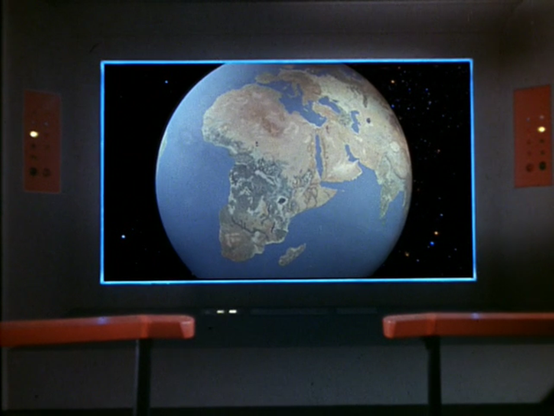
Just ran across this in my photos from a recent #StarTrek conversation. In the original cut of "Miri," which featured a rare exact Earth duplicate, a simple globe without annotations was used to convey the point. This was before the 1st Moon landing. I would guess the audience at the time was unused to seeing the Earth from space. Later remasters added clouds. Remarkable how banal the view has become.