RE: https://labyrinth.social/@nash/116178591588359360

you ever write code so inefficient you have to secure 80% of the world’s DRAM production

@colinstu Electron app authors be like
@colinstu In the era of the first Pentium processors we had 8 MiB (yes, Mibi) of RAM quite often, and 16 MiB the lucky ones.
Had a colleague who wrote a memory leaking application, because he wrote convoluted C++ code, instantiating too many out of control classes - the style that I would later witness with Java.
When he got a new job position he was triumphant: "Ha! Now I have a PC with 256 megs!".
He didn't realize that any space can be filled.
@luc0x61 I had installed Linux on a machine with 16MB in 1995, started X, a web server and a Netware server. I had an bunch of terminal windows open. It wasn’t until I started another terminal window that I ran out of memory and found out that this Slackware version didn’t enable the swap correctly, so I had done all that without swap.
@ahltorp The first version of Linux I actually installed was from Lasermoon, an UK distributor, Linux-FT 1.x, and it did run on a 486 with 4 MiB RAM. We used it, along with early Slackware, on many 486 on static IPs to the net, for some time.
A colleague some 10thousand km from the office, one day that no one was noticing him online, logged on a machine to play the "when henry met sally" notable scene, on the speaker. That generated quite some hilarity in the silent office.
@luc0x61 @colinstu @harald not can every space be filled, but every space WILL be filled.
@colinstu So I really didn't need that university algorithms course after all?
Microsoft of the 1990s says hi
@colinstu doesn't count if your program was correct.
@colinstu you'd think with scarcity of RAM developers would refocus on writing more efficient code that can handle tasks with less RAM use.
but instead we get more vibe coding.
@colinstu of course we've long abandoned any pretenses that code needs to actually be useful and work for its intended use case. just more code for the code god.

@elexia @colinstu

while this period sucks, i'm rather positive cause it seems that there is a growing interest at low code, optimization etc... I might be in a echo chamber as it is one of my interests, but as i'm spammed by vibe-code bros and like-it-or-not wannabee, i think it's legit.

@omar @colinstu one can only hope. not much of a computer toucher myself, especially these days, but I do have some interest and hope for a permacomputing movement that would align well with this, even if it's not looking like it will be a mainstream thing in the near future.
@colinstu
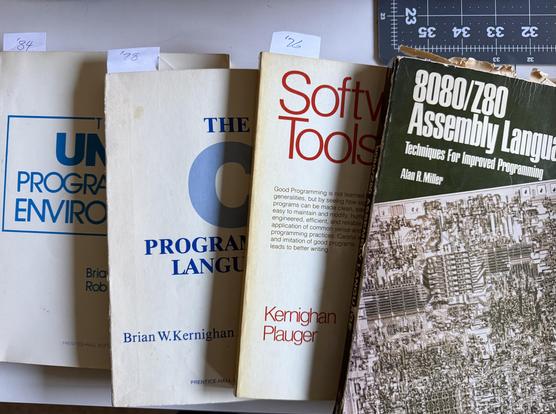
C programming on 64KB w/Z80 cpu.
@stevewfolds @colinstu Writing C compilers that fit in 48K RAM for each pass.
@etchedpixels
Looked at Lex and Yacc but never ventured there.
@stevewfolds looked at lex and yacc decided they were too big and wrote my own parser

@stevewfolds @colinstu

Try running 6 task stacks, buffers and overlaid variables on an 8044 with 192 bytes of on-chip RAM

@X31Andy @stevewfolds @colinstu

remind me again about the Monty Python Four Yorkshiremen sketch

@colinstu Wot happens if you tell an AI "see this code base? - make it do the same thing but a few orders of magnitude faster and cheaper".
@TimWardCam @colinstu
I think you will find a lot of assumptions are unfounded

@TimWardCam @colinstu

ever tried it?

@Patashu @colinstu No. I was made to use AI at work for a week to try things out but didn't get that far.
@TimWardCam We kind of saw the results with the leaked Claude code, the results are not great. Inefficient and highly duplicative code.
@colinstu As someone who remembers packing bits and worrying about approaching address &A6F0, the reach for petabytes worries me that someone is doing it wrong.
@colinstu Running Unix on a PDP/11 in 1981, we had to upgrade the memory from 96kB to 256kB to support three users. That's kilobytes, not gigabytes. Queensland University had a 16 port terminal device with students on the same hardware
@colinstu I was able to compile C code, play Pacman (fullscreen TUI), or run database code while other users used a sonic digitiser to trace radiographs on an interactive vector graphics screen (Tektronix storage tube), and a plotter made colour drawings or uploaded data files to the supercomputer. Real-time applications...

@cliffordheath @colinstu
I don't understand; in 1976..1979 at UC Berkeley we had a PDP-11/70 with 1 megabyte running initially Unix V6 and later Unix V7 that supported 50 users.

It allowed 60 users but was very unresponsive with that many.

Perhaps your users were always running resource-intensive apps.

@colinstu many times, except I could never afford to actually do it :( For instance TSP-type problems go from O(n!) to 2^n if you also use 2^n of memory.