 ddp26
ddp26A forecast of the fair market value of SpaceX's businesses

Not bad for about $12-$16B in total actual revenue.
net income probably: $1.5B – $3B
P/E:500-1000
Of course people will trip overthemselves to buy it up.
According to commentators on other threads people with any index funds will be automatically buying, no need to trip over ourselves
I remember when this happened with Nortel!
Yeah, it's wild. But it's not like the P/E should be 30, what do you think would be fair?
That's the thing about SpaceX, some businesses are real businesses that can be modeled in normal ways, like the government launch contracts, and to some degree starlink.
Others, like ~all of xAI, and the starship stuff, are being valued completely independent of revenue. I predict the IPO investors will generally follow the analysis consensus today with those eye-popping numbers.
It's hard to imagine this turn into 50-60% short term banger starting from a $1.75T market cap, I wonder if people will actually trip over themselves to buy. I had been thinking I wanted to jump on it to flip but at that price and the macro environment it may end up cratering before a pop. Seems like a sketchy buy.
As long as we don't find a new it energy to get stuff up, I don't think so.
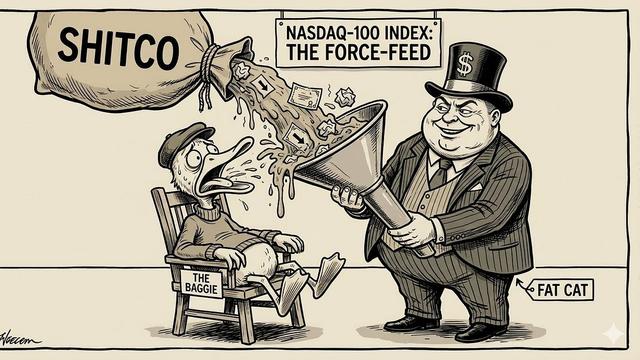
An passive investors are going to get hosed by this thanks to NASDAQ cooking the rules to favor Elon and his band of misfits.
No longer will there be a year of price discovery for index funds, 15 days. Meaning index funds have to buy it at the peak of the hype cycle. Will be a huge wealth transfer from mom and pop retirement accounts to the ultra wealthy.
Now I need a fund that will honor a year of price discovery rather than 15 days. Any recommendations?
Legally, any fund that tracks the NASDAQ 100 must follow the rules set by NASDAQ, so you'd want something that is neither a total market index, nor tracks the NASDAQ. Something like an S&P500 index would work
What law prevents someone from choosing to buy stocks from the NASDAQ 100 however they want for a fund?
You can make a mutual fund or ETF with any stocks you want, you just can't call it a NASDAQ 100 fund if you're not tracking the NASDAQ 100 index.
Is that really true? It doesn’t sound likely to me. Then again I’m often surprised by this stuff.
In order to call it a NASDAQ 100 Tracking Fund you need to pay the NASDAQ a licensing fee (same with S&P500, Wilshire 5000, etc.). The contract you have with NASDAQ will determine exactly how much freedom you have to change rules and still call it a NASDAQ 100 fund. I've never seen a licensing agreement, don't know anything about how they would typically read.
There is also the concept of "Index Tracking Error". No fund can perfectly mimic the index, and that is expected and understood, but the goal is generally to have the tracking error <0.1%- 1% would be a bad track. And so an index fund could take the risk that they will have a tracking error and delay picking up SpaceX even after it joins the official index, but then if it goes up they will look worse relative to their real competitors, the other NASDAQ 100 tracking index funds. If SpaceX goes down, of course, they will have positive tracking error, but I'm not sure how much potential investors would value that. SpaceX would be something like 4% of the NASDAQ 100 at it's announced expected market cap, so a 10% movement by SpaceX would be enough on its own to get you into the notable tracking error range if you didn't have any exposure to it.
It's an interesting question whether you could legally track the NASDAQ 100 without calling it that, or something very similar, e.g. "NASDAQ 100, but with a one year delay for new listings".
But assuming it is: How would you even call it, and how would you describe your methodology in the prospectus? "Tech 100 (compare with e.g. NASDAQ)"?
Actively managed funds like that charge around 0.5% to 1% a year. E.g. [0] The most prominent Nasdaq ETF, QQQ, charges 0.2% [1]
Spacex will be around 4.5% of the index [2].
If you believe the thesis of the article that Spacex is about 30% overvalued, and if the only advantage your fund manager has over the rest of the market is that they will avoid Spacex, they will save you 1% of your money over the lifetime of your investment. Assuming you're saving for retirement in 30 years time, the fees will cost you 15% or more.
Maybe your fund manager finds a Spacex-level mispricing every two years. In that case, they're worth the fees. Some people will tell you nobody can beat the market. My employer among others believes very strongly in the idea that some people do make better investment decisions than average. What is certainly true is that not everyone does.
[0] https://helpcenter.ark-funds.com/what-is-the-fee-structure-e...
[1] https://www.invesco.com/qqq-etf/en/home.html
[2] https://www.fool.com/investing/2026/04/01/how-the-spacex-cou...
> the idea that some people do make better investment decisions than average.
Of course some do. After all, that's what makes an "average".
Some people are taller than average, too!
They mean consistently make better decisions than a baseline index investor in a way that isn't luck.
Someone can win at roulette and make more money than the average player over some measurement period, but nobody can be good at roulette (when properly implemented and stuff). Stocks are somewhat possible to be good at but results are mostly random and the fee you'd pay is usually way too much.
>that isn't float adjusted?
AFAIK the problem is that they're lobbying the nasdaq 100 index provider to add a 5x multiplier for free float for spacex. Otherwise it would be far less controversial.
> Legally, any fund that tracks the NASDAQ 100 must follow the rules set by NASDAQ
No? Contractually, maybe. But legally you can do whatever you want with index constructions.
> An passive investors are going to get hosed by this thanks to NASDAQ cooking the rules
I’m genuinely confused how a passive investor winds up tracking the NASDAQ 100 versus a broader index.
Also, if you’re picking and choosing your exposures, you aren’t passive.
When index funds became such a default I knew they’d change the rules.
They’re taking everything thats not nailed down. A wealth tax is the only way, it cannot continue like this.
Yeah imma get out of index and hold my basket and just rebalance. This is dumb. Why bend the rules for a trillionaire?
> Why bend the rules[?]
> for a trillionaire[!]
This writes itself. It shouldn't, but "should" as a concept needs a lot of work.
And even that isn't accurate. They are not bending the rules for a trillionaire, they are maintaining the consistency more systemic rules. This is how it has always been. We can all point to real or perceived ethical islands. They certainly exist, and are worth creating and preserving. But for now, the sea still sets the rules, and the sea is deep. For the deeper system, island visibility is a useful distraction. Sometimes something heavy moves near the surface and we misinterpret visibility as exception.
Did you get lost and start writing a poem? What’s all this about the “sea”? Fine. Let me turn down my anti-Elon-ness for a bit and caveat that the timing of these changes coinciding with this listing is suspicious, no? Grant me that at least. And then we can, with new found common ground, investigate the motives behind such a change.
Someone who can't articulate who the villains are out of a pre-selected list and has to fall back to personal attacks is pretty "weak" as well.
If you were to apply the principle of charity[0] to the person you originally asked the question to, who do you think that they would mean by the word 'they' in this context?
Open your eyes? Everyone on the top 1000 Forbes and at trumps inauguration?
The unknown subject is a valid construction in language. It is not necessary to be able to answer "who's they?". It is semantically equivalent to saying "I knew the rules would be changed."
There are also perfectly ordinary situations in which this pattern is used to imply the influence of an unknown party. "They built a bridge over the river." Clearly the speaker does not believe that bridges over rivers construct themselves. She doesn't need to know who built the bridge.
>There are also perfectly ordinary situations in which this construction is used to infer the influence of an unknown party. "They built a bridge over the river." Clearly the speaker does not believe that bridges over rivers construct themselves. She doesn't need to know who built the bridge.
This excuse only works if who built the bridge isn't central to the discussion. Otherwise this is just generic conspiratorial thinking that we're being oppressed by The Elites™.
Aren't we, though? Like it's hard not to argue that there's one or more groups of people that get together at lunches and dinners and galas and have ongoing projects to do things like institute rule changes at NASDAQ that effectively require index funds to take on outsize risk from a known-overvalued IPO just in time for that IPO to happen.
To understand why this isn't a conspiracy of a sort by some "elite" group of people to take money from 401ks and IRAs, you'd have to argue that there's a good reason to shorten the window that outweighs the reason the window exists. The fact remains that many many IPOs crater within a few months. The rule change seems to exist to leave small low-effort investors holding the bag.
Just because we're paranoid doesn't mean they're not out to get us.
>Like it's hard not to argue that there's one or more groups of people that get together at lunches and dinners and galas and have ongoing projects to do things like institute rule changes at NASDAQ that effectively require index funds to take on outsize risk from a known-overvalued IPO just in time for that IPO to happen.
It's also not hard to think of half a dozen other groups that could possibly benefit and plausibly have enough clout to steer things in their favor, hence why the need to make a specific claim rather than beating around the bush a vague "they" that can't be refuted.
Got a source on this? I didn't take into account in this forecast that public markets could be very inefficient in this way.
oh baby, that's the just 'new' way they screw ya
Wow! This comment inspired me to dig deeper.
After 20+ years in the market, today I learned: "The S&P 500 is a float-adjusted, market-capitalization-weighted index."
So presumably an S&P 500 index fund is not disadvantaged, since it is tracking a float-adjusted index, i.e. the weight of SpaceX will be tiny if its float is tiny.
Or, is there a nuance that I'm missing?
>So presumably an S&P 500 index fund is not disadvantaged, since it is tracking a float-adjusted index, i.e. the weight of SpaceX will be tiny if its float is tiny.
Nasdaq already caved. FTSE and S&P are supposedly considering it.
https://www.economist.com/leaders/2026/03/31/index-providers...
Low float, large cap companies will get a 5x multiplier.
Huh, TIL, thank you.
Seems like MSCI can add new large constituents very quickly as well [1], so to remain neutral to the frenzy until a price has been discovered, one might need to actively short.
[1] e.g. https://www.msci.com/eqb/methodology/meth_docs/MSCI_GIMIMeth...
> Starship at $170B is pure option value on technology still in advanced testing.
The argument that Starship is somehow an experimental/unproven technology that might fail to materialise was absurd but plausible sounding before flight 1, there were many new technologies simultaneously being deployed to a single launch system in one go.
But after 3 tower catches of the booster demonstrating centimetres of guided precision of the entire stack, this is becoming a tired argument.
I know the author is not making that case at all here, but it seems like one the core reasons to undervalue SpaceX is that Starship might not work out, and this all sounds exactly like how reusability might not work out for the Falcon 9 from 10 years ago.
> and this all sounds exactly like how reusability might not work out at all for the Falcon 9 from 10 years ago
I think a lot of it depends on whether they can make the reuse of the second stage work without having to redo stuff constantly like the shuttle. Reusing the booster will obviously save tons of money and make launches cheaper, but they're competing with themselves here. How big is the launch market with cheaper launches? We don't actually know.
Yeah, I might have stated this poorly. In the forecast it's just a question of expected value, I don't give almost any probability to "Starship is worthless".
My 50% CI on Starship's fair market value at IPO time is $123b - $227b, with a 80% CI even wider, not based on my own modeling, but based on anchoring to analysts that give credible arguments.
The viability of direct to cell connectivity at scale is unproven. This is actually the core value of SpaceX in the next 3-5 years.
The other core value generation product will be financial transactions. It is unproven whether X money will be adopted for friction free transactions across national boundaries and whether the company can compete in the financial services sector.
The question is not even whether or not Starship works. Starship is, in theory, designed with the idea of getting many, many payloads to Mars. However, getting payloads to Mars is not currently something that anyone is paying for; even NASA isn't going to focus on Mars for at least another decade (likely more). And in the meantime, it's not like we don't have rockets capable of getting payloads to Mars (the Saturn V was fully capable of doing so in the 60s). Likewise in the meantime, the Artemis plans that look to require a dozen+ launches for a single moonshot aren't painting Starship in a favorable light.
So what is the near-to-medium-term economic prospect of Starship? That's the question. You can't just say "bigger rocket make more money", because there exists a useful upper to the size of payloads that companies actually want to ship to LEO in practice. To use an analogy, we have jumbo jets, but most flights are not on jumbo jets.
> because there exists a useful upper to the size of payloads that companies actually want to ship to LEO in practice
This is only true because we are so completely beholden to the tyranny of the rocket equation with the current status quo. With the $/kg (and payload volume) that Starship would unlock, the entire ELO/GEO/Interplanetary/Deep Space market looks very different.
Labs in space. Hotels in space. Weapons in space. Much more interesting satellites in space. More government science missions. Privately funded science/research missions. etc
How many space telescopes better than anything we currently have can we put up when launch costs are <$50m?
A huge synthetic telescope in orbit with an aperture the size of the planet?
How many private earth observation satellites?
The market is huge when weight constraints largely go away and $/kg drops so hard.
The question is whether those markets are not already adequately served by Falcon 9. Once again, just because you have a jumbo jet that can fly 500 people from New York to London does not mean that everyone flying out of New York wants to go to London, and it doesn't mean that it's worth flying that jumbo jet from New York to Pierre, South Dakota with only one passenger on board.
> The question is whether those markets are not already adequately served by Falcon 9
What does that even mean? Almost every single Falcon 9 customer will prefer launching on Starship if/when it is available, because the cost will be much lower. A very small segment who have payloads that are exactly Falcon 9 sized and want a very particular orbit might still be better served by F9, but maybe not.
Beyond that, much lower cost unlocks previously untenable opportunities that you have not sufficiently imagined, as stated earlier.